Society and community updates summer 2026
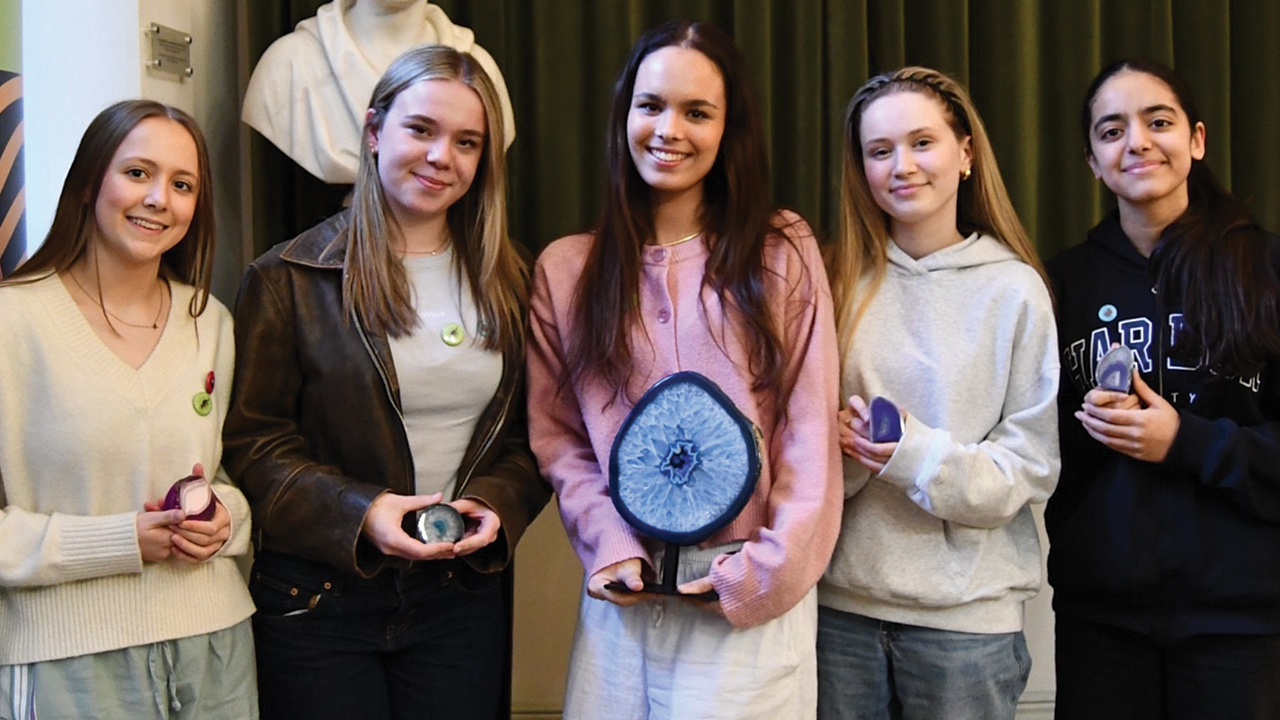
Winners of the 2026 Schools Geology Challenge at Burlington House.
Schools Geology Challenge 2026
To be in with a chance of reaching the final of our annual Schools Geology Challenge, teams of students aged 16 to 18 were tasked with creating a piece of media for an online audience on any geoscience topic of their choice—and the results did not disappoint. From a gripping murder mystery to a parody of The Traitors featuring scheming palaeontologists, and even a deep dive into the geoscience of the movie The Core (spoiler: it is not very realistic!), the creativity on display was incredible. With space for only ten teams in the final, competition was fiercer than ever.
During the final held at Burlington House in March, teams faced off in an exciting problem-solving challenge: to develop a proposal for a tunnelling project to supply water to a new theme park. The fictional “Burlingtopia” aspired to become a world-class destination in the UK, but to be granted a licence to operate, its developers first needed to demonstrate that a utilities tunnel could be safely and sustainably constructed to transport water from a source to the park and ensure a reliable supply.
The sheer volume of information teams had to work through made this year’s challenge particularly demanding. Teams were required to assess the sustainability of different water sources, weigh up the cost and time implications of their chosen tunnelling methods, and develop an Environmental, Social and Governance strategy for the local area. Variations in subsurface geology added another layer of complexity, forcing teams to decide whether to tunnel through more challenging ground and accept a longer timeline, or alter their route to avoid these difficulties, potentially raising the cost. Despite these hurdles, teams remained composed and approached the task strategically by delegating responsibilities and managing their time effectively through strong teamwork.
To secure the support required to begin construction, the teams needed to impress the key decision makers: our panel of judges. Each team submitted a detailed tunnelling plan and delivered a concise three-minute pitch. As the judges probed their decisions and challenged their approaches, well-considered, clearly justified proposals set the strongest teams apart.
We are delighted to announce that the 2026 winners are Sheffield Girls’ High School! Their team delivered an outstanding project proposal, earning them a coveted trophy and £500 to support geoscience education at their school. This year’s runners-up were Caistor Grammar School and West Kirby Grammar School, each receiving £200. We look forward to hearing how the schools put their prize money to use.
Acknowledgements
A huge thank you goes to this year’s judging panel—Ruth Allington, Rod Young, and Chris Jack—who brought expertise in geology, tunnelling, and project management to their evaluation of the teams’ work.
Sarah Quinn Education Officer, Geological Society
Conference: AI in the Geosciences
Artificial intelligence is rapidly transforming how Earth data are processed and analysed, enabling predictive, actionable insights across areas from geohazards to the energy transition. Join us on 4–5 June 2026 as we bring together a global community to explore what this transformation means in practice.
This dynamic hybrid conference (held at Burlington House and online) will feature 60 papers and posters from 20 countries across six continents, alongside interactive panel discussions. Day one opens with a keynote from Professor David Leslie, Director of Ethics and Responsible Innovation Research at The Alan Turing Institute.
We will examine how AI is being applied across the geosciences, and the challenges that come with it. Topics span mineral prospecting, geothermal, oil and gas, carbon capture and storage, subsurface modelling, geohazards, oceanography, hydrogeology, environmental science, geoethics, education and workforce development.
Discover the latest methods and real-world applications of machine learning, deep learning and large language models in areas such as seismic analysis, landslide prediction, geological mapping and rock classification. Key themes include data integration and automation, transparent and ethical AI, open data collaboration and preparing the next generation of geoscientists.
As AI moves from research to operational reality, geoscientists must navigate new questions around skills, trust and governance. This conference offers a timely opportunity to learn from leading practitioners, share experiences and help shape best practice, whether you’re just starting out or already deploying AI at scale.
With geoscience central to tackling climate change, enabling the energy transition and improving resilience to natural hazards, the responsible use of AI has never been more important.
Click here to secure your place and view the full programme.
Geological Society Annual review 2025
Read the 2025 Annual Review here.
Research grants
The Research Grants Committee received 33 applications in 2026. Following the panel’s review, 16 applications totalling almost £27,500 were recommended for Council’s formal approval.
Congratulations to this year’s successful recipients, who can be viewed here.
We express our gratitude for the long-standing support of the Jeremy Willson Charitable Trust, Jeremy Ingham Fund and Robert Scott Memorial Award, as well as the Research Grants Committee panel members for the significant time and expertise they provide.
To be part of next year’s Research Grant Committee, please submit an expression of interest to grants@geolsoc.org.uk
UK’s first geothermal plant launches
The opening of the UK’s first geothermal power plant at United Downs in Cornwall marks a significant milestone in the country’s renewable energy transition. After nearly two decades of development, the facility has begun generating electricity by tapping into naturally heated water more than 5 km underground, where temperatures approach 200°C. Steam-driven turbines can deliver around 3 MW of continuous, weather-independent power—enough to supply roughly 10,000 homes—providing a stable baseload of electricity, which could strengthen energy security, stabilise prices and reduce reliance on imported fossil fuels.
Beyond electricity generation, the plant also represents a broader technological and economic opportunity. It is designed as a dual-purpose system, enabling valuable lithium extraction from geothermal brines alongside power production, which could support electric vehicle and clean-technology supply chains while advancing net-zero goals.
The success of this pilot scheme suggests the UK may have significant untapped geothermal potential, particularly in regions like Cornwall, though high upfront drilling costs remain a barrier to widespread rollout. If these challenges can be addressed, this first plant could pave the way for geothermal energy to become a more meaningful contributor to the UK’s long-term renewable energy mix.
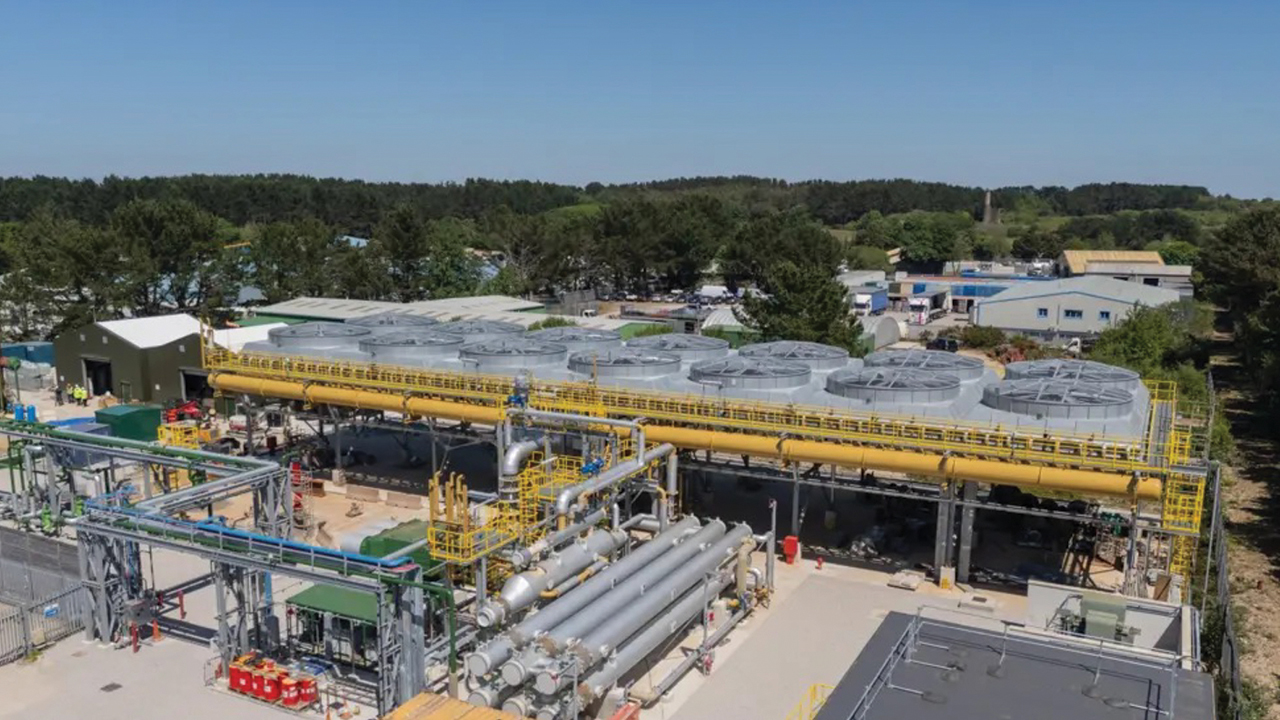
The UK’s first geothermal power plant at United Downs in Cornwall (© GEL).
Tercentenary Hutton concert
On 27 June, the Edinburgh Geological Society presents Hutton 300: the Concert at the iconic Greyfriars Kirk—a unique evening of music, poetry and film inspired by deep-time and celebrating the legacy of geologist James Hutton.
Featuring performances by Karine Polwart and Dave Milligan, singer Olivia Rafferty, composer Michael Begg, and numerous poets, the event blends art and science in a powerful tribute to Earth’s deep history, including inspiration from Siccar Point.
Arrive early to visit the Hutton memorial in Greyfriars Kirkyard and continue the experience the next morning with a Geopoets tour to Siccar Point.
More information and tickets can be found here.
Bill to target the UK’s fragmented ground data
In March, Labour MP Mike Reader introduced a Ten Minute Rule Bill to improve access to geotechnical data across the UK’s infrastructure sector, arguing that poor data sharing causes delays, cost overruns and waste.
Reader says the UK cannot build “faster, greener and more affordably” while “digging blind”. The Geotechnical Data Bill (or Ground Data for Growth Bill) would require subsurface information such as borehole logs, soil assessments and groundwater records to be shared via the National Underground Asset Register (NUAR). Although NUAR already maps 4 million km of pipes and cables, it excludes geotechnical data. Closing this gap could reduce duplication, cut delays and unlock £1.2 billion a year.
CCS pioneer honoured
Professor Peter Cook of the University of Melbourne and former Director of the British Geological Survey (1990–1998), was awarded the Companion of the Order of Australia in January 2026 for eminent service to science, particularly his pioneering work in carbon capture and storage (CCS), policy development and climate change mitigation.
Awarded a CBE in 1996, Professor Cook credits his time at BGS with shaping his interest in CCS, later advancing the field in Australia by establishing the Cooperative Research Centre for Greenhouse Gas Technologies (CO2CRC) and the Otway International Test Centre field facility, which have significantly influenced CCS research and development in Australia and internationally. The University of Melbourne established the Peter Cook Centre for CCS Research in 2012.
Explorer, geologist, soldier
The City of Plymouth unveiled a blue plaque on Astor Hall, Devonport Road, in August 2025 to honour Ralph Alger Bagnold (1896–1990), the renowned desert explorer, geologist and soldier. Born in Devonport, he was educated at Malvern College and the Royal Military Academy, Woolwich, and was commissioned into the Royal Engineers in 1915. He served in the First World War trenches, was mentioned in despatches and awarded the Belgian Order of Leopold.
After the war, Bagnold studied engineering at the University of Cambridge before pioneering vehicle-based desert exploration, earning the Royal Geographical Society’s Foundation Medal in 1935. In 1940 he founded the Long Range Desert Group, playing a key role in the Second World War. His later research on desert geomorphology won major international awards (including the National Academy of Science’s Warren Prize in 1969 and the Society’s Wollaston Medal in 1971), and his legacy is uniquely marked by the Bagnold Dune Field on Mars, explored by NASA’s Curiosity rover in 2015.
Malcolm Hart Chair, Plymouth Branch of the Devonshire Association, UK
Colin Kilvington Hon. Secretary, Plymouth Branch of the Devonshire Association, UK