Obscurity and notability
A new exhibition focuses on lesser-known female geologists who donated specimens to the Geological Society’s Museum in the early 19th century, reports Caroline Lam

Drawing of Kent’s Cavern by John Marten in 1825, with two figures likely to be local female guides, possibly alongside Mrs Cazalet, who was known to have joined John MacEnery in his excavations (© Geological Society of London, LDGSL/400/22).
The Geological Society did not elect its first female Fellows until 21 May 1919—but women had already been part of its story for decades. Founded in 1807, the Society, like many learned bodies of the time, excluded women from membership and attendance at meetings, reflecting contemporary prejudice about their ability to participate in scientific study. Yet, scattered among the thousands of donor names recorded in the Society’s early museum registers are traces of their contributions.
In many cases, however, these women are difficult to identify today. The record entries often list only surnames, or more correctly those of their husbands. This reflects the realities of the 19th century, when the law of coverture erased a married woman’s individual identity, merging it with her husband’s, along with all her property.
When the Society sought legal advice in 1902 about admitting women as Fellows, the conclusion was telling: only unmarried women could be elected, as married women were not considered ‘separate persons in law’. Adding to the ambiguity, many unmarried women adopted the title ‘Mrs’ to appear more respectable in the restrictive social proprieties of the period.
But who were these women? By exploring a selection of these donors and the specimens they contributed, we can begin to piece their stories back together.

Cheirolepis cummingiae named after Lady Gordon Cumming. This coloured lithograph of a fish is based on one of the drawings by Gordon Cumming taken by Agassiz and included in his ‘Monographie des poissons fossiles du vieux grès rouge ou système Dévonien (Old Red Sandstone) des Îles Britanniques et de Russie’ (1844/1845) (© Geological Society of London).
Lady Eliza Gordon Cumming
Despite her status, the activities of Lady Gordon Cumming of Altyre (née Eliza Maria Campbell, c.1798-1842) are likely obscure to many today. Her fossil collecting lasted only three years before her untimely death aged just 44, cutting short plans to publish a work on her remarkable collection. At the same time, material she gathered and drawings she produced were taken and used without permission or proper attribution.
Eliza, granddaughter of John Campbell, 5th Duke of Argyll, married Sir William Gordon Cumming, 2nd Baronet of Altyre, Dallas, Gordonstoun and Roseisle, in September 1815. Now Lady Gordon Cumming, she was known for the usual accomplishments expected of a young woman of the nobility—beauty, drawing and embroidery—but her interests extended further. She pursued horticulture, experimenting with plant crossbreeding in her own greenhouse (the first of its kind in Moray, Scotland) and even took up salmon fishing, a relatively daring pastime then.
Her passion for palaeontology began in 1839, following the discovery of remarkably well-preserved fossil fish in the Old Red Sandstone at a quarry in nearby Lethen Bar, Nairn. Within a year, her collection had grown so large that it filled an entire room at Altyre House, with the lesser examples stored under the veranda. With such abundance, she began to distribute material to others—most notably to William Willoughby Cole, 3rd Earl of Enniskillen, an avid collector of fossil fish. He, in turn, shared the finest specimens with Sir Philip de Malpas Grey Egerton, his equally avid fossil collector friend.
Lady Gordon Cumming’s contribution extended further still. Sixteen images of her specimens appear in Louis Agassiz’s Monographie des Poissons Fossiles du Vieux Grès Rouge (1844/45), a major work on the recently discovered Devonian fish of Britain and Russia. Yet this recognition came at a cost: Agassiz ‘carried away’ a set of drawings made by Eliza and her daughter without permission, reproducing two as plates. The book includes at least another 26 illustrations of specimens from the Enniskillen and Egerton collections from Lethen Bar that likely originated from her personal collection.

Megaceros hibernicus. This giant Irish deer jaw was donated by Mrs Cazalet in 1826, with the additional historic element of the accession number being in the handwriting of Thomas Webster, the Keeper of the Society’s Museum between 1812 and 1827 (© British Geological Survey, GS 127).
Mrs Cazalet
Before the mid-1820s, Kent’s Cavern was viewed as little more than a tourist attraction for the more daredevil visitors to Torquay. Accompanied by two local female guides, groups could crawl around the dank and pitch-black cave system with only candles attached to split sticks for light.
The site took on new significance in 1824, when geologist William Buckland (1784–1856) was alerted to the discovery of animal bones resembling those he had described in his Reliquiae Diluvianae (1823), based on excavations of an ancient hyena den at Kirkdale Cave, Yorkshire. Suspecting similar origins and not having time to oversee the excavation himself, Buckland encouraged local Roman Catholic priest Father John MacEnery (1797–1841) to undertake a proper excavation of Kent’s Cavern in his place. Between 1825 and 1829, MacEnery uncovered the remains of extinct animals—including bears, hyenas, rhinoceros, and deer—alongside worked flint tools, hinting at a deeper human past.
The funds for these excavations appear to have come from a Mr and Mrs Cazalet. This would explain why Mrs Cazalet had first pick of the finds before MacEnery, and why she was able to donate a substantial number of specimens to the Geological Society’s Museum between 1826 and 1827.
Little else is known about the Cazalets. They were described as ‘co-religionists’ of MacEnery (suggesting they were Roman Catholics, perhaps members of his congregation) and were involved in the excavations of Kent’s Cavern from November 1825 until their departure from Torquay in June 1826.
The fate of Mrs Cazalet’s own private collection remains unknown. However, the material she donated to the Geological Society’s Museum survives today within the collections of the British Geological Survey, preserving a lasting trace of her role in the early exploration of Kent’s Cavern.
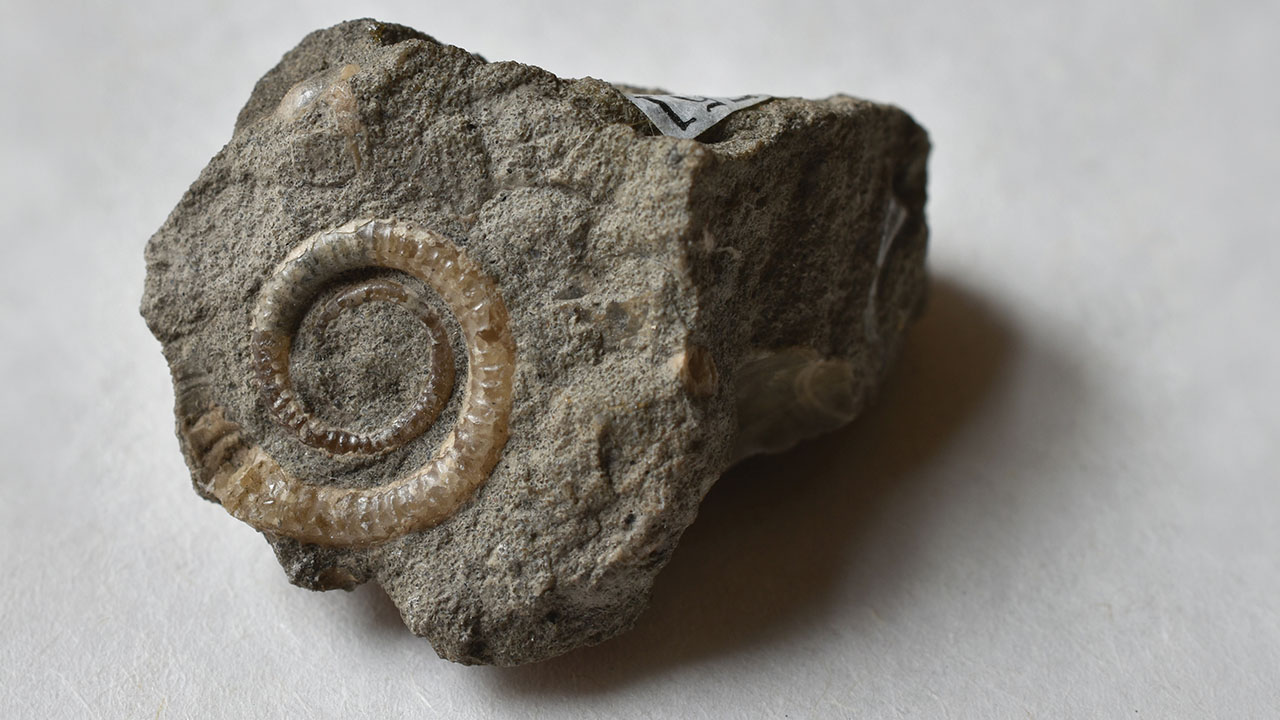
Parapatoceras sp. ammonite from the Kellaways Formation, Chippenham, donated by Mrs Lowe (© British Geological Survey, GSa 3751).
Mrs Lowe
A number of the female donors are identified only by their surname and home town. Mrs Lowe of Chippenham is one such figure.
While the details of her life remain elusive, we do know that she donated a series of Jurassic specimens from the Kellaways Rock and Oxford Clay (formations well known for their rich fossil remains of ancient marine life) near Chippenham in 1838 and 1842. The two donations, four years apart, imply a keen awareness of the local geology and an active engagement in collecting.

Pecten sublaevis phill. Molluscs from the Early Jurassic Marlstone Rock Formation, Middle Lias in Bathford, Somerset, donated by Miss Lonsdale (© British Geological Survey, GSa 4983-4984).
Miss Lonsdale
The brief reference to a Miss Lonsdale seems to reveal little, yet it offers a tantalising hint of a possible connection to wider geological circles and influences. Her surname, combined with the presence of specimens from Bathford, suggests a possible familial link to the geologist William Lonsdale (1794–1871), who lived in nearby Batheaston before serving as the Geological Society’s curator, librarian and assistant secretary between 1829 and 1842.
Bathford and Batheaston—small villages just a few miles apart on the northeastern edge of Bath—place her within the same local landscape and social sphere, making it likely that her collecting was shaped, directly or indirectly, by his geological work.
Restoration
Taken together, these fragmentary records offer glimpses of women who were actively contributing to geological knowledge, even as their identities are now obscure to us or have been overlooked. By revisiting their stories, we can begin to restore their place within the history of geoscience.
Caroline Lam Archivist, Geological Society of London, UK
Acknowledgements
With thanks to Louise Neep and the British Geological Survey, who kindly arranged the specimen loans originally housed in the Geological Society’s Museum.
More information
The exhibition will be on display at Burlington House until January 2027 or can be viewed online here.