In search of Ithaca
John Underhill, James Diggle and Dave Kilcoyne investigate the geological mystery surrounding the homeland of Homer’s Odysseus, Ithaca, uncovering a fresh interpretation of one of antiquity’s most celebrated works



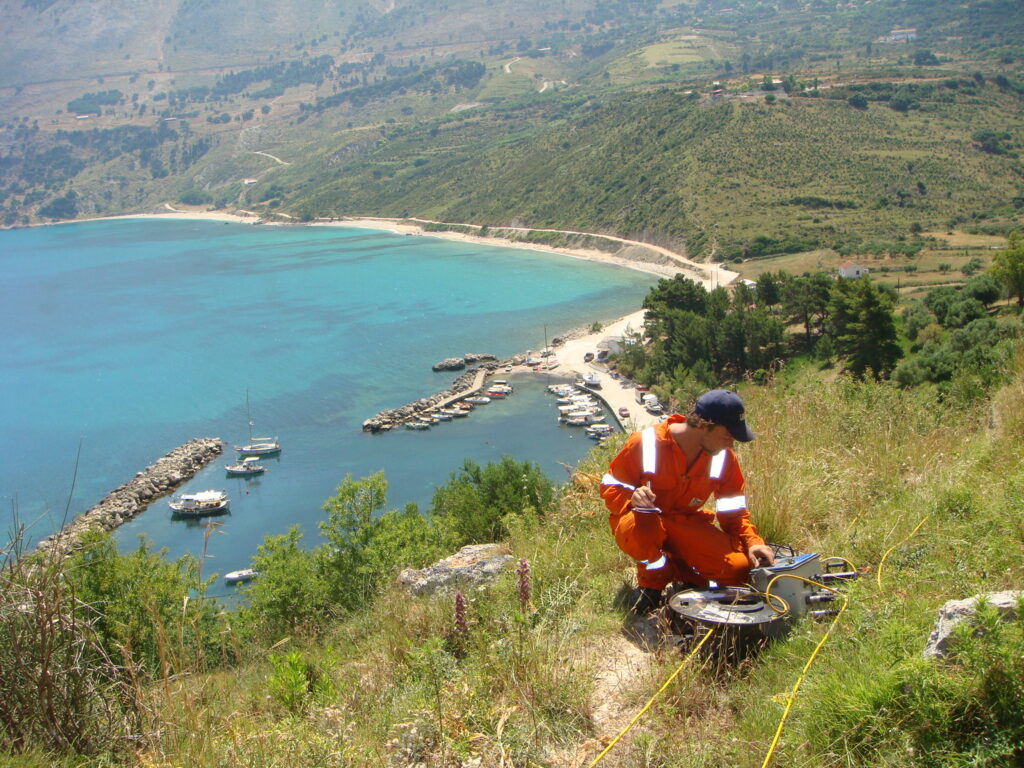
Field geophysical (gravity) measurements aided in understanding geological structures (© Fugro)
Traditionally attributed to the ancient Greek poet Homer, The Odyssey recounts the perilous journey of Odysseus, king of Ithaca, following the Trojan War. Blending mythology with real-world settings, the epic poem has long intrigued scholars seeking to identify the places it describes.
For John Underhill, answering this question has meant looking beneath the surface of a Greek island. Working alongside James Diggle and a multidisciplinary team, John has spent more than two decades investigating whether a narrow valley on the Ionian island of Kefalonia once separated its western peninsula, Paliki, from the rest of the island.
The findings have prompted a fresh interpretation of Homer’s text, while demonstrating how geoscientific techniques can be applied beyond industry projects to investigate ancient landscapes and the stories associated with them.
A question of geography
The location of Ithaca has been contentious. Whilst the modern Greek island of Ithaki bears the name, its geography does not readily correspond with Homer’s descriptions of Odysseus’ homeland.
“Ithaca is a name to conjure with,” James says. “It is more than the name of the island of Odysseus, it has gained a deeper resonance. Ithaca is too important to misplace, yet everyone has misplaced it.”
The search took a new direction with the publication of Robert Bittlestone’s Odysseus Unbound in 2005. Robert proposed that Paliki, the western peninsula of Kefalonia, was the location of ancient Ithaca as the landscape appeared to fit Homer’s descriptions, provided Paliki had once been a separate island.
Today, Paliki is connected to the rest of Kefalonia by the Thinia Valley, a narrow strip of land measuring approximately 6 km by 2 km. Robert suggested that a navigable marine channel had once passed through the valley, separating the peninsula from the main island before being filled by rockfalls and landslides triggered by earthquakes.
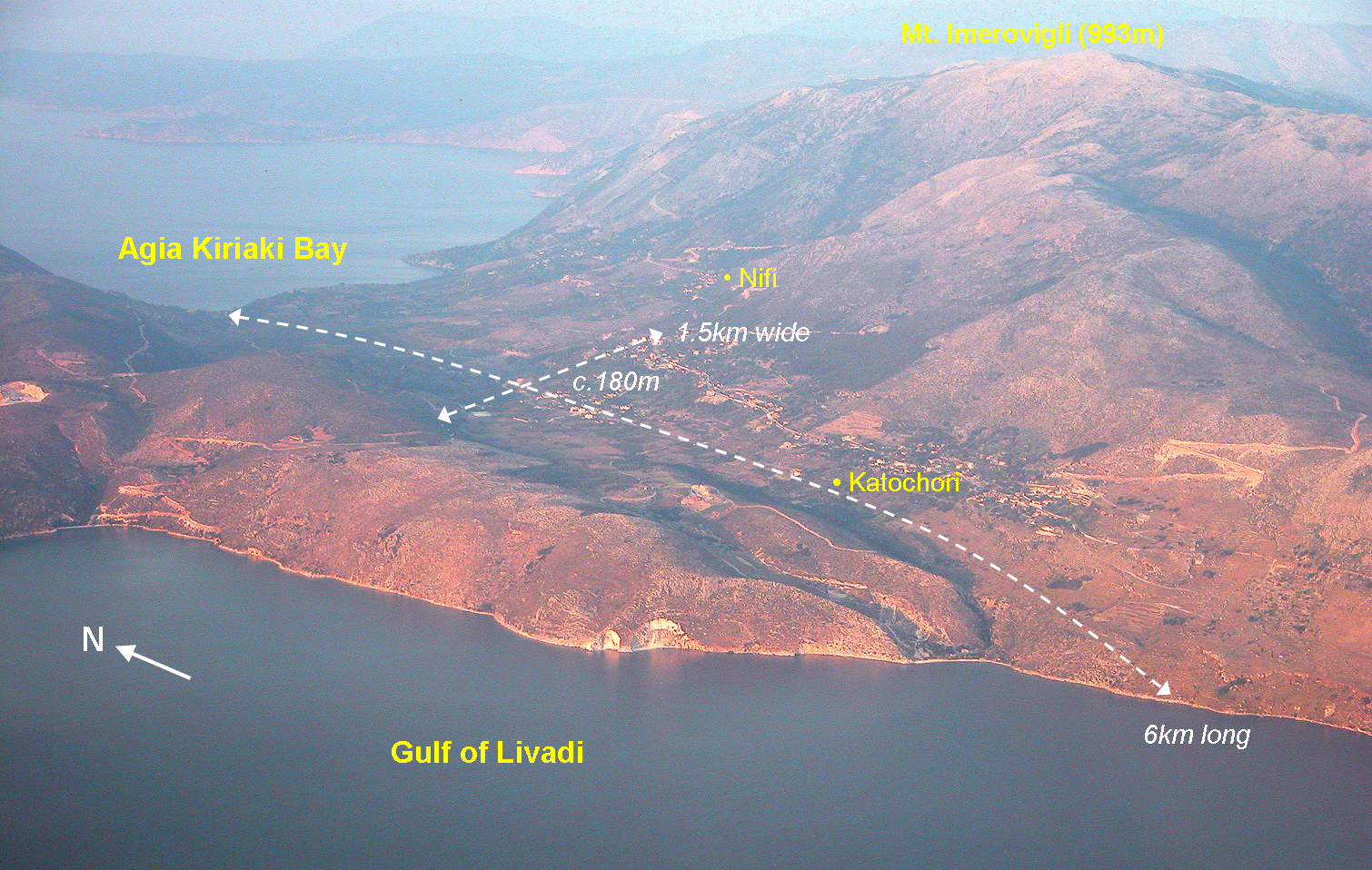
Aerial view of Thinia Valley between Agia Kiriaki Bay and the Gulf of Livadi, Kefalonia (© John Underhill)
The hypothesis was bold, but testable. If a marine channel had existed beneath the valley during the Bronze Age, when The Odyssey is set, the geological record should preserve evidence of its former presence. Yet the valley now lies well above sea level, reaching elevations of around 180 m in places, posing a significant challenge to the idea of a navigable seaway.
Familiar with western Greece’s geology through his PhD studies and subsequent peer-reviewed publications, John was well placed to investigate: “I was introduced to the Roman geographer Strabo’s description of a water course going ‘from end-to-end from time-to-time’. Knowing what I did from previous research, I realised that the marine channel hypothesis could be tested through the application of geoscience and I agreed to join the quest, which is something I have never regretted.”
Looking beneath the surface
Investigating the Thinia Valley presented a substantial challenge. Much of the evidence needed to reconstruct its geological history lay buried beneath the modern terrain, so establishing whether the valley once hosted a marine channel required more than a geological map or a handful of boreholes.
John and Robert approached Fugro, a geoscience company specialising in subsurface investigation. The company agreed to support the project, bringing together specialist teams, equipment and expertise that would have been difficult to secure through academic research budgets alone.
Fugro worked with John and the wider research team over several years, providing helicopters, boats and drilling rigs to recover rock cores. The team used airborne electromagnetic and magnetic surveys to investigate subsurface properties to depths exceeding 150 m in places, and LiDAR to produce a high-resolution digital terrain model beneath vegetation. Ground-based resistivity, seismic refraction and gravity surveys provided further detail, while marine bathymetry and seismic reflection data allowed the team to map the seabed and buried bedrock.
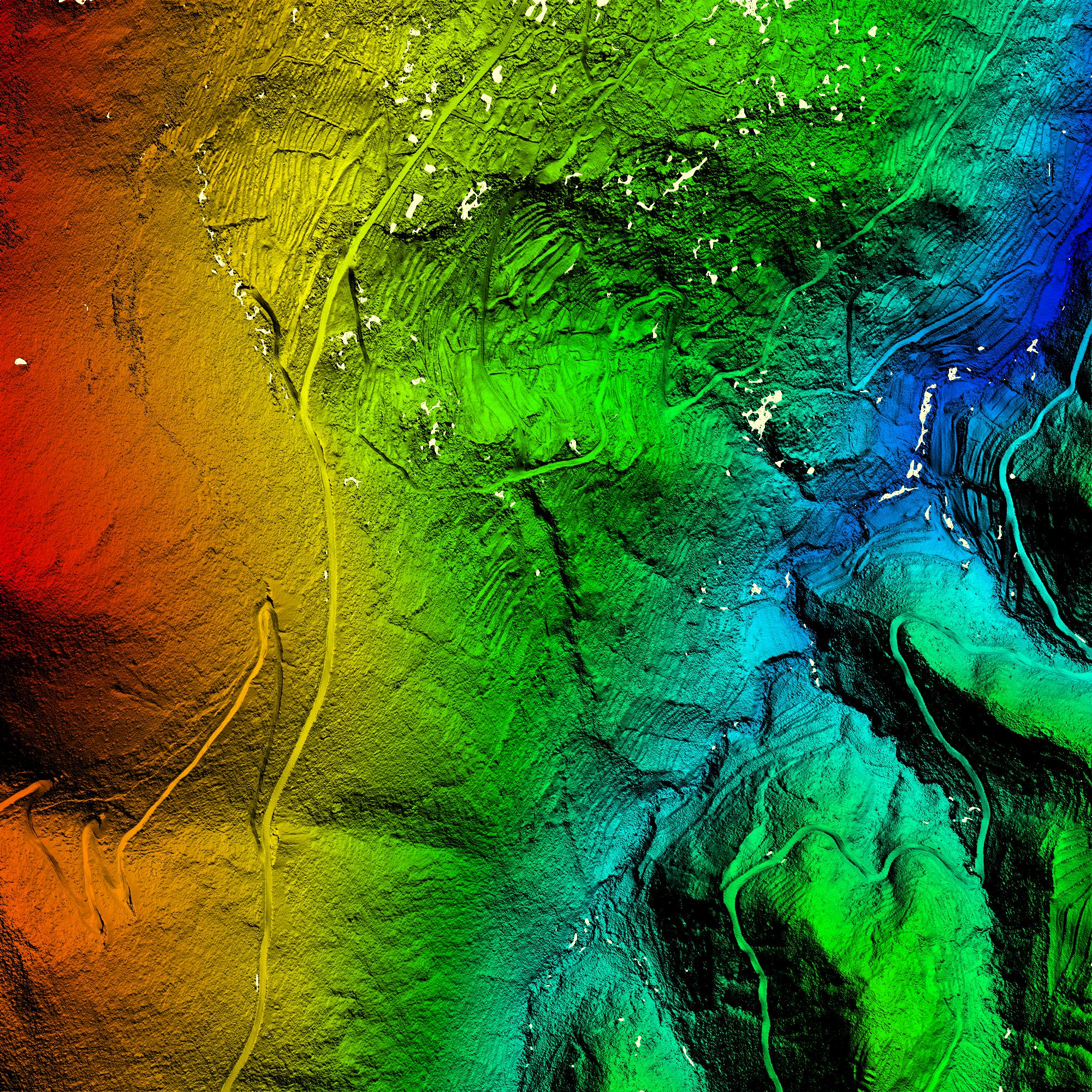
A LiDAR-derived terrain model revealed subtle landscape features (© Fugro)
“The geology of the Thinia Valley and surrounding areas is very complex and couldn’t have been understood without such a multidisciplinary strategy,” Dave Kilcoyne says.
The survey results suggested that limestone bedrock lay at considerable depth beneath parts of the valley, overlain by a mixture of rockfall deposits, colluvium, river sediments and lake deposits. This was consistent with the possibility that the valley had once been occupied by marine water before being infilled. However, the geophysical evidence alone could not establish precisely when the landscape had changed, or whether a marine channel had existed during the period associated with Odysseus. To answer those questions, the team needed to investigate the sediments themselves.
Dating the landscape
The steep valley terrain made access difficult, so geophysical models and topographic mapping helped the team select borehole locations and plan drilling operations using a specialist land and jack-up barge geotechnical drilling plant.
The investigations confirmed that the Thinia Valley had once been a marine channel due to the presence of marine fossils in Oligo-Miocene sediments and those from the Late Pliocene to Middle Pleistocene, meaning Paliki was temporarily separated from the rest of Kefalonia.
Analysis of the recovered cores showed that the marine channel was no younger than 400,000–290,000 years old—hundreds of thousands of years before the Bronze Age. Emplacement of the thrust faults during the Late Pleistocene led to the marine sediments being uplifted and the valley has been above sea level ever since.
Further fieldwork between 2022 and 2024 built upon these findings. Using earlier geophysical data to guide new sampling, the team identified strategic locations for excavating trenches and examining the deposits exposed on their side walls in greater detail.
No one technique alone could have solved the mystery. ~John Underhill
Analysis of the sediments helped establish how the landscape had changed over time, overturning the original hypothesis. Furthermore, the new results allowed a palaeogeographic reconstruction in which the valley was occupied by an upland meadow, with an ephemeral lake forming occasionally around the Katochori Plain from which two streams flowed to the northern and southern coasts to effectively separate Paliki from the rest of Kefalonia
Crucially, the evidence showed that the valley was no longer a marine channel during either the Bronze Age or the Roman period. Paliki was therefore not a separate island at the time traditionally associated with Odysseus.
But disproving the idea that Paliki was an island during the Bronze Age did not necessarily rule it out as a candidate for Homer’s Ithaca. If it was part of Kefalonia at the time, could it still have been the homeland described in The Odyssey?
Rereading Homer
The geological findings prompted James to revisit Homer’s text and question the key assumption underlying the original hypothesis that Ithaca had to be an island. Homer refers to Ithaca as “land”, “country” or “territory”, rather than explicitly describing it as an island, and James argues that some passages suggest it could have been part of a larger landmass. He also reinterpreted Strabo’s description of a watercourse through the valley as flowing water, rather than evidence of a navigable marine channel.
“There was suddenly alignment between the geology and classical scholarship, which was a surprising outcome,” John says.
This convergence offers a new interpretation of the geographical clues in The Odyssey, but it does not establish beyond doubt that Paliki was Homer’s Ithaca. Geology can test whether a proposed landscape fits the evidence, but it cannot by itself identify a place described in an ancient poem.
For James, however, the value of the research lies precisely in this exchange between disciplines: “Without the stimulus provided by John’s geoscientific work, I would never have thought to examine the Homeric text again and come to the conclusions that we have now reached.”
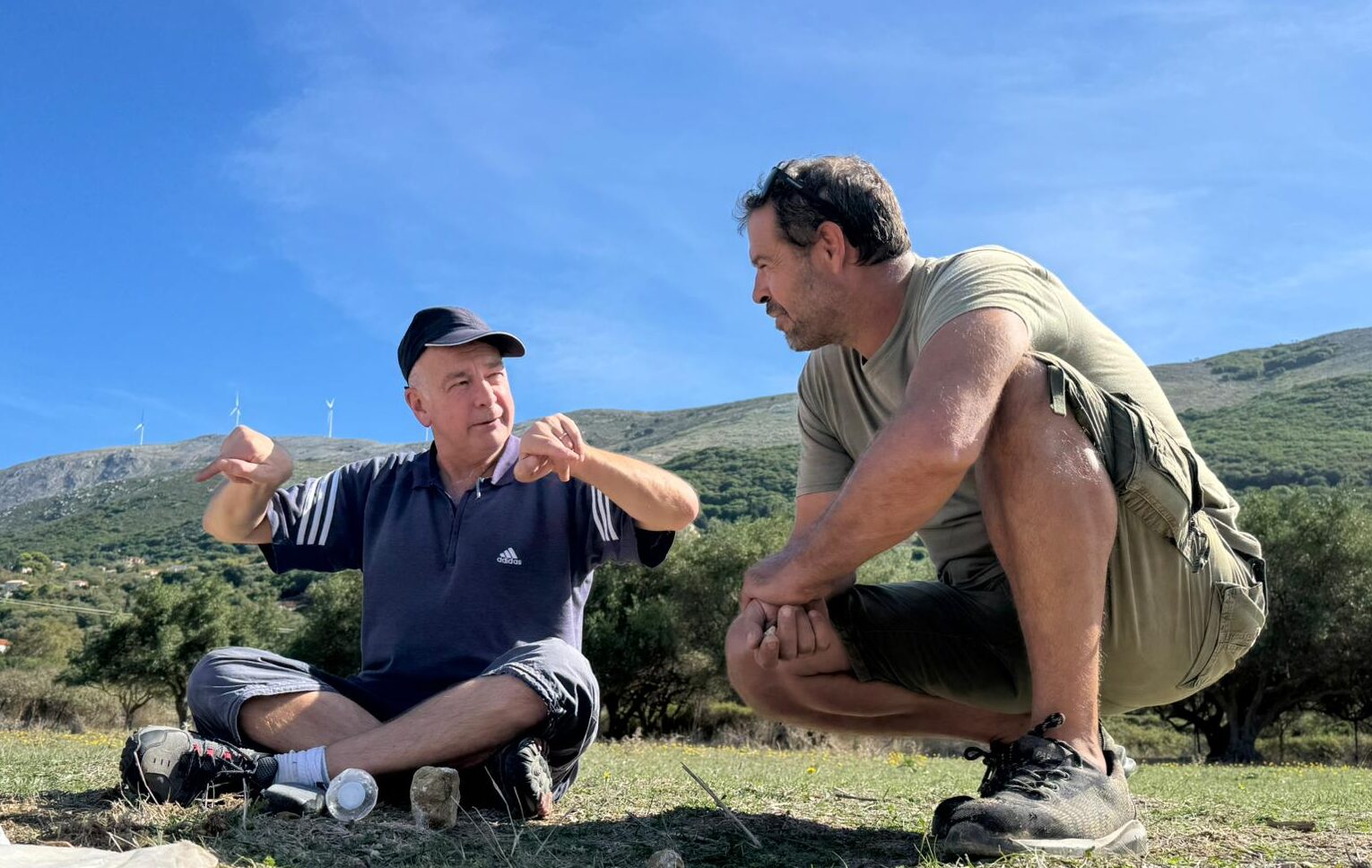
John explaining the geology of the Thinia Valley to a Kefalonian in the field (© John Underhill)
Beyond The Odyssey
This investigation highlights how geoscientific techniques often used for infrastructure, energy and environmental projects can also help archaeologists uncover buried landscapes and reconstruct their history. By combining existing geological knowledge with geophysical surveys, researchers can gain a better understanding of the subsurface and identify areas that warrant more detailed investigation—an approach Dave describes as a key success of the Ithaca project. Advances in geophysical technology, portable equipment, drone-based surveys and data processing are making such investigations increasingly efficient.
John hopes the next stage of the research will investigate the age and significance of buried structures identified during the surveys, potentially revealing further evidence of Bronze Age society on Paliki.
Reflecting on the project, he adds: “There is an undeniable sense of achievement and feeling that geoscience has proven its value in testing and solving a challenge that has perplexed scholars for centuries. It is rather poetic that it took twenty years to undertake this research, the same length of time that Odysseus took to travel to Troad, participate in the Trojan War, and return to his homeland of Ancient Ithaca!”
Whether Paliki was definitively the Ithaca of Homer’s imagination remains an open question. But the search has revealed something about the value of geoscience and power of looking beneath the surface: sometimes, the route to answering an ancient mystery begins by questioning what everyone thought they already knew.
Authors
Professor John Underhill, Director for Energy Transition and Professor of Geoscience and Energy Transition at the University of Aberdeen, UK
Professor James Diggle CBE, Emeritus Professor of Greek and Latin at the University of Cambridge, UK
Dave Kilcoyne, Land Geophysics Manager at Fugro, UK
Interview by Hannah Bird, Associate Editor, Geoscientist Magazine
Acknowledgments
The team gratefully acknowledge the support of the Natural Environment Research Council (NERC), Fugro, the University of Aberdeen’s Development and Alumni Relations (DAR) and the Odysseus Unbound Foundation (OUF) for funding to support the geoscientific research. They also thank Peter Styles, Jean-Luc Schwenninger, Maria Triantaphyllou, Kirsten Hunter, Ruth Hamilton, Steve Poulter, Steve Thompson, Tyler-Jade Kelly, George Anastopoulos, Vasilis Rouchotas, Grigorios Grigorakakis, Eleni Papafloratou, Isidoros Kampolis, the Hellenic Survey of Geology and Mineral Exploration, the Institute of Geology and Mineral Exploration, the Ministry of Foreign Affairs, the Ministry of Culture, and the Dimarcheions of Paliki and Argostoli for their technical expertise and facilitating the necessary research permits and fieldwork on Kefalonia.
Further reading
Bittlestone, R. (2005) Odysseus Unbound: The Search for Homer’s Ithaca. Cambridge University Press, 618 pp.
Diggle, J. & Underhill, J. (2026) Was Homer’s Ithaca an Island? Antigone; antigonejournal.com/2026/07/in-search-of-ithaca
Underhill, J. (1988) Triassic evaporites and Plio-Quaternary diapirism, western Greece. Journal of the Geological Society of London, 145, 269-282; doi.org/10.1144/gsjgs.145.2.0269
Underhill, J. (1989) Late Cenozoic deformation of the Hellenide foreland, western Greece. Geological Society of America Bulletin, 101, 613-634; doi.org/10.1130/0016-7606
Underhill, J. (2009) Relocating Odysseus’ homeland. Nature Geoscience, 2, 455-458; doi.org/10.1038/ngeo562
Underhill et al. (2018) Ithaca—The story continues. Geoscientist, 28 (4), 10-15; geoscientist.online/wp-content/uploads/2024/01/Geo_May2018_WR.pdf
Underhill et al. (2027) A 21st Century Greek Odyssey: the geoscientific case for re-locating Odysseus’ homeland, Ancient Ithaca. Earth Science, Systems and Society (in press).