AI in action
AI has moved beyond the realm of future possibility. Andrew Osarumwense Lator and Paul Cleverley report on how AI is actively reshaping the field of geoscience

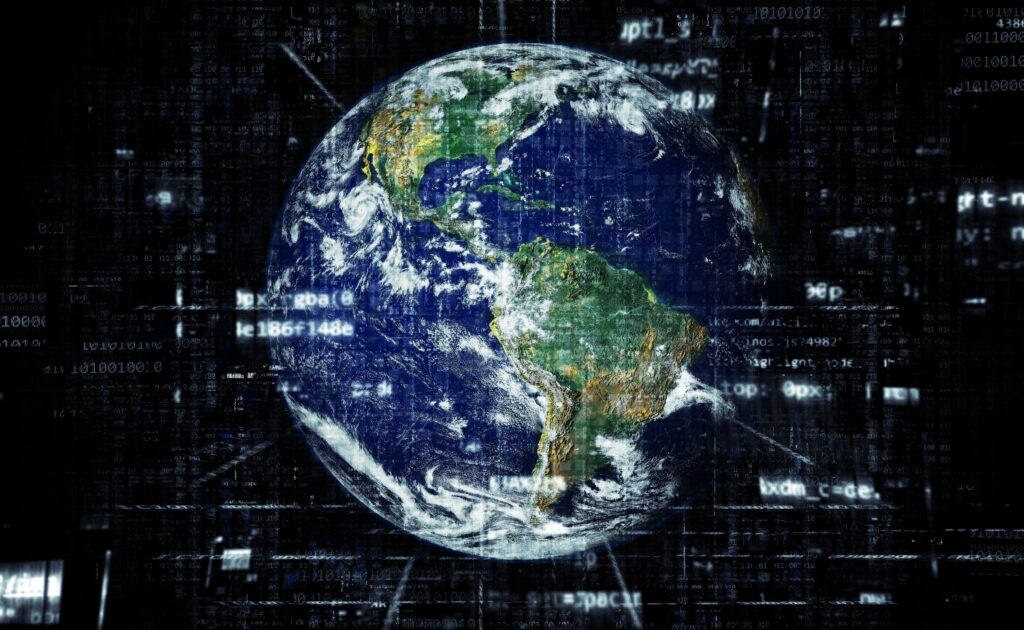
Earth is at an “axial” moment where humanity can still tip the balance positively, argues David Leslie (© Pete Linforth/Pixabay)
Artificial intelligence (AI), machine learning (ML), and big data are influencing almost every aspect of modern daily life. However, these transformative technologies bring critical ethical, educational and policy challenges. With a focus on responsible innovation, the Society’s inaugural AI in the Geosciences meeting, held in June 2026, explored the opportunities and challenges around the rise of AI in our discipline.
This hybrid conference, held in-person at Burlington House, London, as well as online, gathered speakers from over 20 countries across every continent and drew over 130 participants. During more than 60 presentations, experts explored the intersection of AI, ML, and geoethics across diverse fields, including geothermal energy, oceanography, geotechnics, hydrogeology, mining, oil and gas, carbon capture and storage, geohazard monitoring, geological mapping, land remediation via LiDAR, and AI-assisted literature reviews.
As geoscientists working to advance technical capacity and mentor the next generation of geoscientists, attending this event reinforced a core truth: AI is no longer a futuristic luxury, it is actively reshaping how we evaluate the subsurface, manage data, and train future geoscientists. From automated workflows to deep ethical considerations, the insights from the conference offer a vital roadmap for geoscientists worldwide.
AI at a crossroads
David Leslie (Director of Ethics and Responsible Innovation Research, The Alan Turing Institute) introduced the idea of an “axial” moment: humanity stands at a decision point between becoming a destructive species or an ethically responsible steward of the living biosphere. David argued that AI is an axial technology because it is becoming embedded in digital infrastructure, personal life, public discourse, and decision-making systems across society.
In geoscience, AI applications are especially valuable for seismic hazard modelling, subsurface imaging, climate simulation, and environmental monitoring, with the aim of reducing loss of life and supporting adaptation, mitigation, and safer subsurface management. By stressing that AI should amplify geoscientific judgment rather than replace it, we strengthen our ability to read Earth systems and protect vulnerable communities.
We decide what we do with AI and when to use it. We can shape the future!
David argued that the central issue is not only what AI can do, but who controls its development, deployment, and agenda-setting power. Some private technology corporations and government-backed labs currently dominate the direction of AI innovation through market concentration, control of infrastructure, and profit-driven incentives. A lively question and answer session provided thought-provoking discussion on who defines what is meant by orienting AI in the geosciences towards ‘public good’ because we won’t all share the same views.
Other presentations addressed the importance of conveying uncertainty in AI/ML outputs, agents orchestrating geoscience workflows (that is, using autonomous or semi-autonomous AI tools to plan and complete tasks), and the impact of large language models (LLMs) on our skills. Audience participation was fantastic, with questions covering the different definitions of Artificial General Intelligence and the importance of critical thinking, as well as ethical debates such as how AI can be used to extract more hydrocarbons and how this fits in with our position on climate change, and whether we are really in control of AI.
AI with accountability
A major theme was how ML and generative AI augment, rather than replace, human and geoscience expertise. Karen Heyburn (Head of Product Management, Halliburton) explored the practical applications of AI for subsurface investigation. For example, in stratigraphy it is traditionally difficult to determine whether variations in rock layers were caused by past sea-level changes or variations in sediment supply. Karen highlighted how stratigraphic modelling plays a crucial role in creating “perfect” synthetic data that serve as unambiguous examples with which to train ML models, eliminating this traditional ambiguity. Karen also demonstrated how digital workflows are dramatically accelerating timelines across the exploration lifecycle, from regional geological screening to prospect definition.
Indeed, AI is accelerating workflows across our discipline. For example, in palaeoclimate prediction, AI tools can reduce the computational bottlenecks associated with using Paleo-DEM (a digital representation of Earth’s past topography and bathymetry); in subsurface resource recovery, automated well-failure extraction avoids the need for engineers to manually sift through thousands of logs to identify the cause of a well failure, while automated repetitive data processing requires a fraction of the traditional timelines required for petrophysical log prediction, seismic interpretation, and play/lead identification.
What is clear however, is the essential role for geoscientists in defining workflows and validation. The talks stressed ethical, reproducibility, and data-quality challenges, recommending transparent, explainable systems, human governance and upskilling.
As technical capabilities expand, robust frameworks must keep pace. As Keith Holdaway (CEO, Digitaloil.ai) noted: “Ethics is not a constraint on AI. It is the foundation.” Implementing AI with rigour requires addressing several critical operational pillars:
- Explainable AI (XAI): XAI is a set of tools and methods that helps us understand how artificial intelligence models make their decisions. Despite its necessity for professional liability and traceability, XAI is currently mentioned in only 6.1% of geoscience AI research papers (Dramsch et al. 2025). Every AI output must communicate confidence intervals (such as the percentile-based confidence estimates P10, P50, P90) rather than simple point estimates.
- Bias Auditing: This systematic evaluation of an artificial intelligence system, its training data, and its outputs helps to identify, measure, and mitigate unfair or discriminatory treatment. In geoscience, systematic validation is required to catch geographic, lithological, and vintage (or historical data) biases before structural models or reserve estimations are submitted.
- Data Integrity: Organisations like the British Geological Survey highlighted that while variable data quality is not a new problem, generative AI requires strict verification protocols before scientific outputs are released into the public sphere. Once an institution suffers ethical harm, trust is incredibly difficult to rebuild.
Skills for an AI era
The rapid adoption of these transformative technologies presents a unique double-edged sword in geoscience education. Survey results shared at the conference by Bernique de Kock revealed that up to 80% of students utilise AI, often relying blindly on it as a safety net due to a fear of failure. This uncritical use can lead to over-reliance and a drop in critical thinking skills. Academics and industry leaders agree that universities must work more closely with employers to integrate AI literacy safely into their curricula.
For young geoscientists, the path forward does not lie in simply learning to write basic code. With the rise of highly sophisticated LLMs and tools like Claude Code, the competitive edge shifts towards fundamental scientific mastery.
The key advice for the next generation was to learn a little bit of coding and Python but focus intensely on understanding geophysics and structural relationships. The geoscientists of tomorrow must be capable of building AI tools, critically evaluating their computational outputs, and boldly refusing to deploy them when ethical or geological parameters demand it.
Shaping the future
The future of geoscience is not set, but it is undeniably intertwined with frontier AI. The intersection of ML, open-source code repositories like GitHub, and public domain data represents an unprecedented opportunity. By balancing fast-paced technological integration with strict ethical safeguards and deep fundamental knowledge in geoscience, we can ensure that the next generation of geoscientists lead the charge in sustainable Earth resource exploration, environmental and climatic studies, and technological innovation.
While the conference was about AI, what we saw was the creativity of people. We decide what we do with AI, when to use it, and when not to use it at all. While AI is already embedded in our lives and workflows, we can still shape the future!
To continue driving these crucial conversations and shaping the geoscience industry’s evolution, we look forward to the next edition of the AI in the Geosciences conference, scheduled to take place from 1-2 July 2027. Find out more here.
Authors
Andrew Osarumwense Lator, NextGen Mentoring and Training Initiative, Nigeria
Paul Cleverley, Infoscience Technologies Limited, UK
Acknowledgements
Andrew Osarumwense Lator would like to thank the Geological Society for sponsoring his virtual attendance at the meeting, which aligns with the mission of the organisation he founded, NextGen Mentoring and Training Initiative: to empower the next generation of African and global geoscientists with modern technology skills and entrepreneurial mindsets.
Further reading
- Dramsch, J.S. et al. (2025) Explainability can foster trust in artificial intelligence in geoscience. Nat. Geosci. 18, 112–114; doi.org/10.1038/s41561-025-01639-x