The grounds of architecture
As human construction rapidly reshapes Earth’s surface, Paul Dobraszczyk discusses the ways in which architecture can connect people with geology and the deep history of our planet

In 2020, Emily Elhacham and colleagues published an article in Nature which argued that, for the first time in history, the mass of everything made by humans exceeded that of all living biomass (the latter being approximately 1.1 tera tonnes; Elhacham et al., 2020). The team also demonstrated that the growth in the total mass of human-made artefacts was exponential, doubling every twenty years or so.
Just a century ago, less than 3 per cent of the planet was human made; it crossed the 50 per cent threshold in the 2010s. Following this trajectory, we would have ample reason to believe that, sometime in the 22nd century, the entire planet will be one great mass of metals, asphalt, plastic, bricks, aggregates and concrete. A planet like Trantor in Foundation, a series of science fiction novels by American author Isaac Asimov where a single conurbation covers every available surface on the globe. That prospect is undoubtedly far-fetched, but it flags up the extraordinary speed at which humans are now altering the very material fabric of Earth’s crust itself, a process that has, or more precisely will have, significant geological implications.
The Anthropocene
We are now living in what some call the Anthropocene, a new geological epoch in which humans are the principal planet-changing force. A key buzzword for social scientists over the past two decades, the term firmly entered the public realm in 2024 when the International Union of Geological Sciences formally rejected the Anthropocene as a successor to the Holocene, the geological epoch that began at the end of the last Ice Age some 11,700 years ago, and which was only accepted by the scientific community in the 1990s (IUGS, 2024).
Architecture has a reciprocal relationship with Earth
Despite broad agreement on humanity’s unprecedented impact on Earth (and its recentness) and plenty of material evidence to support this, the formal rejection of the Anthropocene by geologists was due, in large part, to the short period of time under consideration — the last seventy years or so. Geologists, and particularly stratigraphers, generally deal with periods of time that extend into tens, if not hundreds, of millions of years. They look to the distant pre-human past to discern changes in the geological record. While there is no doubt that the sheer amount of anthropogenic mass is already affecting and contributing to Earth’s strata, there is simply no formal geological framework for investigating what might happen in the deep future, as opposed to the deep past. Neither is there a framework for the sheer speed at which humans are generating the materials that will still be there in the distant future (Zalasiewicz, 2008).
What debates about the Anthropocene do flag up is the central role that human construction plays in the alteration of Earth’s fabric. As of 2023, the global construction industry accounted for nearly 40 per cent of carbon emissions worldwide, mostly a consequence of the manufacture of concrete and steel in colossal quantities (Dyson, 2023). But construction, and particularly architecture, always has a reciprocal relationship with Earth. On the one hand, construction consumes the planet’s resources by turning raw materials into things we can use; on the other, it also has the potential to draw us into an awareness of Earth and deep time.
15 Clerkenwell Close

15 Clerkenwell Close. Designed by architect Amin Taha and built in 2017, this six-storey office building in Clerkenwell, London, has a rough-hewn limestone façade with visible fossils and textures that express the geological origins of the building material. (© Paul Dobraszczyk)
In 2017, the appearance of a new six-storey office building in Clerkenwell in London generated intense debate that keyed into architecture’s reciprocal relationship with Earth. Designed by architect Amin Taha, 15 Clerkenwell Close has an exposed structural façade made of rough-hewn limestone, rather than polished stone cladding, with visible fossils and textures that express the geological origins of the building material. Taha sourced the stone from the famous Caen quarry in Normandy — a decision inspired by the 11th-century abbey that used to stand on the same site as the new building. This Jurassic Period limestone was used to build many of England’s medieval cathedrals and other ecclesiastical buildings; and it is rich in fossils from this period in Earth’s history.
The building faced significant opposition from the borough council, heritage groups and some locals. The controversy was so fierce that the building received two demolition orders (one in mid-2017 that was withdrawn and another in 2018 that was later overturned). Fortunately, the building survived this furore and seems safe for now. The planning officer’s ire centred on the architect’s decision to use raw quarried limestone for the building’s structural frame. According to the local council, the untreated limestone wasn’t specified in the original planning application. Taha thought otherwise: for him, it was the appearance of the building that caused such offence. It looked unfinished, an uncomfortable reminder that what we generally appreciate in architecture is the erasure of any signs of its origin in the natural materials of Earth.
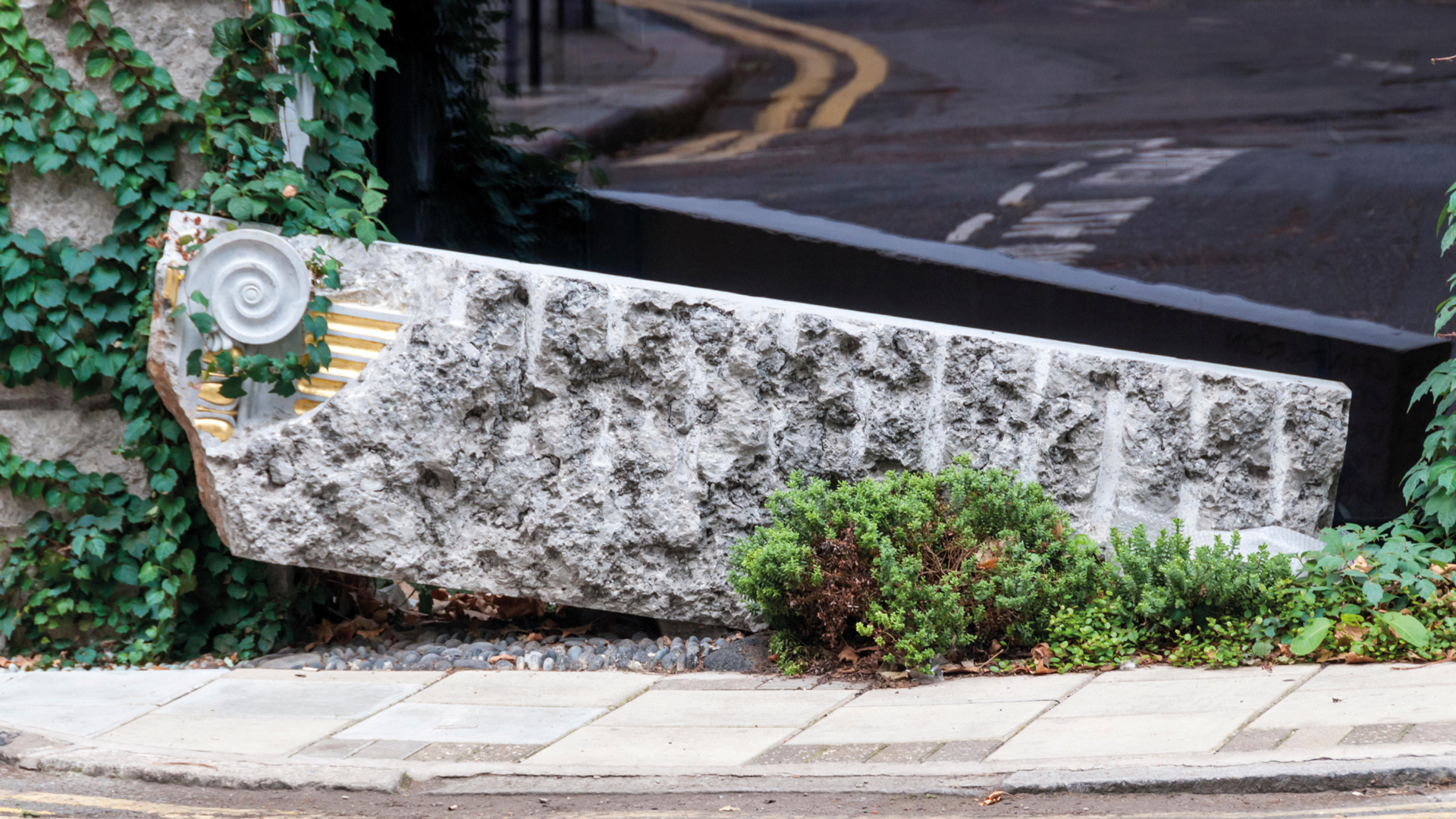
A fallen Ionic capital placed directly outside 15 Clerkenwell Close (designed by Amin Taha) refers to the beginnings of classical architecture. (© Alamy)
When I visited the building after the planning furore had died down, I noticed something that many of its detractors had missed: a fragment of stone at the base of the façade that displays a knowing reference to architecture’s oldest recognized theorist, the Roman writer Vitruvius, whose De Architectura (normally translated as Ten Books on Architecture) was written between 20 and 30 BCE. In this treatise, Vitruvius speculated about the origins of architecture itself, arguing that human construction must have been inspired by examples already set by nature. These included birds’ nests, tree branches and caves — each natural architecture producing a human equivalent over time.
The artifice of architecture can make geology meaningful to humans
fragment of stone placed outside the Clerkenwell office building we see a reference to the beginnings of classical architecture: an Ionic capital, picked out in gold paint, seems to emerge from the otherwise untreated stone. The ivy that half concealed the stone when I visited only added to its symbolic power. For me, this artful fragment and the rough-hewn façade behind it questioned the origins of architecture itself. Does architecture begin in the quarry or in the transformation of natural stone into art?
If the Anthropocene requires us to look into the far future, it also means looking back, too, to the point where the gargantuan juggernaut of human construction we know today first began — the moment when geology was turned into architecture. Perhaps the emotive charge of Taha’s building lies in this provocation — the unfinished aesthetic suggesting that, in the Anthropocene, far bigger things are up for question than the niceties of planning legislation.
Reciprocal landscapes
Quarries are part of architecture’s ‘reciprocal landscapes’, in the words of landscape architect Jane Hutton: places where the materials used to build with are extracted from Earth.
Hutton’s 2020 book, Reciprocal Landscapes, highlights the hidden connections between designed sites and the distant places that supply their materials, urging us to see landscape architecture as a web of mutual — and often unequal — exchanges between people, materials, and ecosystems.
Stone, along with timber, may be some of architecture’s oldest building materials, but these have long been eclipsed by materials that humans rather than Earth or its living biomass fabricate. Such human-made materials include concrete, iron and steel, brick and plastic, to name only the most common. Many view quarries as sites of violence meted out on the planet, with raw materials only given meaning as they are shaped into buildings and other things we can use. These sites are generally shunned as places of pollution, noise and ugliness — connecting architecture to these places is discomforting. It is commonplace to assume that for a work of architecture to attain value, it must transform its ‘mere’ material basis in nature into art. Put another way, the artifice of architecture is the very thing that can make geology meaningful to humans. That is why a piece of natural stone is not usually called architecture: it has to be shaped by human hands (or our machines) and made useful for it to possess any architectural meaning.
Utility
Utility — utilitas in Vitruvius’s treatise — is often seen as one of the cardinal virtues of architecture, even more so in the modern period, when it became something of a religious tenet for leading modernist architects like the Swiss-French architectural designer Le Corbusier [1887 – 1965]. Yet the very idea of utility comes with enormous historical baggage, especially when applied to geology.
In her provocative book A Billion Black Anthropocenes or None (2018), geographer Kathryn Yusoff traces the origins of the science of geology to the advent of colonialism and the widespread instigation of slavery. Yusoff’s argument is that the early science of geology was intimately tied up with the Eurocentric empires that began at the end of the fifteenth century after the first voyage of Christopher Columbus. For colonisation was predicated on the exploitation of natural resources — the materials of Earth — and geological investigation was closely allied to the sourcing and extracting of these resources. Surveying the ground and investigating rocks showed the colonisers what was available for their use. In Yusoff’s estimation this led directly to the enslavement of millions of Black Africans, because seeing Earth as inert paved the way for seeing other people in the same light. Thus, any idea of the usefulness of resources — whether rocks or people — is tied up with the ways in which we construct knowledge about those resources. In short, things/people are made useful by first being described as such. There’s nothing natural about utility; indeed, it is loaded with political and social meaning from the start.
Yusoff’s thesis is extremely disquieting. She questions whether definitions of the Anthropocene are yet more evidence of humans’ (here meaning colonialist humans) unwillingness to treat Earth and each other with respect, particularly when it comes to the still-thorny issue of racial difference. Even if we don’t agree with Yusoff’s conclusion that the science of geology and slavery are closely aligned, there’s a wider point here about the tendency of certain human ideas of utility to render all things, including people, as subservient to our needs.
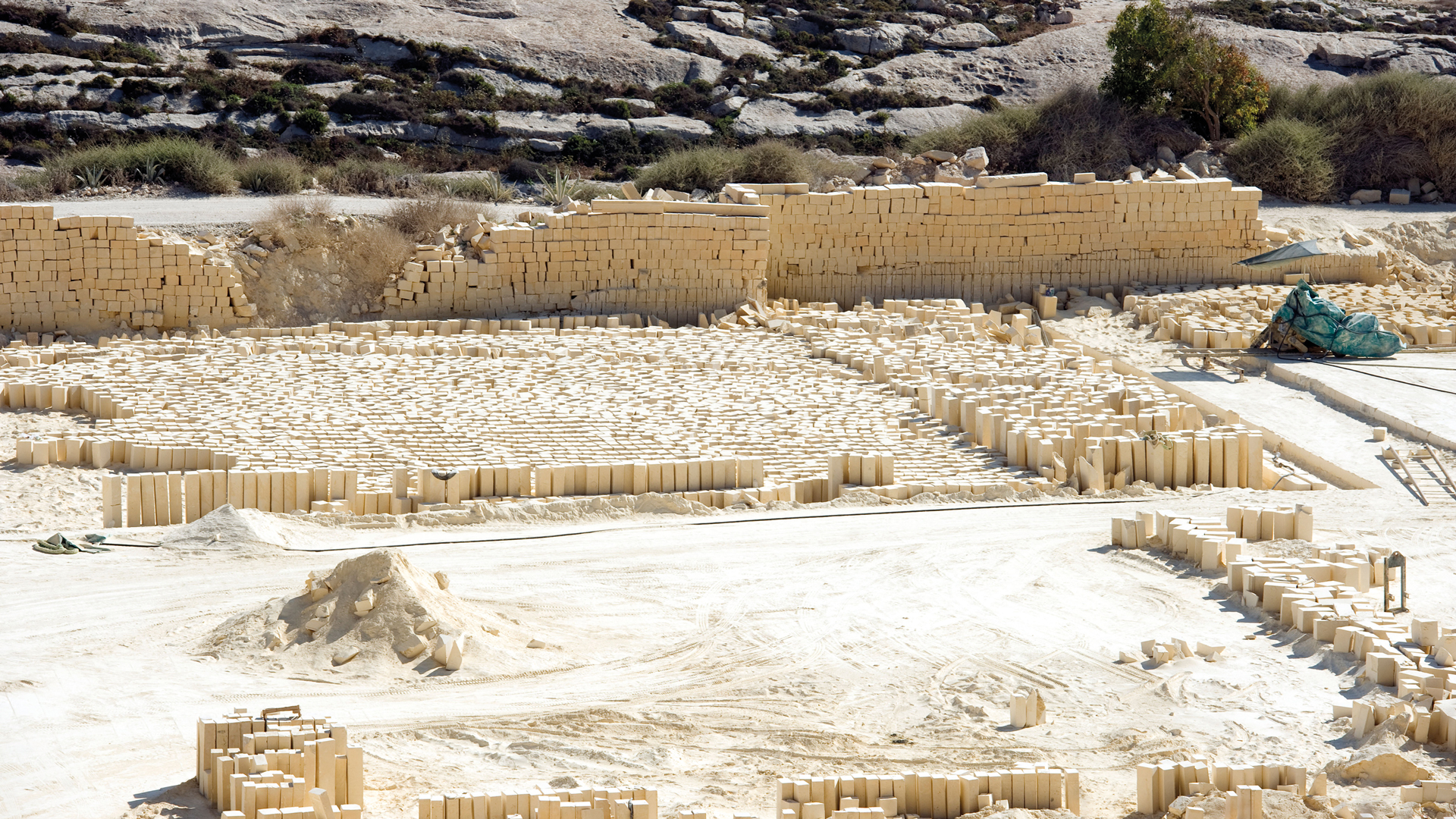
Does architecture begin in the quarry or in the transformation of stone into art? Here, limestone building blocks are cut from a quarry on Gonzo, Republic of Malta (© Alamy)
Stories of stone
What I see in the rough-hewn stone of Taha’s building in Clerkenwell is an assertion of other ways of being in the world. The stone in that building, freshly extracted from the ground, forces awareness of the life of stone in the world, the way in which it has its own places of origin, its own stories of becoming and its own futures. Just because the stories of stone are indifferent to and immensely longer than our own doesn’t mean that they are of any less value.
Author
Paul Dobraszczyk
Architectural writer, photographer and artist, and lecturer at the Bartlett School of Architecture, London, UK
Paul Dobraszczyk’s book, The Matter of Architecture, will be published by Reaktion in 2026
Further reading
- Amos, J. (2024) Anthropocene Unit of Geological Time Is Rejected. BBC News, 21 March; https://www.bbc.co.uk/news/science-environment-68632086
- Dyson, A. et al. (2023) Building Materials and the Climate: Constructing A New Future. United Nations Environment Programme; https://www.unep.org/resources/report/building-materials-and-climate-constructing-new-future
- Elhacham, E. et al. (2020) Global human-made mass exceeds all living biomass. Nature 588, 442–444; https://doi.org/10.1038/s41586-020-3010-5
- Hutton, J. (2020) Reciprocal Landscapes: Stories of Material Movements. Routledge.
- IUGS (2024) The Anthropocene. Statement from the International Union of Geological Sciences, 20 March; https://www.iugs.org/_files/ugd/f1fc07_40d1a7ed58de458c9f8f24de5e739663.pdf?index=true
- Vitruvius (2014) The Ten Books on Architecture. Translated by Morris Hicky Morgan, Harvard University Press.
- Yusoff, K. (2018) A Billion Black Anthropocenes or None. University of Minnesota Press.
- Zalasiewicz, J. (2008) The Earth After Us: What Legacy Will Humans Leave in the Rocks? Oxford University Press.
Citation: Dobraszczyk, P. The grounds of architecture. Geoscientist, 36 (1), 28-31, 2026. DOI: 10.1144/geosci2026-004.