


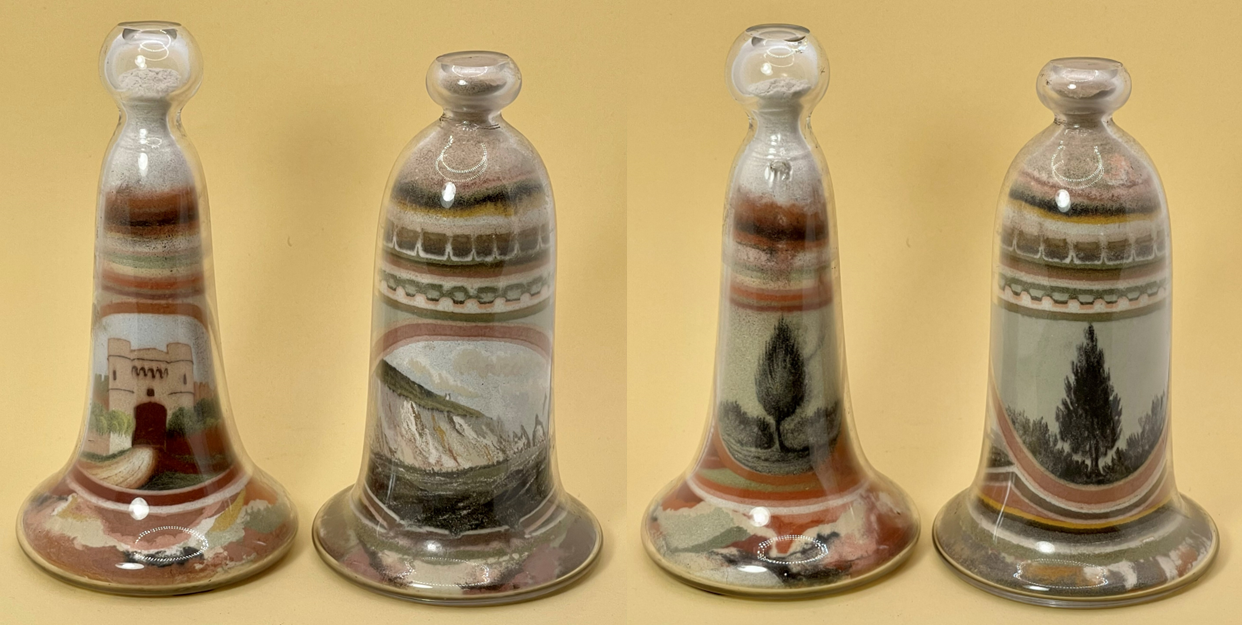
Isle of Wight sand bells discovered in Salisbury Antiques Market. To the left, the front of the sand bells depict Carisbrooke Castle and The Needles, whilst to the right are the reverse sides of both displaying the same distinctive ‘grisaille’ tree design. (© Phil James)
In the early 1980s, in a shop window in the Northam Road antiques quarter of Southampton, I spotted a beautiful glass bell filled with coloured sands forming a picture, but the shop was, typically, closed. I never had a chance to go back, yet the image stayed with me. Ten years later, during a family holiday on the Isle of Wight, we visited Alum Bay to see the cliffs made up of a range of coloured sands. In one of the local shops we bought small glass lighthouses and filled them with layers of coloured sand, though our efforts were a pale reflection of the artistic object in my memory. Then, on a visit to the museum at Blackgang Chine, we saw more antique examples of the craft and I became determined to find one of my own. Subsequently, over a period of several years, I managed to acquire a number of sand bells, each for just a few pounds. They were fairly basic, showing scenes of the Isle of Wight, including The Needles, Freshwater’s Arched Rock and Carisbrooke Castle.
A lucky discovery
In October 2022, I was in the treasure trove of Salisbury Antiques Market when I noticed two glorious sand bells, far superior to those I already had. One had a picture of Carisbrooke Castle, and the other, The Needles. On the reverse, both had a tree depicted in tones of grey – a style I later discovered is known as ‘grisaille’. A label on the underside read: ‘The natural coloured sand of Alum Bay, so arranged as to represent Carisbrooke Castle, Isle of Wight, by W. Carpenter’.
Despite the lack of a label on The Needles bell, it was obvious to me that both were by the same maker. They really are quite something, made with great skill and artistry upside down, using just compacted coloured sand – no glue, no painting. The bases have the sands arranged in a ‘marbling’ style, just like the inside boards and end papers of old books. Above that is a picture window with incredible detail; The Needles bell shows textured chalk cliffs, white crests to the waves, and realistic looking clouds in the sky. This is topped off by simple or geometric coloured bands.
My own interest in coloured sand souvenirs was reflected over a century earlier when the Isle of Wight became increasingly popular as a tourist destination. Queen Victoria moved into a completed Osborne House in 1851, whilst poets Alfred Tennyson and John Keats also established homes on the island, and other famous visitors included Charles Darwin, Charles Dickens and Lewis Carroll. Substantial villas and hotels were built in towns such as Ventnor, Ryde and Shanklin to house an increasing influx of wealthy visitors who were keen to buy souvenirs.
An investigation begins
When I searched the internet in preparation for a presentation on ‘The Art of Sand’ for the Southampton Mineral & Fossil Society (of which I have been a member for over 46 years), I found hundreds of examples of Isle of Wight sand bells, amongst which were a few clearly made by W. Carpenter. Some of these Carpenter bells were plainly identified by a label, but all had that distinctive grisaille fir tree on the reverse. However, very little seemed to be known about this highly skillful artist and I was determined to find out more.
By searching through records on Ancestry (ancestry.co.uk), I pieced together the life of a William Carpenter who first appeared in Southampton, then moved to the Isle of Wight some time between 1844 and 1851. In Southampton, his business is recorded as the ‘Southampton Repository of Arts’ in the High Street, but is also noted as a bookseller.
In further searches, I soon came across a coloured engraving of Alum Bay. Drawn by W. Carpenter and published by ‘Carpenter, Repository of Arts, Southampton’, the caption reads: ‘In this sublime scene, the vertical strata of many colored sands, the stupendous chalk cliff with its towering lighthouse, and the far famed huge rocks rising boldly out of the sea complete the climax in the charming series of views that increasingly delight the visitor of Vectian Scenery’.
It was pointed out to me that there was a London-based artist called William Carpenter who produced a fine portfolio of work in both oils and watercolour based on travels in Egypt and India; although contemporary with ‘our’ Carpenter, his work was completely different in style. That they were two different people was confirmed when I found six more W. Carpenter engravings, produced around the early 1840s, all showing views and events in the lower part of Southampton near to the location of the Repository of Arts. I then discovered two further views of the Isle of Wight by W. Carpenter, one of Bonchurch, and another of Carisbrooke Castle, which had details strikingly similar to those on the sand bell; both prints were labelled Repository of Arts, Southampton.
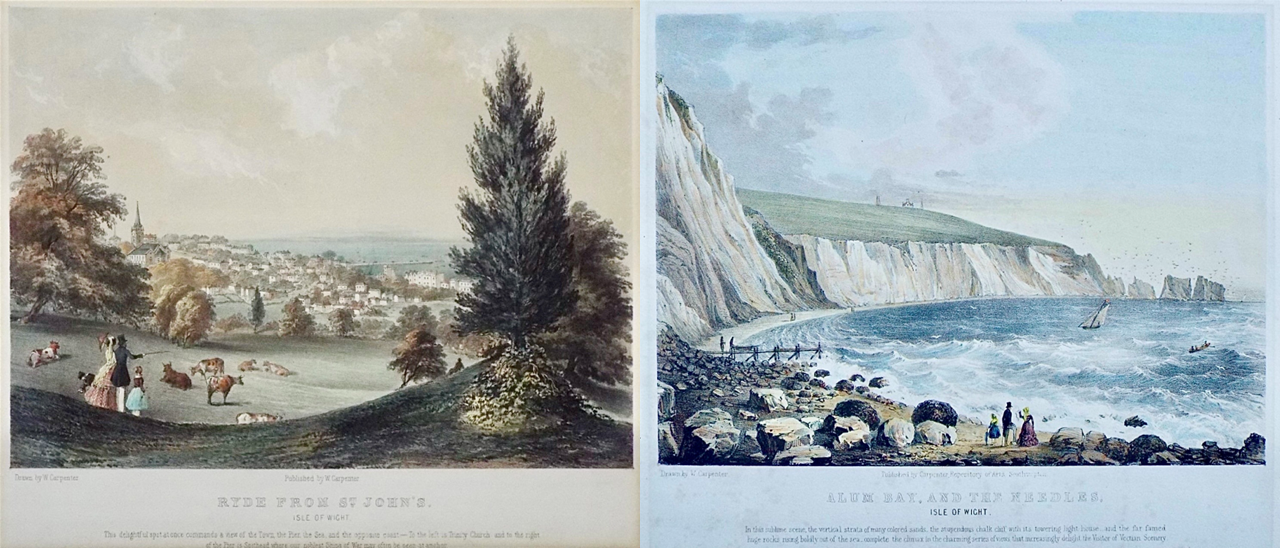
Lithographs of Ryde and Alum Bay by W. Carpenter.
Then, finally, the ‘eureka’ print appeared! While speaking to fellow History of Geology Group member Martin Simpson – who has himself had a lifetime interest in sand bells – he sent across a portion of a print depicting Ryde, likely dated just after 1846, the year Trinity Church in the view was completed. Just look at the fir tree in the foreground on the right hand side; it almost looks out of place, but it is the very tree that is in Carpenter’s sand bells! Like the others, it was drawn and published by W. Carpenter but now there was no mention of the Repository of Arts.
Turning back to Ancestry, I found the 1851 Census shows a W. Carpenter, an artist and stationer, at 52 High Street, West Cowes, together with four of his children, aged 14 to 22, shown as ‘Father’s Assistant’. Also, although barely legible, a cousin is listed as an ‘Assistant in Plastic Art’ (anything that could be moulded). Could this have indicated an involvement with the making of sand bells, and if so, in what capacity? 52 High Street is still a shop today. By 1859, Carpenter moved to Ventnor High Street where he is shown as ‘Artist’ on the 1861 Census. Again, the premises are still a shop today. By 1871 he had moved back to West Cowes and had become a schoolmaster.
So, all this evidence, whilst not 100% proven, does point to William Carpenter the artist, being the same W. Carpenter who produced the beautiful sand bells. The fact that he was an accomplished artist confirms to me that he had the skill to create sand bells that were so much better than those of other makers. The dates of his art, the periods when he was in West Cowes and Ventnor, all tie in with the times when the sand bells were made. Returning to the label on my Carpenter ‘Carisbrooke’ sand bell, the previously elusive mention of ‘Sold at W C’ on the base is almost certainly West Cowes.
Global appeal
During my research, I also came across a video of the American version of the Antiques Roadshow from Cincinnati, Ohio. Broadcast on 21 July 2012, it featured a huge and incredible Isle of Wight sand bell, nearly 18 inches (45 cm) tall, which must surely have been an exhibition piece.
The presenter did not mention a maker, but I thought at once that it was almost certainly by W. Carpenter: similar marbled base and use of ‘grisaille’ style, though this time featuring Shanklin Chine. But then I had another ‘eureka’ moment. Just compare the Alum Bay/Needles sand image with the Carpenter engraving — it’s the same boat in the bay and the cliff profile at the end of the Alum Bay rocks is identical!
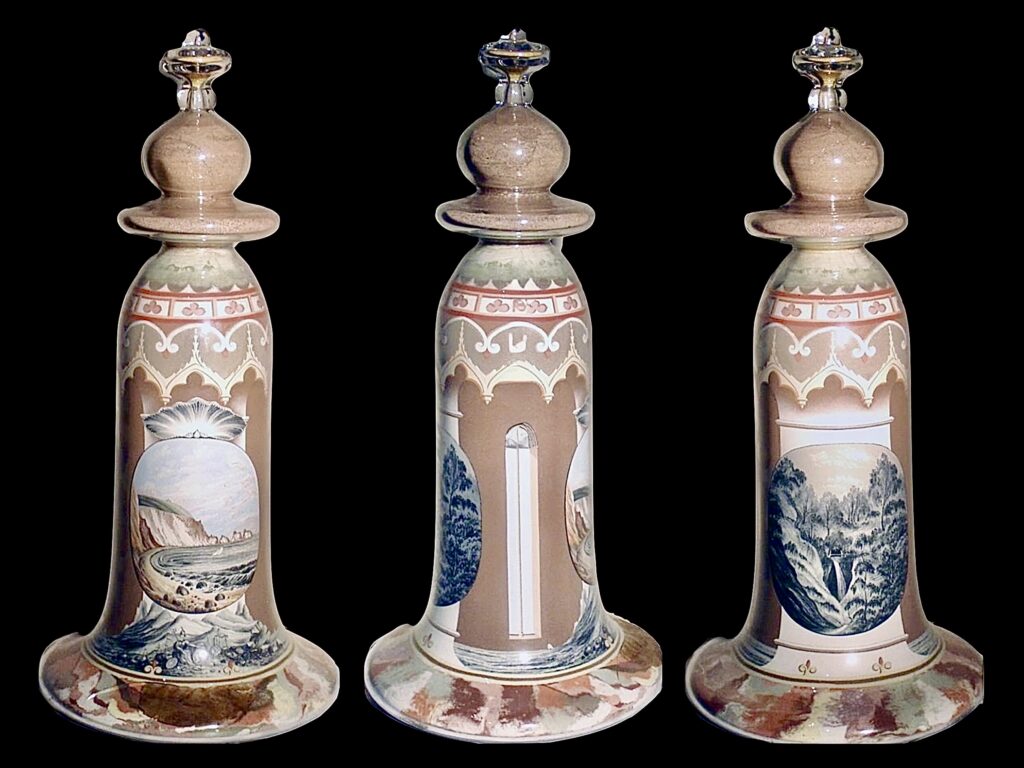
Another Isle of Wight sand bell likely produced by W. Carpenter, which appeared on American television. The view of Alum Bay in the bell bears a striking resemblance to Carpenter’s Alum Bay lithograph. (© Roy Sucholeiki/Phil James)
Isle of Wight geology in brief
The island’s geology provided Carpenter with raw materials, and for that we have the Alpine orogeny to thank. Without Africa colliding with Europe over millions of years, forming the Alps and creating a ripple reaching 1,000 miles to the north, the Isle of Wight would not be as it is today. An anticline was formed through the island from west to east; the southern facing dip side now has Cretaceous rocks at the surface, whilst the scarp consists of younger Tertiary strata, and the northern half of the island is covered with still younger beds. As a result, the strata exposed in Alum Bay to the west are now vertical, with over 1000 feet (305 m) of beds, 42 to 56 million years old.
One of the earliest geological maps of the Isle of Wight is by Thomas Webster (1772-1844) in the magnificent 1816 work by Sir Henry C Englefield (1752-1822) entitled A Description of the Principal Picturesque Beauties, Antiquities, and Geological Phenomena of the Isle of Wight. Webster made a significant contribution with a series of 12 geological letters (chapters) making up well over half of the book, plus 36 of the 50 plates, including an important detailed geological map dated to 1815, the same year as William Smith’s map.
Englefield and Webster both give descriptions of the coloured sands as: ‘The tints of these cliffs are so bright and varied, that they have not the appearance of anything natural. Deep purplish red, dusky blue, bright ochreous yellow, grey nearly approaching to white, and absolute black, succeed each other, as sharply defined as the stripes in silk’, and ‘The number and variety of these vertical layers is quite endless, and I can compare them to nothing better than the stripes on the leaves (? flowers) of a tulip.’ It is now generally accepted that there are no fewer than 21 different colors produced through the influence of various iron minerals and carbon, perfect inspiration indeed for Carpenter’s artistic endeavours.
The original version of this article was published in GeoHistories, the magazine of the History of Geology Group (HOGG), affiliated to the Geological Society of London.
Author
Phil James
Member of the History of Geology Group; former Chairman of the Southampton Mineral and Fossil Society
Further reading
- James, P. (2023) Isle of Wight Sand Bells and the mysterious Mr Carpenter. GeoHistories 75, 25-27


