From anatomy to deep time
Nearly a century apart, two physicians trained at the same Dutch university helped lay the foundations of a new science. Jan de Coo explores how Leiden University’s revolutionary scientific climate shaped the thinking of geology’s earliest pioneers.

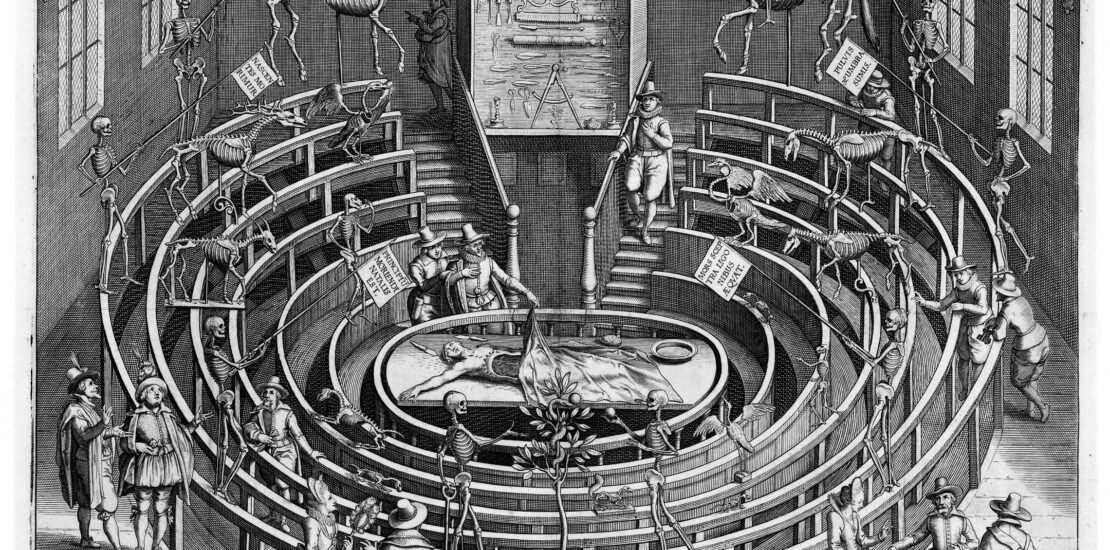
The anatomical theatre of Leiden University, Netherlands, in the early 17th century. Engraving by Willem Swanenburgh, drawing by Jan Cornelisz. (Credit: Willem Isaacsz Swanenburg, Public domain, via Wikimedia Commons)
Walk through the old centre of Leiden, Netherlands, a city whose anatomy theatres and botanical gardens once drew students from Copenhagen to Edinburgh, and you will find a university older than the United States. Among these students were two men who would never meet, separated by a hundred years, yet bound by a shared education that would quietly shape the way humanity reads the Earth itself.
Niels Stensen, also known to geologists as Nicolaus Steno, matriculated at Leiden in 1660. James Hutton arrived in 1749. Both came to study medicine. Both developed habits of observation that later revolutionised the study of rocks, strata, and time. Their stories are not just biographical curiosities: they reveal how a distinctive medical culture at a Dutch university seeded the empirical foundations of modern geology.
Leiden against the grain
In the seventeenth and eighteenth centuries, many of Europe’s great universities, such as Oxford in the UK and the Sorbonne in France, still largely taught from the authority of ancient texts. Leiden chose a different path. Empirical observation, hands-on dissection, and bedside teaching were placed at the heart of its medical curriculum. Where others trusted Galen and Aristotle, Leiden asked its students to trust their own eyes.
Leiden chose a different path
Two teachers embodied this spirit. Franciscus Sylvius, the Latinised name of François de le Boë, institutionalised bedside teaching in the 1660s, taking students daily to the St Caecilia Hospital to observe living patients and later dissect the dead. Herman Boerhaave, a century later, unified chemistry, physics, and medicine into a single mechanistic framework, teaching that the body was a system of processes governed by physical law.
This was the intellectual air Stensen and Hutton breathed. Neither came to Leiden to study geology. The discipline had not yet been established. But both left carrying a method: the conviction that hidden structures can be revealed by careful, sequential observation of what lies visible on the surface.
Stensen: The anatomist who dissected Earth
Stensen arrived in Leiden having already discovered the parotid salivary duct, the ductus Stenonianus, in Amsterdam. Under Sylvius, he honed a skill that would prove revolutionary: the ability to read structure from form, to infer process from arrangement.
A few years later, in Florence, Italy, Stensen examined the head of a great white shark and recognised that the mysterious glossopetrae, “tongue stones” prized as curiosities for centuries, were fossilised shark teeth. An anatomist’s eye, trained on glands and muscle fibres, had identified in a stone the structure of a living organism.
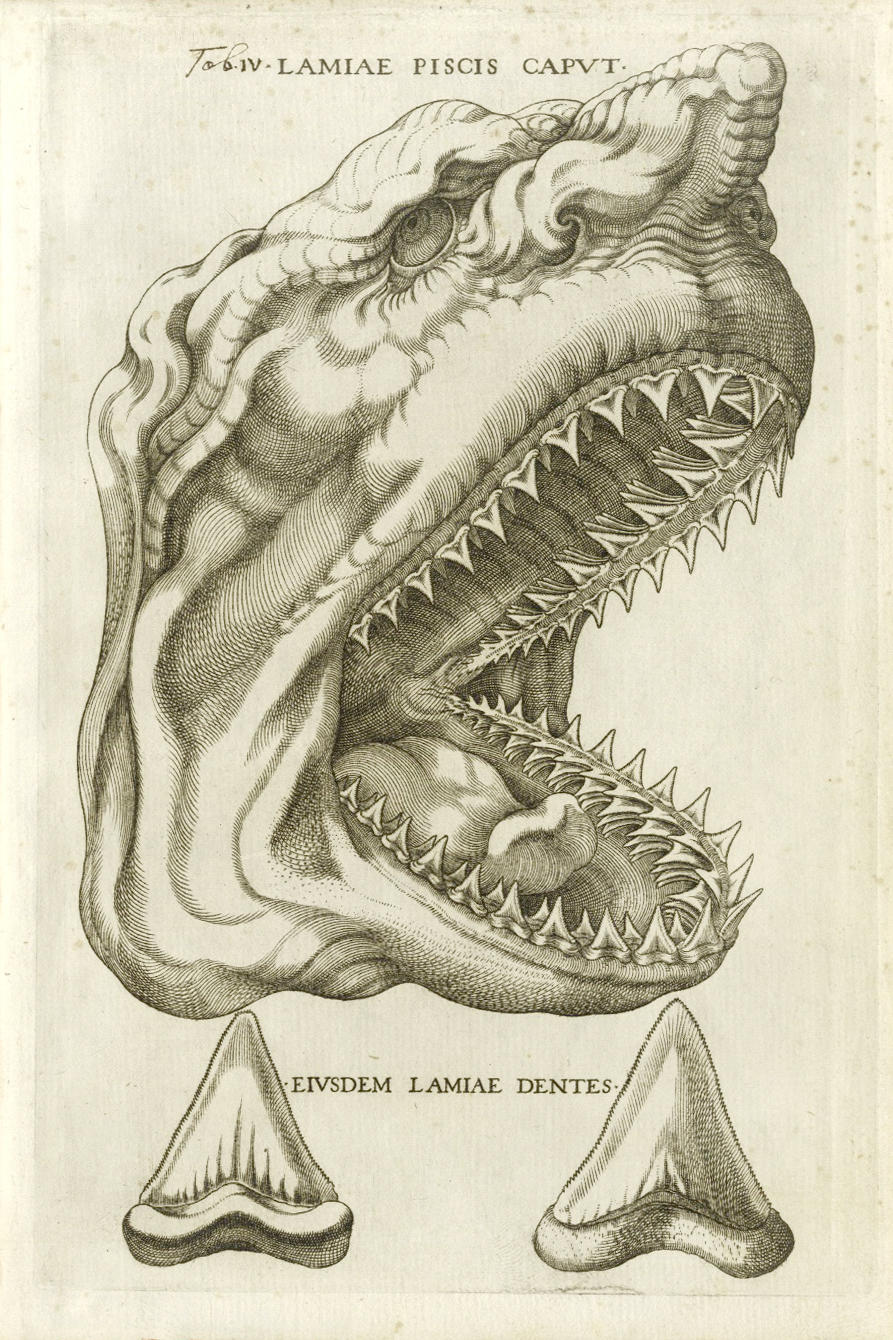
Illustration comparing the teeth of a shark head with a fossil tooth from Niels Stensen’s 1667 paper Elementorum myologiae specimen (Credit: Nicolaus Steno, Public domain, via Wikimedia Commons)
This insight cascaded. In his 1669 Prodromus, Stensen proposed three principles that still anchor stratigraphy today: superposition (younger layers lie on top of older ones), original horizontality (strata are deposited in flat or near-horizontal layers), and lateral continuity (a layer extends until it thins out or meets a barrier). Just as an anatomist reads the history of a disease in the sequence of tissue changes, Stensen argued, a geologist can read Earth’s history in the sequence of its rock layers. He had, in effect, taught geologists to treat Earth as a body to be dissected.
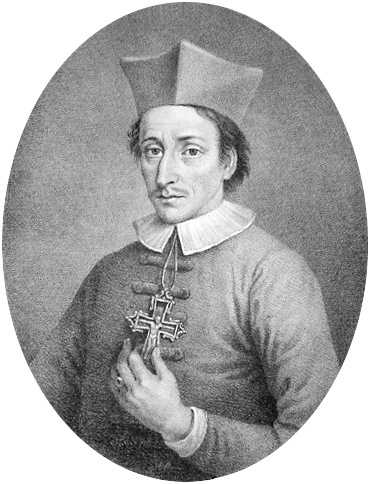
Nicolas Steno (born Niels Steensen, 1638-1686), Danish anatomist, geologist, and bishop (Credit: J. P. Trap 1868, Public domain, via Wikimedia Commons)
Hutton: The physician who found deep time
Nearly a century later, Hutton came to Leiden from Edinburgh and Paris to complete his doctorate. Although the renowned teacher Herman Boerhaave had died, his intellectual tradition endured. His work represented a chemically minded, mechanistic natural philosophy that treated circulation not as a mystery, but as hydraulics, tubes, pressure, and fluid dynamics.
Hutton applied his systemic and process-oriented thinking to the field. He observed across Scotland a dynamic Earth rather than a static one: rivers erode mountains, sediments settle on the sea floor, molten fluids intrude into preexisting strata and form new rock, and Earth’s forces uplift new land for further erosion. Earth was a self-renewing system, cycling over timescales that dwarfed anything in the biblical chronologies of his day.
His famous line, that Earth shows “no vestige of a beginning, no prospect of an end”, was not a philosopher’s flourish. It was a conclusion forced by observation: the processes he could observe and interpret on Scottish coastlines, repeated endlessly, demanded a past far deeper in time than anyone had dared imagine.
While Stensen read the Earth almost as an anatomist reads a body, Hutton conceived it as a dynamic system of processes. The shift from anatomy to physiology mirrored the shift from relative sequencing to deep time.
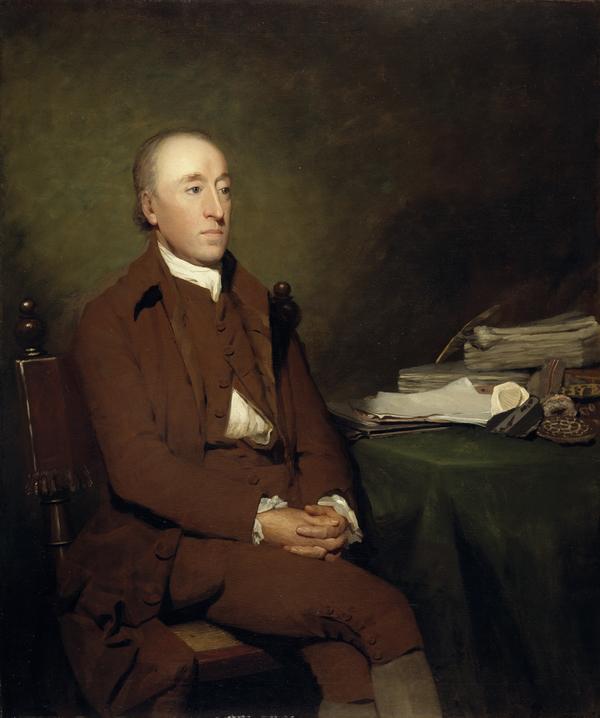
James Hutton (1726-1797), Scottish geologist, agriculturalist and physician. Portrait by Henry Raeburn, 1776. (Credit: Henry Raeburn, Public domain, via Wikimedia Commons)
The Leiden thread
Hutton is rightly called the father of deep time, but his work did not replace Stensen’s, it was built on it. Stensen demonstrated that strata represent a chronological record. Once accepted, the vast durations implied became increasingly difficult to dismiss. Both men rejected speculation unsupported by observation. Both insisted that explanations come from evidence in nature, not inherited authority. The difference between them was one of scale: Stensen established the method for reading the sequence; Hutton supplied the temporal dimension that the sequence demanded.
The connection is their medical training. Anatomical reasoning taught both to look past surface description towards underlying structure and cause. Whether dissecting a gland or a cliff face, the habit was the same: observe layer by layer, infer process from arrangement, and trust what you see over what you have been told.
This was not, it should be said, a simple transfer of medical theory into geology. Leiden did not hand Stensen or Hutton a geological doctrine. It offered a discipline of observation, a unique way of looking that each man redirected in his own way towards Earth.
An open Republic
The broader setting mattered. The Dutch Republic of the seventeenth and eighteenth centuries was a hub of scientific exchange and relative intellectual freedom. Leiden attracted students from across Europe, including Danes, Scots, Germans and Italians. It encouraged them to test existing ideas rather than simply accept them. Stensen, a Danish Lutheran who converted to Roman Catholicism, and Hutton, a Scottish Presbyterian, both held firm religious convictions throughout their lives. Neither found science and faith at war. The tolerant climate of Leiden let empirical inquiry proceed largely free of doctrinal interference.
Had either man studied at a more conservative institution, their ideas might have stayed within scholastic and scriptural bounds. At Leiden, they found both the freedom and the tools to investigate nature on its own terms.
Two physicians, one science
Neither Stensen nor Hutton ever practised medicine as a career. Stensen became a geologist and a bishop; Hutton an agriculturalist, manufacturer and gentleman scientist. Yet their medical degrees were not detours. They were the intellectual preparation from which a new science of the Earth emerged. The anatomy theatre and bedside ward instilled in them a clinical perspective. They viewed rocks and fossils as evidence to be studied independently rather than tested against scripture.
the concept of deep time, perhaps the most expansive idea in the Earth sciences, was nurtured in an institution organised around the small, tangible scale of the human body
It is a fitting irony that the concept of deep time, perhaps the most expansive idea in the Earth sciences, was nurtured in an institution organised around the small, tangible scale of the human body. Understanding Earth’s vast history turned out to require exactly the kind of careful, layer-by-layer analysis that Leiden’s students practised on the body itself.
Today, geologists still read the Earth as a chronological record shaped by ongoing processes of destruction and renewal. This second-nature approach originates from techniques of observation developed in the medical teaching of a Dutch university over three and a half centuries ago.
Author
Jan C.M. de Coo
Independent scholar and board member of the Leiden Geological Society, based in The Netherlands
Further reading
- Castel-Branco, N. (2025) The Traveling Anatomist: Nicolaus Steno and the Intersection of Disciplines in Early Modern Science. University of Chicago Press, Chicago.
- Cutler, A. (2003) The Seashell on the Mountaintop: A Story of Science, Sainthood, and the Humble Genius Who Discovered a New History of the Earth. Dutton, New York.
- Dean, D.R. (1992) James Hutton and the History of Geology. Cornell University Press, Ithaca, New York.
- de Coo, J.C.M. & Hogendoorn, P.C.W. (2025) The impact of Leiden-educated Niels Stensen (Nicolas Steno) on the advancement of medical knowledge and practices. Journal of Medical Biography 33(4), 355-363; org/10.1177/09677720251376127
- Gould, S. J. (1987) Time’s Arrow, Time’s Cycle: Myth and Metaphor in the Discovery of Geological Time. Harvard University Press, Cambridge, MA.
- Repcheck, J. (2003) The Man Who Found Time: James Hutton and the Discovery of Earth’s Antiquity. Perseus Publishing, Cambridge, MA.