Unearthing identities
Dear Editors,
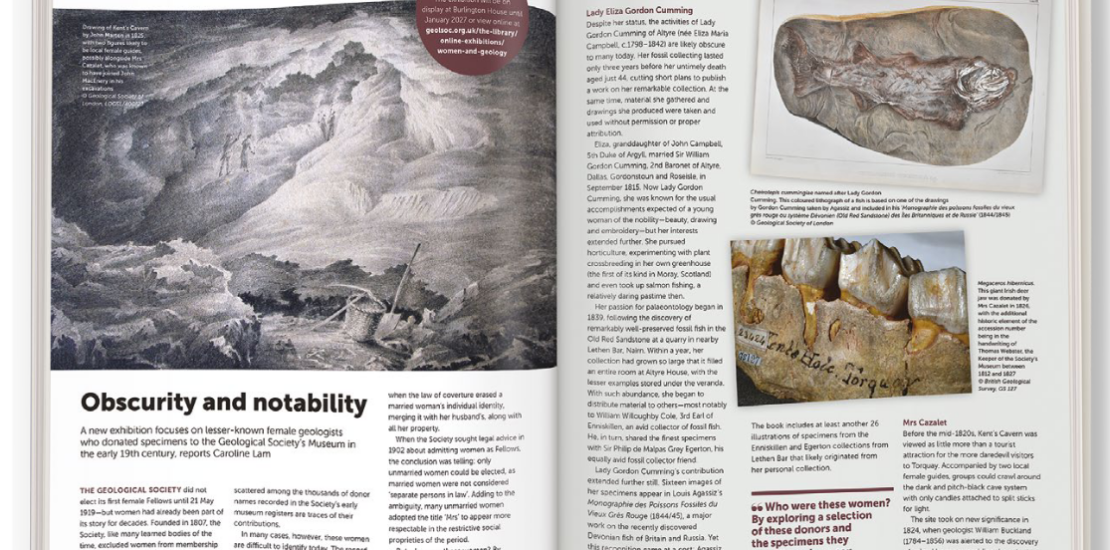
Having read with interest the article Obscurity and notability (Geoscientist 36 (2), 10–12, 2026), I decided to investigate the identities of some of the women who donated specimens to the Geological Society Museum during the nineteenth century.
Miss Lonsdale
The article suggests a possible familial connection between Miss Lonsdale and the geologist William Lonsdale (1794–1871).
William was the son of William and Mary Lonsdale. Mary is listed as living at Batheaston, Somerset, under the heading Nobility, Gentry and Clergy in Pigot & Co’s National and Commercial Directory, 1830 (Facsimile edition, 1993). She died in 1832, aged 74. Her will was proved in the Prerogative Court of Canterbury on 16 July the same year. Already being well provided for, she left her sons Charles, James and William only £10 each. She bequeathed the remainder of her personal estate and property to her unmarried daughters, Mary and Jane. The sisters were still living at Batheaston at the time of the 1841 census.
Interestingly, in 1844 Mary is credited as having donated a collection of Greek Essays to the Bodleian Library, Oxford, the calligraphy and illustrations of which are thought to be her own work. I wonder whether Mary’s sister, Jane, contributed to that work. Jane died that year and, according to her will (proved at the Prerogative Court of Canterbury on 23 July 1844), Mary was her sole beneficiary.
I favour Mary as the collector of the fossil mollusc collected in 1841
Mary had a keen interest in the natural world and a curious mind. The Phytologist (1844) records Mary finding Equisetum sylvaticum (wood horsetail). The source for that claim appears to be Charles Cardale Babington (1808–1895), author of the book Flora Bathonensis and a Fellow of the Royal Society, Geological Society of London, and Linnean Society of London. Presumably Mary and Charles knew each other. The book Flora of Somerset (1896, p. 87) also credits Mary with finding Onobrychis viciifolia (sainfoin) in a lane leading from Bathford to Farleigh Down.
Botany is not palaeontology, but Mary could have received encouragement to collect fossils from Charles Babington and her brother, the geologist William Lonsdale. Excavation of the landscape near Mary’s home to build the Great Western railway would also have afforded excellent opportunity for fossil collecting—as it did for Mr and Mrs Lowe in Wiltshire.
And so, I favour Mary as the collector of the fossil mollusc collected in 1841 and illustrated in the article Obscurity and notability. Mary died on 5 March 1854 and now sleeps at Bathford. Her sole beneficiary was William.
Mrs Lowe
The identity of Mrs Lowe of Chippenham had also been lost in the shadows of time, but I believe I have established her identity.
Elizabeth Mary Coombs was born at Chippenham, Wiltshire, in 1794, and baptised on 10 January 1795. She was the only daughter of James Morris Coombs, a bookseller and printer, and his wife, Elizabeth. Her father died in 1820.
On 16 August that year, Elizabeth Mary married Josiah Graham Lowe at St Andrews, Chippenham. Josiah, the son of Joseph Lowe, a weaver of Goldsmith Street, Cheapside, London, entered the same occupation as his father; he became a silk manufacturer trading under the name J G Lowe & Co. As the business was based in London, it is likely Elizabeth Mary and Josiah both lived at Goldsmith Street.
By the mid-1830s, however, the couple were residing in Chippenham High Street, with Josiah serving as Mayor of Chippenham in 1845–1846. Construction of the Great Western Railway exposed fresh ground, affording opportunities to search for fossils. In 1842, Josiah “donated a collection of fossils from Wiltshire” to the Wisbech Museum in Cambridgeshire (Cambridge Chronicle and Journal, 7 May 1842) and in 1847, he donated “270 Specimens of fossils from the Bradford clay, compressed Oxford clay, Cornbrash, chalk, and Kelloway’s Rock of Wiltshire” to the Leeds Philosophical and Literary Society (The Leeds Intelligencer, 11 December 1847).
Josiah was a director of the Agriculturist Insurance Company. Following a company audit in 1849 that found his travelling expenses to be in excess of £67, it was agreed that he should reside in London. The 1851 census records Josiah and Elizabeth Mary as living in Kensington.
Mrs Lowe is no longer simply a surname prefixed by her marital status
A few years later Josiah and Elizabeth both received thanks from Thomas Wright of the Palaeontological Society: “… to J Graham Lowe, Kensington Park, for the gift of Pygaster umbrella, Lamk., from the Coral Rag; and to Mrs Lowe for the gift of the rare Asterostoma excentricum, Agass”. (Monograph on the British Fossil Echinodermata of the Oolitic Formations, Palaeontological Society, vol 1, 1857–1878). Josiah appears to have been the principal fossil collector, but Elizabeth Mary shared his interest and donated specimens in her own right.
Josiah died in Pimlico in 1864, aged 74, and was buried at the West of London and Westminster Cemetery. Elizabeth Mary lived another nine years, dying in her native Chippenham on 29 December 1873, aged 79.
Mrs Lowe is no longer simply a surname prefixed by her marital status. Her identity has risen from the shadows; the memory of Elizabeth Mary Lowe (1794–1873) lives on in the fossil collection.
David C Rayment FRSA FLS
Local history author with training in natural and contemporary sciences, and mathematics and computing, UK
Further reading
- Farmer, C. (2026) A case of mistaken identity. Geoscientist 36 (4), 14
- Lam, C. (2026) Obscurity and notability. Geoscientist 36 (2), 10-12
- Rayment, D.C. (2026) The lady of Kent’s Cavern. Geoscientist 36 (3), 22-23