Earth twin needs geoscience
As society turns to Earth Digital Twins for decision-making, geoscience must play a defining role, urges Pankaj Mishra
© Getty
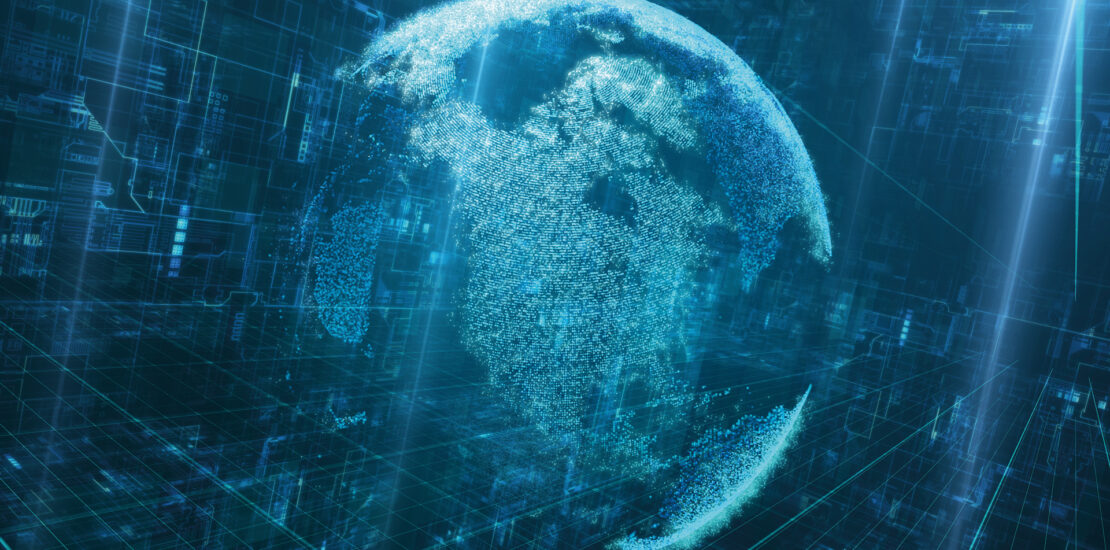
A digital twin is a live, virtual version of something real. It updates as new data arrive and lets us test “what if?” questions, exploring the consequences of choices before they are made. An Earth Digital Twin (EDT) applies this idea to our planet: a virtual, data-driven replica of Earth’s physical systems that helps us model and test scenarios, thereby enabling better decision-making across science, industry, and policy.
Geoscientists have been making digital Earths for decades. From outcrop to deep crust, we have mapped and modelled the lithosphere, integrating observations with numerical models to explain and predict behaviour. These efforts support decisions on natural resources, infrastructure, and hazards. They are exactly the kind of knowledge Earth Twin initiatives now claim to need. So why are geoscientists not at the centre of the conversation?
Segmented approach
Building a single twin of the whole planet that includes everything and serves every purpose is nearly impossible. Instead, modular efforts are under way for climate, atmosphere, and water, including DestinE in Europe and Earth-2, which is being built by NVIDIA in the USA. As a solid Earth geophysicist, I find these projects inspiring but frustrating. Geology and geophysics are barely visible in them, and national surveys are often absent, even where their data and expertise would be decisive.
A digital twin of the lithosphere would not compete with these efforts, it would complete them. Built from geoscientific observations, physics, and machine learning, it could evolve independently while staying interoperable (Mishra, 2025), so that advances in one domain immediately benefit the others. This is urgent because society’s choices increasingly depend on the ground beneath us: critical minerals, geothermal energy, groundwater, safe CO₂ storage, stable transport routes, and even space-weather risks to power grids—all rely on accurate and credible subsurface knowledge.
no credible path to net zero or resilient infrastructure can bypass the subsurface, which silently supports everything built above it.
At the same time, geoscience is shrinking in universities. In the Netherlands, Vrije Universiteit Amsterdam plans to close its Earth Sciences department (vu.nl). In Australia, closures and mergers have been widely reported (timeshighereducation.com; Nat Rev Earth Environ 2, 2021). When budgets tighten, subjects out of sight are first to go. It’s possible that many decision-makers still see geoscience as optional. The reality is that no credible path to net zero or resilient infrastructure can bypass the subsurface, which silently supports everything built above it.
Amplify geoscience
We need sharper, louder science communication by geoscientists highlighting the societal importance of our research at every opportunity we get. Geoscientists should follow EDT developments closely, share our insights more widely, and ensure that the lithosphere has a central place in these global initiatives. The future credibility of Earth Twins depends on it.
Dr Pankaj K Mishra
Senior Scientist at the Geological Survey of Finland (GTK), Finland
Further reading
- Davies, R. & Jacob, D. (2025) Earth science is critical to national resilience – so why is it being gutted?; timeshighereducation.com/opinion/earth-science-critical-national-resilience-so-why-it-being-gutted
- Editorial (2021) Geoscience on the chopping block. Nat Rev Earth Environ 2, 587; https://doi.org/10.1038/s43017-021-00216-1
- EU Publications Office (2025) Destination Earth and Horizon Europe research infrastructures. Projects cluster meeting : meeting report and key messages for policy consideration : Brussels, 2 April 2025; https://op.europa.eu/en/publication-detail/-/publication/d0156b9b-6db8-11f0-bf4e-01aa75ed71a1/language-en
- Mishra, P.K. (2025) Lithosphere in digital twins of the Earth, Geophysical Journal International 242 (2), ggaf199; https://doi.org/10.1093/gji/ggaf199
- NASA Earth Science Technology Office (2022) Advanced Information Systems Technology (AIST)Earth Systems Digital Twin (ESDT)Workshop Report; https://esto.nasa.gov/files/ESDT_Workshop_Report.pdf
- Rao, Y. et al. (2023) Developing Digital Twins for Earth Systems: Purpose, Requisites, and Benefits. ArXiv (Pre-print); https://doi.org/10.48550/arXiv.2306.11175
- VU News (2025) Proposed plan for the reorganisation of the Department of Earth Sciences; https://vu.nl/en/news/2025/proposed-plan-for-the-reorganisation-of-the-department-of-earth-sciences
Citation: Mishra, P. Earth twin needs geoscience. Geoscientist 35 (4), 12, 2025. DOI: 10.1144/geosci2025-030