“Ég kem heim til Eyja”
“Coming home to the Islands”. Rhian Meara reflects on her journey from geochemistry to social science research via the island of Heimaey, Iceland.

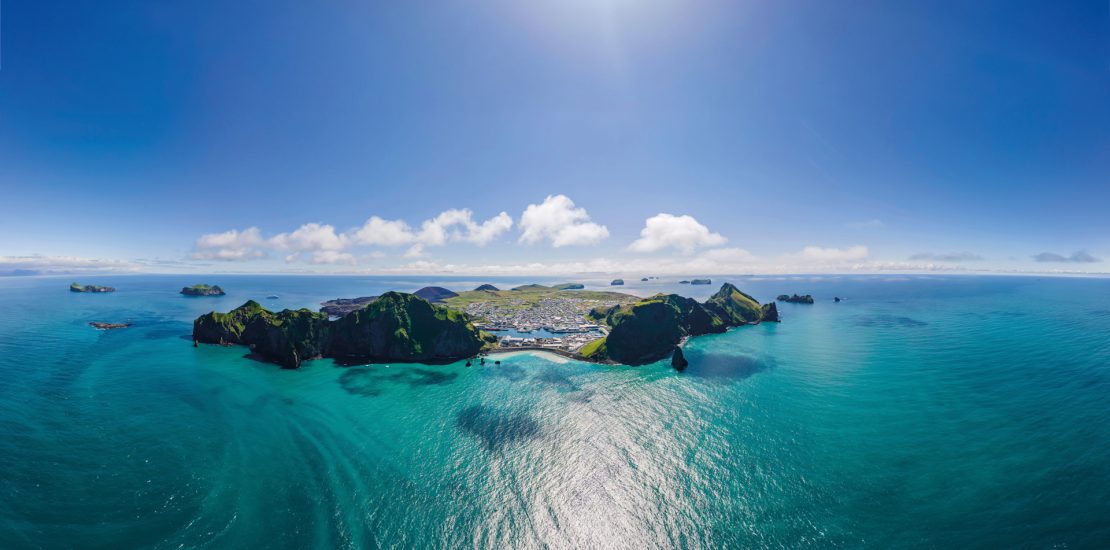
Heimaey Island, part of the Vestmannaeyjar archipelago off the south coast of Iceland (photograph taken looking south). (© Alamy)
As part of a recce for an undergraduate field trip in 2019, my colleagues and I visited the island of Heimaey, accessible by a forty-minute ferry ride from Landeyjahöfn, on the south coast of Iceland. The island is famous for the Eldfell Volcano, which erupted in 1973 with an unexpected fissure eruption triggering the evacuation of 4,500 residents by fishing boat to the mainland. We joined the ‘volcano and puffin’ bus tour, visited the Eldheimar Museum in the town of Vestmannaeyjabær and walked across lavas, excitedly discussing ways to develop the trip for our undergraduates.

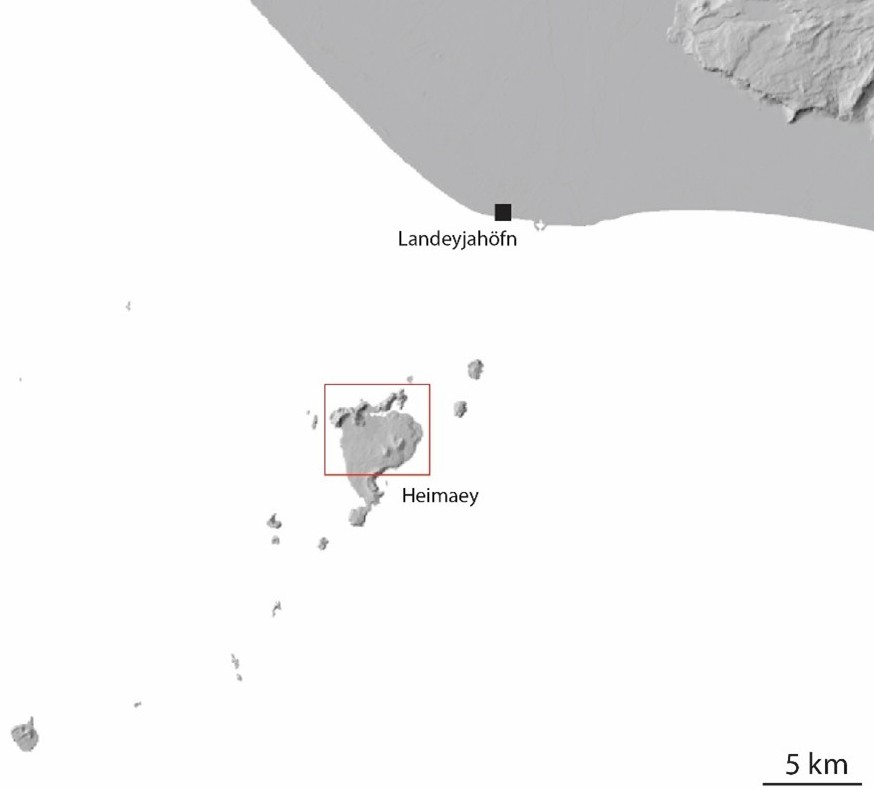

Northern Heimaey showing the Helgafell and Eldfell volcanic cones to the south and the mountains Ystiklettur, Miðklettur and Heimaklettur to the north. Map adapted from Landmælingar Íslands (www.lmi.is/is)
Although our field trip plans were delayed by the global Covid-19 lockdown of 2020 and my time spent on maternity leave following the birth of my second daughter, that six-hour trip to Heimaey planted a seed in my brain. And so began my journey from geochemist to social scientist.
The Before Times
Before my trip to Heimaey, I was a SCIENTIST and a VOLCANOLOGIST. My PhD research on the geochemistry of Iceland’s volcanic ash layers required extensive fieldwork in the Icelandic highlands and frequent travel to present my results at international conferences. I was living the dream! Except I wasn’t. I was struggling with my mental health, sense of self and confidence, so after a short post-doc looking at volcanic ash layers in Greenlandic ice cores, I stepped away from research to focus on teaching.
Maternity leave following the birth of my first daughter in 2017 gave me a chance to focus on my mental health and reassess my priorities. I returned to work with fire in my belly, determined to finish and publish my research. And with the support one very helpful colleague, I did just that. This was huge. I was a SCIENTIST again. I was a VOLCANOLOGIST again.
I was a VOLCANOLOGIST again
You might be wondering why I keep shouting the words “scientist” and “volcanologist” at you. Good question. I think it’s to highlight how ingrained my academic identity has been to my personal understanding of self. I am a scientist. I’m a geologist. I’m a volcanologist. Yet something still wasn’t right. I had no inspiration for new research projects and no collaborators to develop ideas with.
Magmatic memories
The photos I’d taken during my trip to Heimaey showed memorials to the 1973 Eldfell eruption, and to the area lost beneath the lavas. I wanted to learn more about the island and the eruption, so read everything I could find. There wasn’t much; a handful of geological and geochemical investigations from the 1970s and 2000s, and two more recent sociological analyses.
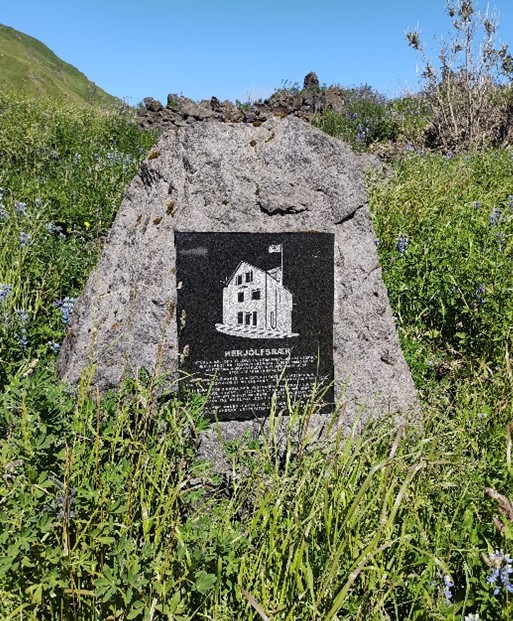
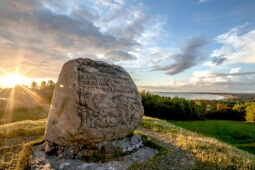
Memorial to the building Herjólfsbær, lost under 15 m of lava on the 27th of March 1973. (Photograph by Rh. H. Meara)
In the 2020 article “Landscapes of Trauma”, Sigurjón Baldur Hafsteinsson and Arnar Árnason highlight the Eldheimar Museum, the focal point of which is a house excavated from the volcanic ash. The authors note that some people with first-hand experience of the eruption were overwhelmed by the immersive nature of the displays – reactions that reflect the ongoing, long-term impact of the eruption. Something clicked while I read this paper. As volcanologists, we aim to understand every minute detail – the chemistry, mineralogy, gas content, earthquake activity, ground deformation. But you know what we don’t research? The people and communities impacted by these eruptions. From a physical science perspective, the Eldfell eruption was relatively “boring” – an effusive lava eruption, with straightforward chemistry and mineralogy, and minimal impacts on proximal environments. Yet, 50 years on, this “boring” eruption is still impacting the community!

View from the crater of Eldfell volcano with a colorful lava fields in foreground and the town and harbour of Heimaey. In January 1973 this volcano was erupted and lava destroyed half the town .
Heimaey is an Icelandic island in the Vestmannaeyjar archipelago, and the largest and most populated island off the Icelandic coast. Heimaey is 7.4 km off the south coast of Iceland.
Perhaps the residual pregnancy hormones and sleep deprivation influenced my decision making, but reading Sigurjón and Arnar’s paper changed my perspective, and I immediately contacted them to ask if they’d like to collaborate.
Be prepared
The journey from geochemist to social scientist hasn’t been straightforward, but it has been interesting! I can’t be the only person moving to an interdisciplinary position, so here I highlight some themes from my experiences that might be relevant to your own journey. Be prepared to…
… feel stupid. No, more than that. Embrace feeling stupid. It doesn’t matter how clever you are, or how many papers or books you’ve published. If you’re switching fields be prepared to ask questions, ask for help and be humble (and if people invest their time and energy into you, be thankful). I accepted my lack of knowledge and attended undergraduate lectures and practical sessions to learn new methods and skills, such as how to effectively conduct surveys and interviews. Listening to my interviews from 2022 is painful; they are clunky and basic, I’m obviously nervous and trying to prove myself. Yet interviews from 2024 are casual and friendly, while the information shared is on point and relevant.
Even basic things have left me feeling stupid. For me, Icelandic fieldwork was camping, hiking, and sample collection. Being outside for hours in the black volcanic landscape requires a field kit that is warm, dry and visible (so that you are easy to find if you need rescuing). So, for my return to Iceland, I treated myself to a new waterproof coat and trousers, fleece lined leggings, sturdy boots, and the most luminous pink fleece you’ve ever seen. I then spent a week working in the library, visiting museums, and interviewing people in their warm homes. What a plonker. At the very least, I got a reputation locally as “kónan frá Bretlandi með bleika peysuna” – the lady from Britain with the pink jumper!
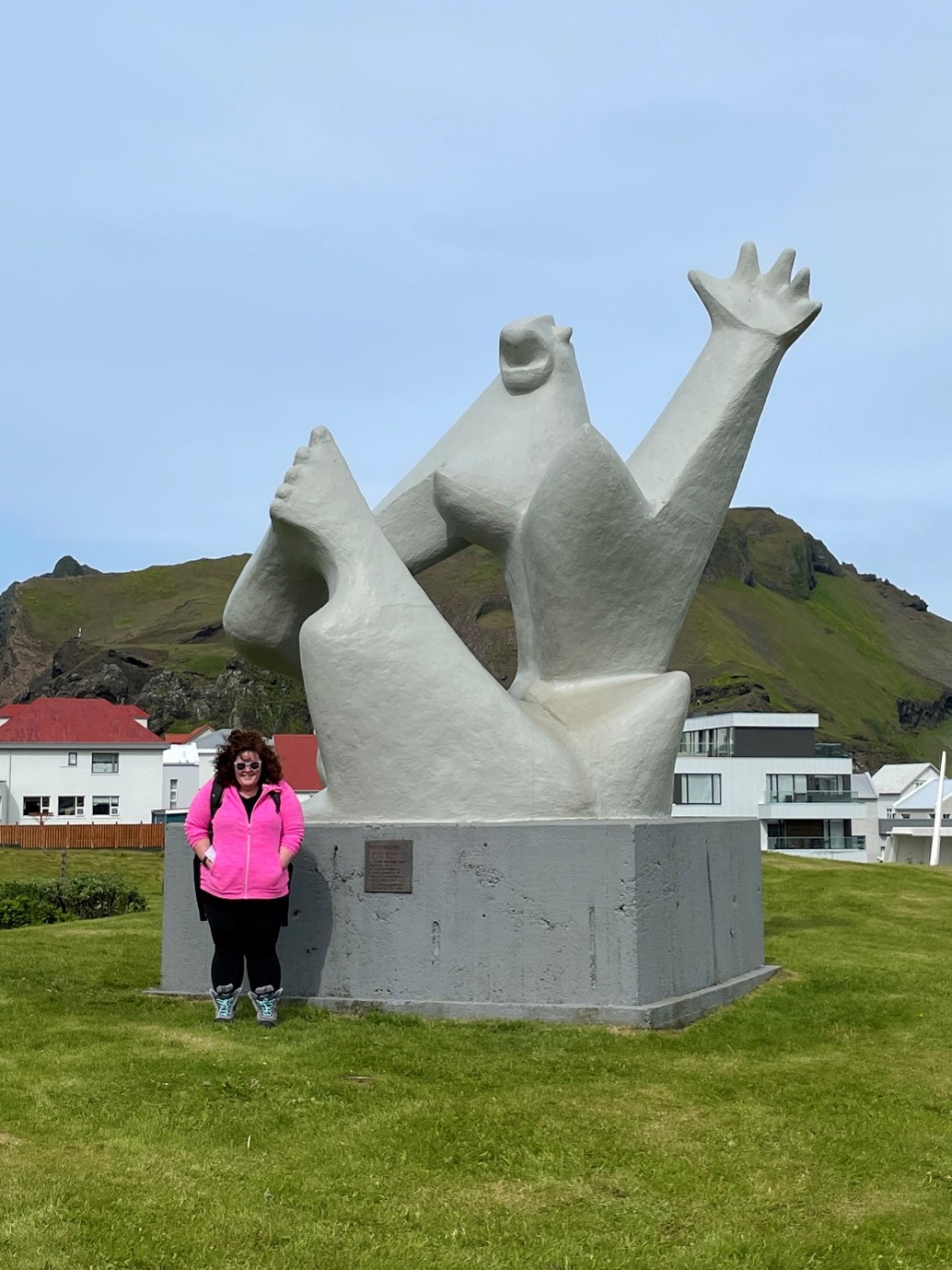
“Kónan frá Bretlandi með bleika peysuna” – The lady from Britain with the pink jumper standing with the Tröllkerlingin memorial, created by Ásmund Sveinsson in 1975 to celebrate the second anniversary of the Eldfell eruption. (Photograph by K. A. M. Wright (used with permission))
… learn the language. Even if the people you’re interacting with speak English, learning the language shows cultural understanding and respect. As an absolute minimum, learn some basic greetings and how to introduce yourself. While language courses may not be cheap, they’re a good investment. My Icelandic isn’t perfect. At best, I have the proficiency level of the policeman from the old British sitcom ‘Allo ‘Allo! I regularly confuse words like “jumper” (peysa) with “sausage” (pylsa), and I struggle in conversations that I’ve not practiced in advance. But I can introduce myself, and I can order a hot chocolate and cake in the cafe.
learning the language shows cultural understanding and respect
I have a leaflet that introduces me and my research in Icelandic, and my participant information sheets are Icelandic. While I generally hold interviews in English, participants can always answer in Icelandic (in which case a project collaborator may attend to facilitate or help with later translations from the recordings). Almost all the interviews have benefitted from my learning the language basics. If interviewees stumble on a word, I can often help with the translation, and the joy of understanding and getting the conversation back on track is wonderful.
A concept that arose repeatedly was one that epitomised people’s feelings and their need to return home following the evacuations in 1973 was that of “Heimþrá”, which translates as homesickness but means far more. In Welsh we have a similar term “Hiraeth”, which translates as a longing for home so deep that it physically hurts. We celebrated the connection of having our own words for a common shared experience and I think moments like this helped demonstrate my understanding and empathy.
… be legitimised. To the islanders, I’m an “útlendigar”, a foreigner, or an outsider. But my willingness to learn and engage with the language and culture has marked me as an inside-outsider so to speak. My inside-outsider status is supported by long-term (since 2007) working relationships with Icelanders. For example, one interviewee was visibly suspicious of me until I explained that I was collaborating with Sigurjón and Arnar – two Icelandic academics who are known and respected by the community – at which point her whole demeanour towards me changed.
I’ve used social media to reach out and establish collaborations with other locals. For example, Helga, who wrote her MSc thesis on the island’s artworks and memorials for the 1973 Eldfell eruption, and Ingibergur, who established the blog Allir í bátana, a repository of information and eye-witness accounts from the eruption. Writing papers together with well-known, respected members of the community helps legitimise me and the research. Community co-production is essential to the success of a project.

A mural of the lost district Urðavegur painted in 2003 by Guðgeir Matthíasson located on a building near the harbour. (Photograph by Rh. H. Meara)
I also use social media to identify and engage with potential interviewees. Icelanders use patronymic naming conventions and don’t change names after marriage, so it’s relatively straightforward to contact people. My social media channels now provide a digital ‘paper trail’ of who I am and who I know, helping to legitimise my connection to Heimaey Island and allowing people to vet me before they agree to meet.
… develop relationships. As a geologist, fieldwork often lasted six weeks or more. But with two small children, annual six-weekly excursions have become a hilariously improbable concept. Fieldwork now lasts two weeks per year max. I initially viewed this time constraint as a burden, but these short yet consistent trips have created a longitudinal study. Time between visits enables me to reflect, find gaps in the data, and improve my techniques, while allowing the project to evolve – I’ve developed new tangents and branches of research that wouldn’t have happened if I’d only visited Heimaey once for six weeks.
Over time, I’ve developed a reputation for being nice, engaged, linguistically competent(ish) and respectful. I’ve developed good working relationships (I’m now trusted to work alone in the archives and borrow library books despite not being a resident with a library card!), as well as more personal relationships. The hotel receptionist recognises me (and laughs when asking if I’m back again?!), I’ve watched an Iceland vs England football game at the pub with Helga, had an evening meal with a couple I’d met the year before, and was even invited to a birthday party.
I’ve developed good working relationships
I interviewed the daughter of a photographer from the 1973 eruption, having assumed that fifty years on the photographer was perhaps no longer with us. After mentioning this sensitively, the interviewee paused thoughtfully before declaring that her father had most definitely been alive that morning when she last spoke with him! She pulled out her phone, rang him and asked loudly in Icelandic “Dad! Are you still alive?? I have a British lady here who thinks you might be dead!”. Upon confirmation of his status as very much alive and well, she drove me up to his house and left us to talk!
My relationship hasn’t just developed with the islanders but with the island itself. I first visited Heimaey in 1997 as a 12-year-old volcano nerd. I didn’t come back until 2019 and have now visited every summer since 2022. This year, as the ferry sailed toward Heimaey, past the mountains to the north and Eldfell and Helgafell to the south, I noticed my heart was singing. “Ég kem heim til Eyja” translates to “I’m coming home to the Islands”, and as the boat pulled into the harbour, it felt like I’d returned to my home from home.
The After Time
Islanders discuss the history of Heimaey and the Eldfell eruption using the phrases “fyrir gos” (“before the eruption”) and “eftir gos” (“after the eruption”), because this event had such a profound impact on the island’s landscape, culture and population – impacts that are still felt today. It feels appropriate therefore to consider my own experiences in these terms. I also consider the eruption as a time marker, not in the literal sense – I was born in 1985 – but as a marker for who I was before I began researching the eruption and who I am now. While I still find myself starting conversations with “I’m a geologist by training…”, today I am proud to self-identify as a socio-volcanologist.

Heimaey, Iceland, August 27, 2020: Eldheimar museum showcasing a house which was buried by volcanic ash after the last eruption of Eldfell volcano in 1973

A wooden signpost on the lavas denoting the location of the lost street Laugarbraut. (Photograph by Rh. H. Meara)
If you’re considering a change of discipline, do it. Throw yourself in at the deep end and immerse yourself in new knowledge, ideas and people. You never know what you might learn, who you might meet, or what impact it might have both on your academic career and your life more generally.
Acknowledgements
Thank you to everyone who has supported me. Not just to my official collaborators, but also to my colleagues at Swansea University, particularly my colleague Erin Roberts, who suggested I write this article. She wisely noted that I can’t be the only person moving to an interdisciplinary position, and that others might benefit from a reflective piece about my experience of “turning to the dark side” of Human Geography and Social Sciences research.
Thanks most of all to the community of Vestmannaeyjarbaer for their support and contribution to the research undertaken on the island. Particularly to Helga, Ingibergur, Kári, Hrefna, Sigrún Inga, Sigurgeir, Marinó, Páll, Helga and Arnór for being so welcoming. Thanks also to those who have supported my academic development throughout this work, Arnar Árnason, Sigurjón Hafsteinsson, Osian Elias, Erin Roberts, Amanda Rogers, Diana Beljaars and Angharad Clos Stephens in particular. Thanks to those who read several drafts and gave constructive feedback including Kirstie Wright, Anna Clark, Sian Neilson, Jonas Rae, Gwen Awbery and Paul Meara.
Author
Dr Rhian Hedd Meara
Senior Lecturer, Geography Department, Swansea University, Wales, UK
Further reading
- Adalgeirsdottir, K. (2021). “The story of the disaster-relief houses in Iceland”. Enhancing Disaster Preparedness: From Humanitarian Architecture to Community Resilience. Edited by N. Martins, M. Fayazi, F. Kikano, and L. Hobeica. Elsevier, pages 41–58. isbn: 9780128190784.
- Arnardottir, I. 2015. “Það var bara að bjarga hlutum og hamast”. Rannsókn efnismenningar á ögurstundu. Bachelor´s Thesis. Háskola Íslands.
- Erlingsdottir, G. 2015. “Vestmannaeyjarbarnas norgesopphold 1973. Var det fornuftig å sende barn til et fremmed land like ette en traumatisk opplevelse?” Bachelor´s Thesis.
- Erlingsdottir, G. 2018. “Líf og líðan í eldgosi. Gosið á Heimaey 1973”. Master´s thesis. Haskoli Islands.
- Hafsteinsson, S. and Arnason, A. 2020. “Landscapes of Trauma: A Reflection on Wonder”. Journal of Scottish Thought 11, pages 152–175.
- Hallbergsdottir, H. 2011. “Menn, haf og hraun Saga í list og minnismerkjum á Heimaey”. Master´s thesis. Háskoli Islands.
- Helgadottir, G. 2011. “Fjolskyldur a flotta Ahrif eldgossins a Heimaey 1973 a ibua hennar”. Bachelor´s thesis. Háskolinn á Akureyri.
- Higgins, M. D. and Roberge, J. 2007. “Three magmatic components in the 1973 eruption of Eldfell volcano, Iceland: Evidence from plagioclase crystal size distribution (CSD) and geochemistry”. Journal of Volcanology and Geothermal Research 161 (3), pages 247–260. doi: 10.1016/j.jvolgeores.2006.12.002.
- Høst, E. S. 2004. “Å leve på en vulkan. Riskio og stedsidentitet på Vestmannaeyjar.” Unpublished MSc dissertation.
- Mattsson, H. and Hoskuldsson, A. 2003. “Geology of the Heimaey volcanic centre, south Iceland: early evolution of a central volcano in a propagating rift?” Journal of Volcanology and Geothermal Research 127, pages 55–71. doi: 10.1016/S0377-0273(03)00178-1.
- Meara, Rh. H., Thordarson, Th., Pearce, N. J. G., Hayward, C. and Larsen, G. 2019. A catalogue of major and trace element data for Icelandic Holocene silicic tephra layers. Journal of Quaternary Science 35(1-2): 122-142. DOI: 10.1002/jqs.3173
- Meara, Rh. H., Árnason, A., Elias, O. H., Hallbergsdóttir, H. and Hafsteinsson, S. B. 2024. Magmatic Memories: Eldfell, 1973. Volcanica 7(1): 361-403. https://doi.org/10.30909/vol.07.01.361403
- Pálsson, K. 2014. Hús-næði og hús-gæði eftir gos: Lífsgæðin í teleskóphúsunum. BA arkitektúr. Listaháskóli Íslands.
- Pyyry, N., M. Hilander, and S. Tani (2021). “Photography and photo elicitation as visual methods”. Creative methods for human geographers, pages 75–86.
- Roberts, E. 2018. “The Transient Insider”: Identity and Intimacy in Home Community Research. In: Emotion and the Researcher: Sites, Subjectivities and Relationships: 113-125. DOI:1108/S1042-319220180000016008
- Self, S., Sparks, R. S. J., Booth, B. and Walker, G. P. L. 1974. “The 1973 Heimaey Strombolian Scoria Deposit, Iceland”. Geology Magazine 111(6), pages 539–548.
Citation: Meara, R. “Ég kem heim til Eyja”. Geoscientist 35 (3), 40-44, 2025. DOI: 10.1144/geosci2025-025.