Out of the Blue
With a rare Aerinite sample set to go on display at London’s Natural History Museum, Anna Grayson gives a personal account of the sample’s backstory

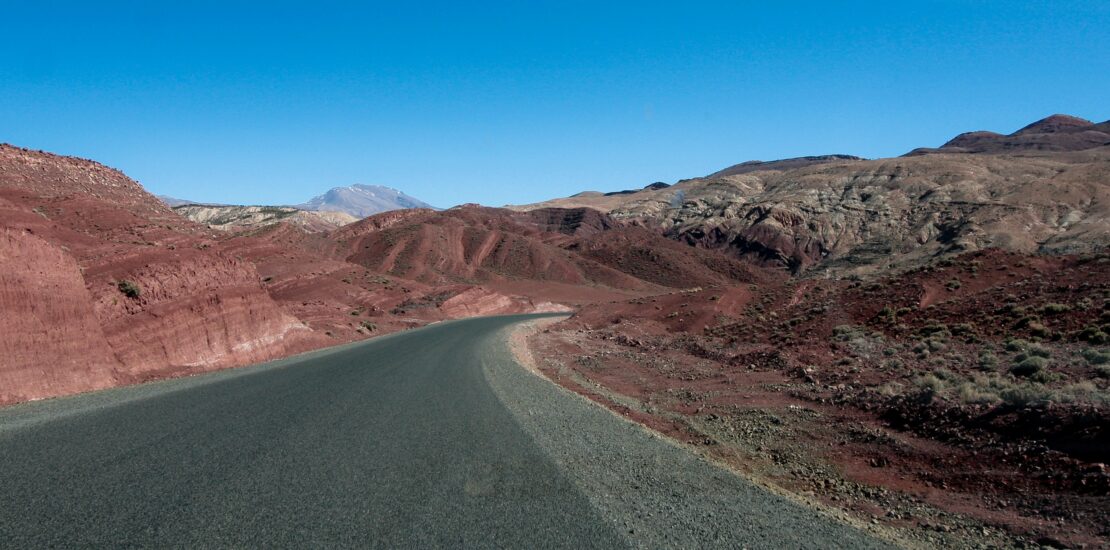
Road winding through the Atlas Mountains, Morocco (Credit: Sosinda via Pixabay)
“Can we stop the car for some fresh air please?”
I was beginning to suspect I might be pregnant… My husband, Des Clark, pulled in by the next roadside stall selling minerals. We were on a road south of Fez on the way to the Eastern pass over the Atlas Mountains. It was August 1980, and we’d driven though France and Spain and taken the ferry to Ceuta and thence into Morocco in a Renault Five. It was a geological holiday, and we were hoping to collect a few interesting minerals and fossils.
My nausea ceased as soon as I saw the spread of minerals on the stall. This was a good one. Des made a beeline for an impressive museum-quality chunk with flattish square yellow crystals – Wulfenite, one of his favourite minerals. I went straight for a bright, opaque lump of blue, very definitely an unusual blue, like the artists’ colour Prussian Blue.
“Qu’est que c’est, Monsieur?”
“C’est Lapis, Madame.”
“Ce n’est pas Lapis!” was my immediate thought. It was the wrong shade of blue and has shears and slickensides polished and scratched from movement along a fault.
I asked where the mineral was from.
“Dans les Montagnes, Madame.”
Realising I wasn’t going to get any further information from the seller, we bartered and agreed on a good price (Des, too, negotiated a good deal on his Wulfenite). With our new specimens safely stashed in the car, we proceeded over the Atlas Mountains. The pregnancy was more than just a suspicion, and the desert heat and growing nausea distracted me from my lovely new mineral.
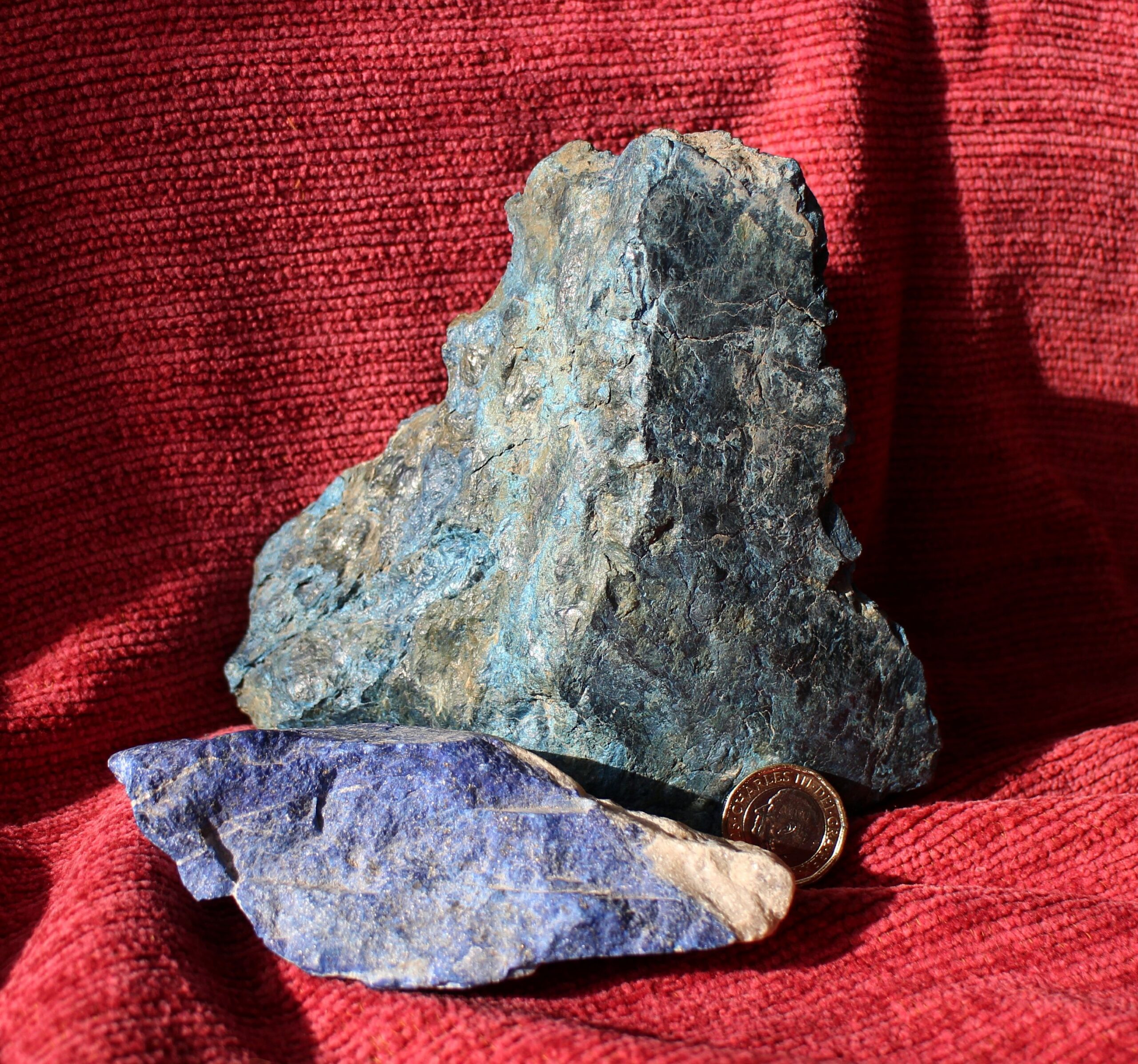
The unusually large sample of Aerinite (top) discovered by Anna in 1980 at a road-side mineral stall in Morocco next to a sample of Lapis (bottom). Aerinite is more of a “Prussian” blue, Lapis a true ultramarine blue (© Anna Grayson)
Unravelling the mystery
In 1986, when my son was five years old and now had a younger brother, I was doing freelance work for the BBC. I embarked on my first geological set of programmes, a radio series for BBC Schools, and one of my locations was the Camborne School of Mines in Cornwall. By this time, we had realised that the big blue mineral was the same as some tiny mineral fragments Des was given while doing his PhD fieldwork in Southern Morocco. I took one small fragment with me to see if the mineralogists at Camborne could shed any light on it. They suggested it could be Serpentine coloured blue by copper, but I was unconvinced – one cannot identify a mineral by colour alone.
The mineral remained a mystery until a visit to London’s Natural History Museum in 1995. I was due to present a live broadcast for Radio Five’s science programme, Chain Reaction, as part of Science Week – an initiative started in 1994 to promote the understanding of, and engagement with, science for the public that still runs today.
While setting up for the broadcast, I met Gordon Cressey, one of the museum mineralogists. We clicked immediately, and that was the start of a long friendship with both Gordon and his wife Barbara, a mineralogist at the University of Southampton. (Gordon and Barbara met in their first week as geology undergraduates at the University of Manchester. This positive spin on a “marriage on the rocks” is something that Des and I had in common with the Cresseys!)
For that second ever Science Week, Gordon set up a kind of “antiques roadshow” whereby members of the public brought in geological specimens for identification.
“We’ve not had much brought in yet though,” said Gordon. I reassured him that I would make up the shortfall myself from our own collection, the blue mineral being one of them.
The broadcast went smoothly. Afterwards a melee of mineralogists came towards me, very excited.
“Where did you get this from?”
“It’s not Serpentine.”
“We can’t identify it.”
“Is it a fake?”
That last question was a pertinent one. Morocco was well known at the time as a source of fake minerals and fossils (most being crudely done with no pernicious intent, but some more subtle and offered for sale as genuine). The Natural History Museum had its fingers burned before, a very long time ago, with the Piltdown Man, which in 1912 was accepted in good faith as the fossilised remnants of an early human, and then in 1953 – forty-one years later – exposed as a fake made up from an assortment of other bones, from both humans and orangutans.
Another reason for caution was the size of the specimen. Most newly discovered minerals are tiny specks or microscopic in size. A mineral specimen new to science that you need both hands to hold is pretty much unheard of. How could a mineral occurring in such large chunks have escaped notice? It seemed incredible.
the slickensides were echoes of rocks sliding past each other in earthquakes
I knew my mineral was not fake. How could anyone fake those slickensides? The triangular shape, with slickensides on two sides, is consistent with a conjugate shear, where cracks or faults in rocks occur in pairs at an angle similar to the Scottish Saltire. This mineral had clearly been through an episode of mountain building, and the slickensides were echoes of rocks sliding past each other in earthquakes.
A decision was made to keep the mineral in the museum for further investigation. For a year, Gordon Cressey and his team studied it, while Barbara Cressey (University of Southampton) and Angus Kirkland (University of Oxford) conducted electron microscopy analyses on it. The mineral appeared to be not only a new species, but a new “genus” – a hitherto unknown structure that fell somewhere between two known groups, Zeolites and Amphiboles. As expected for the Zeolite group, the mineral had needle-like crystals, and within those crystals were long, thin nanotubes, just seven angstroms wide. Yet all the other chemistry and the general appearance looked more like an Amphibole.
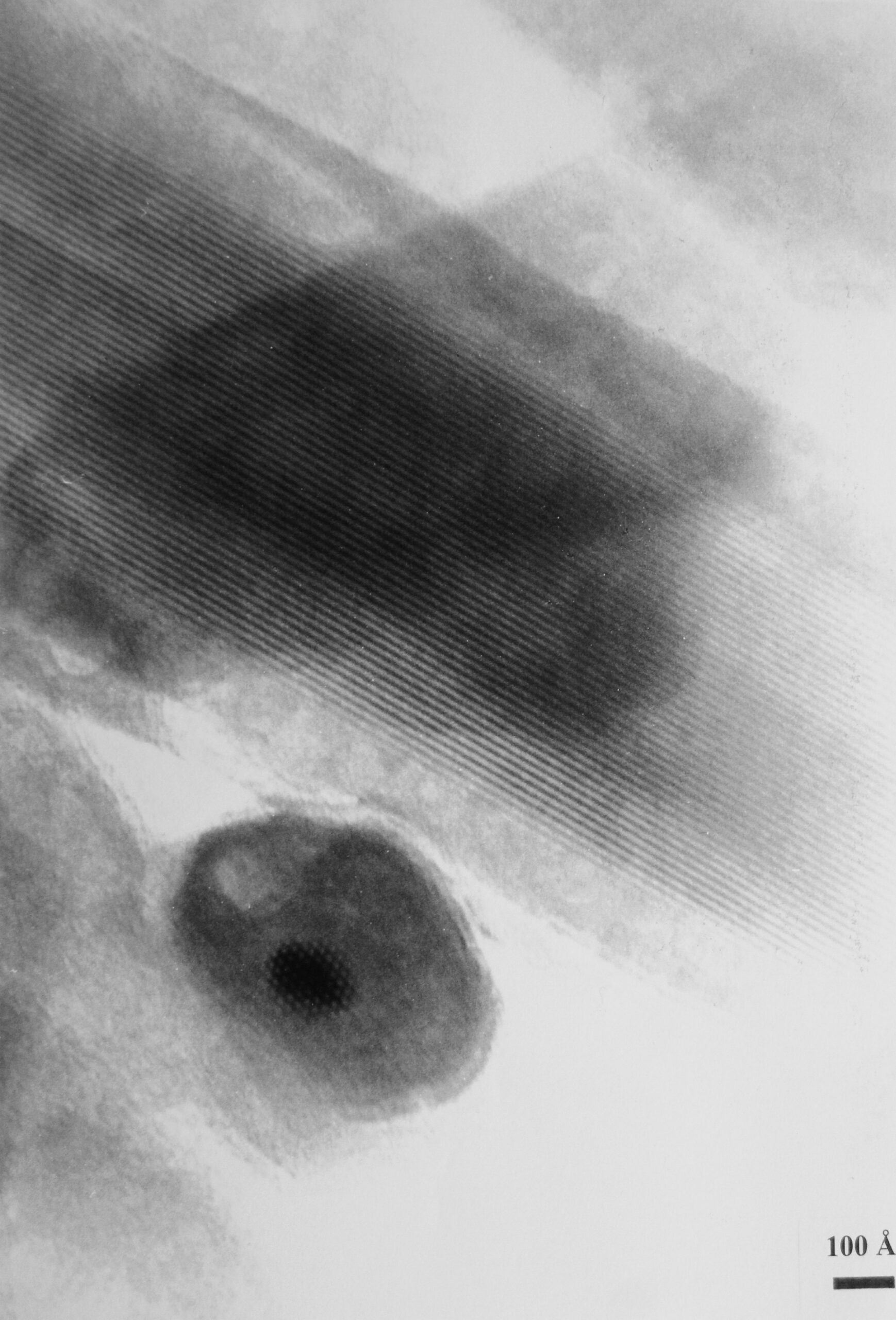
Electron microprobe analyses revealed long, thin nanotubes, just seven angstroms wide (© Angus Kirkland, University of Oxford)
The formula for the sample was also determined:
(Ca,Na)6(Fe3+,Fe2+,Mg,Al)4(Al,Mg)6Si12O36(OH)12(CO3) · 12H2O
The mineral’s intense blue colour could be explained by the special mix of two kinds of iron – Fe2+, which has space for two electrons to join each atom, and Fe3+, where it has space for three electrons to join. The result is that electrons do a kind of fast dance between the two, creating energy that results in the bright blue colour. The synthetic blue pigment Prussian Blue relies on the same dance of electrons.
Databases were searched and other scientists consulted. It seemed that we had something exciting on our hands. A decision was made to launch our findings (well, mainly Gordon’s findings really) during the following Science Week in 1996. The Natural History Museum sent out a press release and BBC News made a short film explaining the science. But none of us were prepared for the media scrum that followed. All these years later, it is interesting to analyse why the mineral captured the public’s imagination in such a big way.
Why the media frenzy?
The story had elements the press love – a mystery, a treasure hunt, colour, interesting people and romantic places. But two accidental factors also played a role. A mix up with the press release, resulting in attempts to retract it after it was published, sent the press reeling with curiosity. Then there was the timing. This was the week after the tragic Dunblane massacre and people just didn’t want to read their papers. The editors were looking for a story to re-engage audiences.
Because of the press release mix-up, the mineral came home with me. With family support and my sons on hand to make tea, I set up a photographic studio in our conservatory and invited the broadsheets to take photos. I also conducted numerous telephone interviews. On 19 March 1996, I woke to find a car waiting outside to take me to the Today Programme at Broadcasting House in London, and my face was all over the front page of The Guardian. Meanwhile there was a flurry of TV interest. The best for me was appearing on Blue Peter – I was one of its original viewers when it first aired in 1958, so the show was very close to my heart!
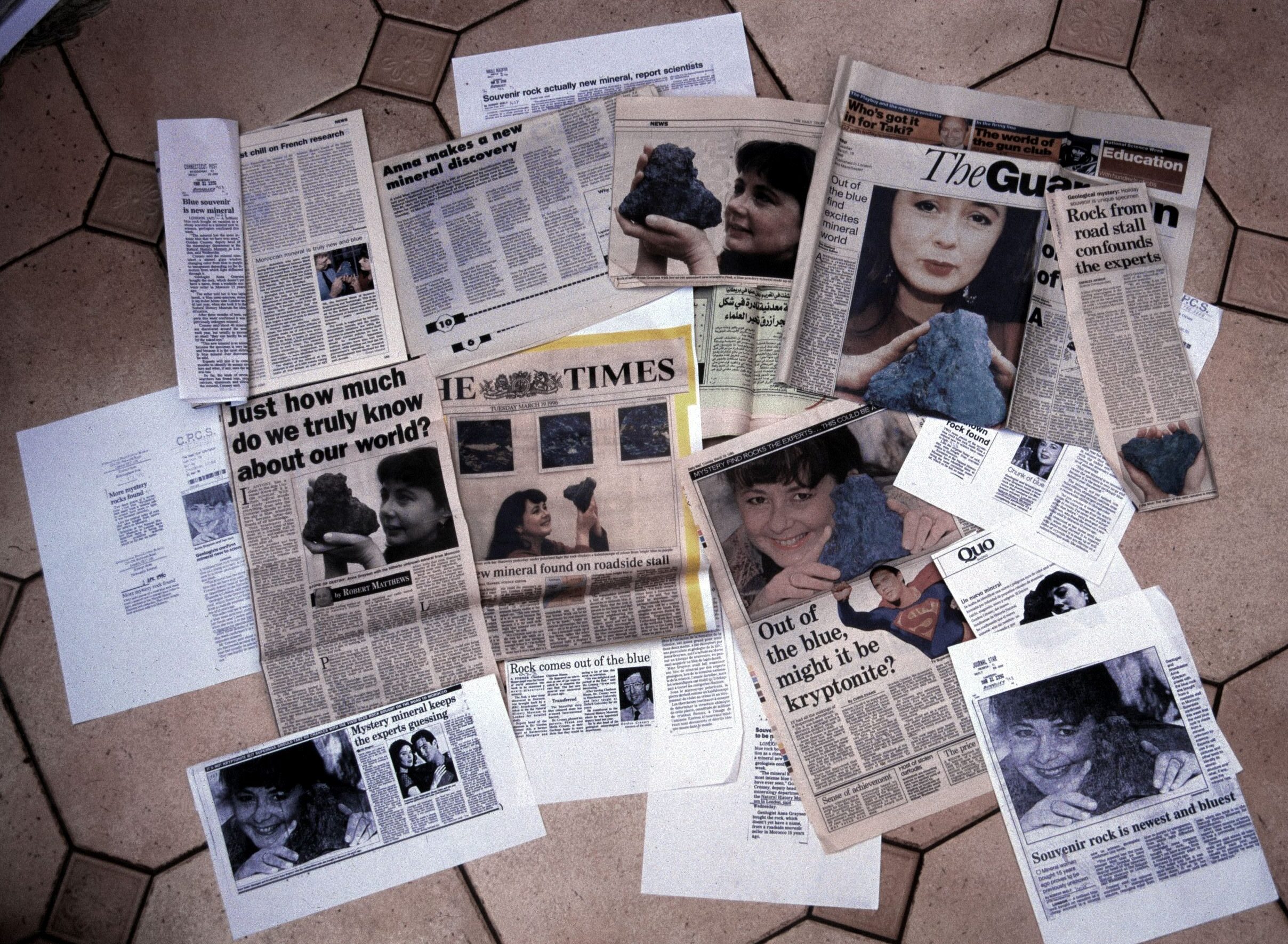
The media were looking for a happy story to engage audiences. A woman discovering something colourful with a bit of a mystery fitted their bill! (© Anna Grayson)
On 28 March, I received a letter from the editor of Horizon, the BBC’s flagship science documentary series. I was already in discussions with an independent production company, Scorer Films, so a collaboration was arranged. We would create a film based around an expedition to the glorious scenery of the Atlas Mountains in Morocco. Usually, a documentary of this nature would not be undertaken until the full scientific results were published in a peer-reviewed journal. But, given the public interest already established, the idea of following the science as it happened seemed irresistible and original.
Ultimately, the producers at Scorer Films turned out to be key players in what happened next, using their journalistic skills to unravel the mystery. They got in touch with the Moroccan Geological Survey and found that the mineral was known to them, although rare. They even had a lovely name for it – Aerinite, which means “blue sky”. But they did not have a specific location for the mineral and no scientific data about it. We learned that Aerinite had been found in Spain, too. Then a bombshell was dropped – a suggestion that there were already four small specimens of the mineral in the Natural History Museum, stored in the so-called “P-drawers” (where “P” stood for “problem”), which we didn’t know existed. This news did not go down well. There was too much uncertainty (as well as a lack of funding), so we agreed to pull the film.
Over the next few months, the mineral went on display first at the Natural History Museum (with a fantastic launch attended by the Moroccan Ambassador to Britain), then at the Manchester Museum (part of the University of Manchester, Gordon and Barbara Cressey’s Alma Mater).
As far as the source location for the mineral was concerned, we were back to square one of “Dans les Montagnes”. It had to be somewhere in the Atlas Mountains that had been subjected to moderate temperature but very high pressure, and earthquakes. I have been back to Morocco several times since 1996 and chatted to mineral dealers, but to no avail. The location of this particularly large specimen remains a mystery to this day.
Information unearthed
Once we had a name for the mineral, more fascinating information came to light, including some very interesting Victorian papers. The very first edition of the Journal of the Mineralogical Society published in 1876 actually mentions Aerinite by name, describing work carried out by a German researcher on a specimen from Spain found in a museum drawer. That article suggests the mineral is a decomposition product of other silicates, which we now know is not the case.
Aerinite was consigned to dusty drawers in which problems were hidden
In the sixth edition of Dana’s Mineralogy published in 1892, Aerinite appears in a list of minerals that were considered “bad or doubtful species”. Aerinite is dismissed as “a blue paste, inclusing (sic) different minerals, perhaps owing its colour to artificial means”. This would explain why Aerinite was consigned to dusty drawers in which problems were hidden and long forgotten!
In 1998, a Spanish team published some papers on the structure of specimens found in the Pyrenees. It was also established that Aerinite had been used as a pigment in wall paintings in Spain during late Medieval times. Blue pigments were very rare then, yet I have seen old paintings in Europe with large passages of blue that are clearly not Lapis, but more of a Prussian Blue hue. Perhaps these are Aerinite?
To add to this gut feeling about Aerinite in the arts, in the early 2000s, Des and I were at an exhibition in Christies, London, when we noticed an antique French gilt table with a blue top labelled “Faux Lapis”. The hue and texture looked to us a very well-observed copy of Aerinite, not Lapis, a suspicion confirmed by Gordon, who jumped on a bus down to Piccadilly to see the table for himself. This left us thinking that there must have been quite a bit of Aerinite doing the rounds in the past.
Unknown nanoworld
The experience highlighted how influential media coverage can be and how quickly a public narrative can take shape, how science communicators can actually contribute to the furtherment of science, and the importance of clear and accurate communication.
Despite the twists and turns, this adventure did reveal to us a previously unknown nanoworld. Gordon and Barbara Cressey, together with Angus Kirkland and their teams, had the vision and open mindedness to investigate the mineral from first principals using electron microscopy and X-ray diffraction. In so doing, they discovered a magical microworld of features and properties that were new to science – and created utterly beautiful images that are works of art in their own right.
Acknowledgements
With many thanks to the real heroes of this story: Dr Gordon Cressey, who sadly died in February 2025 and is very much missed; to Gordon’s team, and especially Dr Paul Schofield, at the Natural History Museum; to Dr Barbara Cressey who conducted the electron microscopy analyses at the University of Southampton; to Professor Angus Kirkland at the University of Oxford who, with new technological developments is now revisiting the detailed structure of this interesting species; and not least, to my husband, Dr Desmond Clark.
ON DISPLAY
View this rare sample of Aerinite in the Minerals Gallery of the Natural History Museum, London, from 16 March 2026 onwards
Author
Anna Grayson BSc (University of St Andrews, UK)
Former Science Presenter with the BBC
Citation: Grayson, A. Out of the blue. Geoscientist, 36 (2), 38-42, 2026. DOI: 10.1144/geosci2026-018