
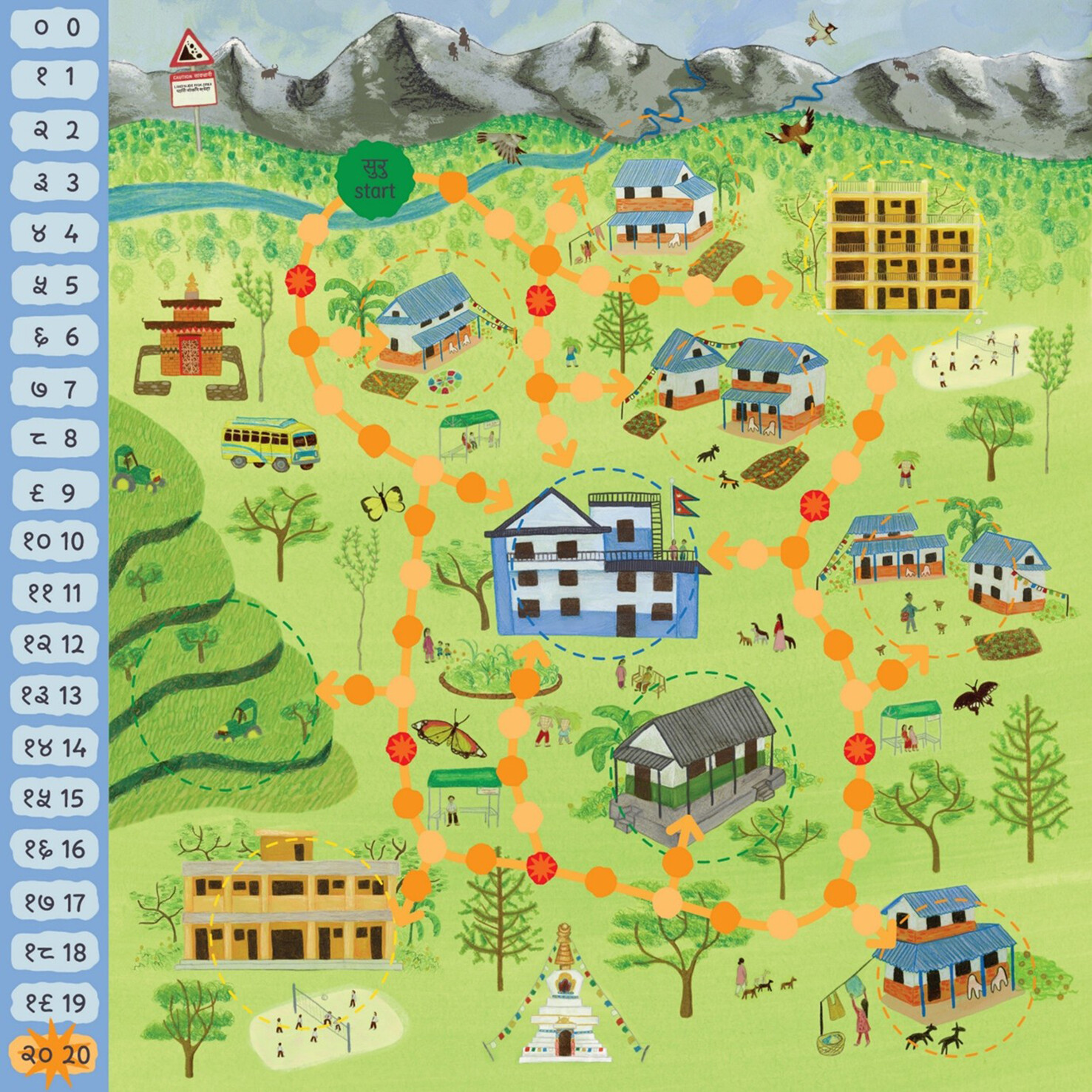
The Disaster Ready! gameboard was co-designed with locals to reflect the surrounding geological and cultural landscape, using drawings from children who played the prototype of the game. (© Wainman et al., 2026; Earth Science, Systems and Society. Published under a CC BY 4.0 licence: creativecommons.org/licenses/by/4.0)
Board games could offer a way to teach children about natural hazards and disaster preparedness, according to research into a new disaster education resource.
Laura Wainman, from the University of Leeds, UK, and colleagues developed Disaster Ready!, a serious board game designed to help young people learn about earthquakes, floods, landslides and wildfires. Serious games have an explicit educational purpose and recreate real-world situations, allowing players to learn through experience. The approach also offers an alternative to traditional disaster education programmes, which can rely on externally produced resources and short-term outreach, rather than working within existing schools and communities.
Nepal is exposed to multiple natural hazards, yet access to disaster risk reduction education can be limited, particularly in rural areas. The researchers adopted a co-creation approach, working with students, teachers and educational organisations to shape the game. They aimed to develop a resource that could be integrated into schools and continue to be used by educators after the project ended.
The team initially developed a prototype focused on earthquakes. During four weeks of fieldwork in Okhaldhunga, they used the game in workshops with 155 students aged 7–15 across four schools. Discussions with teachers and community members highlighted the need to reflect the region’s multi-hazard environment, prompting the addition of floods, landslides and wildfires. Students also helped shape the game’s visual design, replacing generic representations with details from their own communities, landscapes and everyday lives. The game was produced in both English and Nepali, while actions on its cards were checked against national guidance to ensure they were appropriate to the Nepali context.
The researchers found that the game generated enthusiasm and encouraged discussion about disaster preparedness. Students practised actions such as “Drop, Cover and Hold” and debated how hazards affect entire communities. Some participants went on to ask questions about tectonic plates, fault movement and climate change, prompting impromptu geoscience lessons.
The project also highlighted the challenges of meaningful co-creation. Funding requirements and limited project time restricted opportunities to build longer-term relationships and support the different stages of engagement, co-creation and follow-up.
Nevertheless, transferring responsibility for the game to facilitators has helped sustain its use. The game continues to be played in a school club, with preliminary testing indicating increased student knowledge of earthquake resilience and response. A climate change expansion pack is also being tested, adding climate-related hazards and adaptation measures to the game.
Hannah Bird
Details
Earth Science, Systems and Society 6 (1), 2026; doi.org/10.1144/esss2025-011