
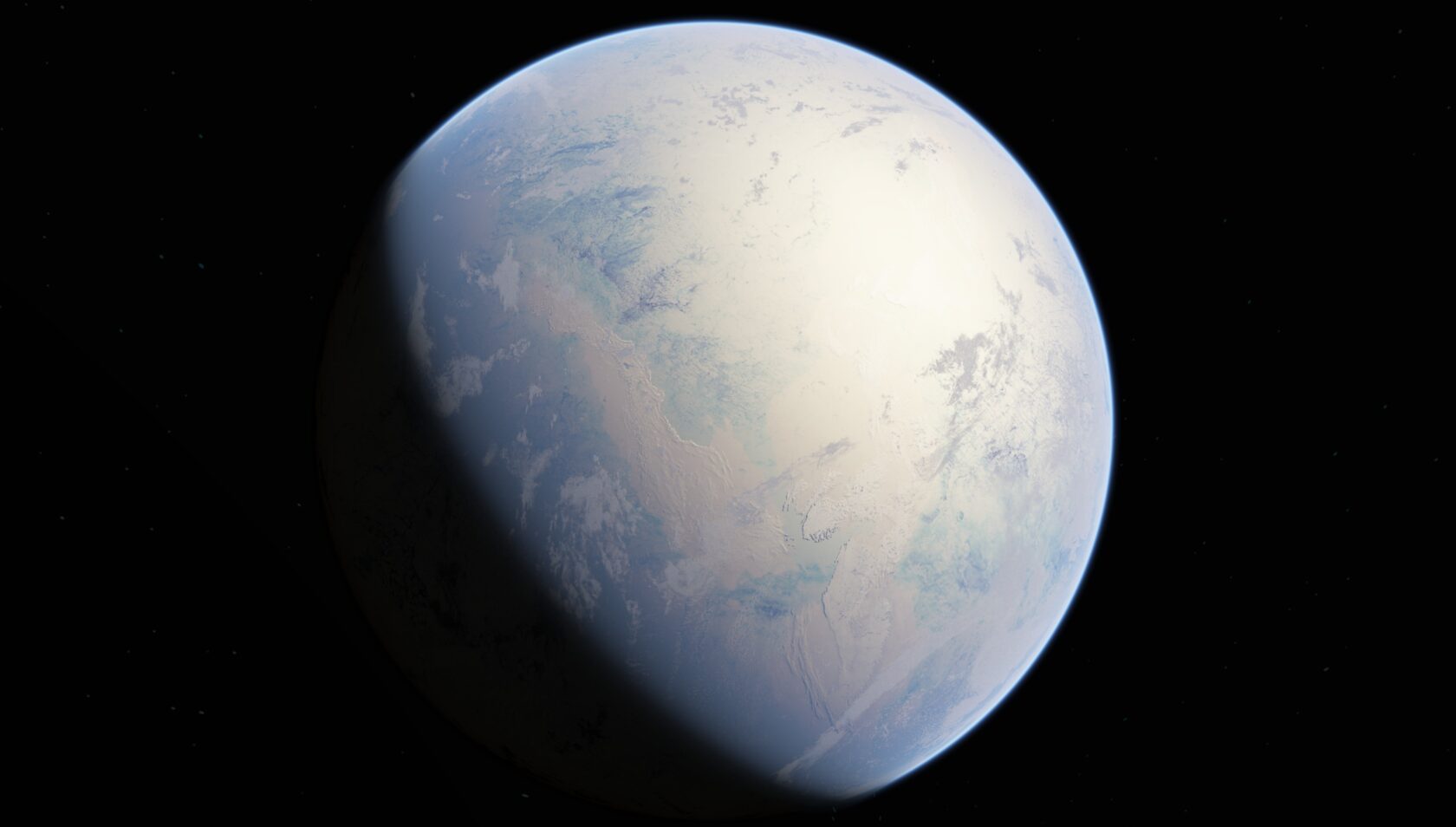
Artistic depiction of Earth frozen over during the Huronian glaciation (© Oleg Kuznetsov / Wikimedia Commons CC BY-SA 4.0)
The Cryogenian Period (720–635 million years ago) witnessed two “Snowball Earth” glaciations—extreme global ice ages thought to represent the largest disruptions to Earth’s carbon cycle in geological history. Yet, despite both events occurring under similarly frozen conditions, they differed dramatically in length: the Sturtian glaciation lasted approximately 56 million years, while the later Marinoan endured for just 4 million years. New research suggests the reason for this variation may lie beneath the oceans.
Trent Thomas, from the University of Washington, USA, and colleagues propose that differences in seafloor weathering (chemical reactions between seawater and oceanic crust that remove atmospheric carbon dioxide) can explain the contrasting durations. Previous hypotheses focused on differences in volcanic outgassing or dust and ice reflectivity, but the new model instead highlights the role of ocean chemistry and the structure of the seafloor itself.
Using carbon cycle modelling constrained by geochronological and geochemical data, the researchers estimate that seafloor weathering during the Sturtian glaciation must have operated at rates 25–53 times higher than modern levels to keep atmospheric carbon dioxide low enough to sustain global ice cover for tens of millions of years. However, the shorter Marinoan glaciation required weathering rates less than 15 times modern levels.
The team argues that the concentration of marine sulfates may have influenced the different weathering rates. During the Sturtian, sulfate levels were likely extremely low, limiting formation of anhydrite minerals from hydrothermal vents to form cements in the pores of oceanic crust, thus making this crust more porous and susceptible to weathering. Increased weathering would have removed more carbon dioxide, prolonging glaciation through a positive feedback loop. Sulfate concentrations later rebounded during the Marinoan, suppressing weathering and allowing deglaciation to occur more rapidly.
As such, the findings suggest that seafloor weathering and changing ocean redox chemistry played a far more important role in regulating Earth’s ancient climate stability than previously recognised.
Hannah Bird
Details
Geology 54 (2), 158–162 (2026); doi.org/10.1130/G53722.1