Everything comes from Earth
Geodiversity and biodiversity underpin society and wildlife. A geosystem services approach is needed to recognise the value of geoscience, argue Murray Gray and Nathan Fox.

Stunning landscapes, such as Maletsunyane Falls, Lesotho, Africa, can offer tangible benefits to society if we capitalise on them more, say Murray and Nathan © iStock
Nature and biosphere are used interchangeably,” according to Professor Sir Partha Dasgupta’s global report on The Economics of Biodiversity (2021, p.31), commissioned by the UK Treasury. The implication is that these are effectively synonyms. As geoscientists, we are used to nature writing, documentaries and media programmes being centred around wildlife, but when did the biosphere become so dominant in our conception of nature and what are the implications?
Everything we have is derived from the planet itself. Yet, the critical role for geodiversity is often overlooked by a biodiversity focused view of nature. A geosystem services approach, which focuses on the benefits society gains from living on a geodiverse planet, should be used to argue for the foundational importance of geology as a subject.
Beyond biodiversity
Early writers on nature, including Charles Darwin, were polymaths interested in several sciences. Indeed, the word ‘ecosystem’ was introduced by British ecologist Arthur Tansley in 1935 to describe the biological and abiotic components of nature interacting as functioning systems. And over 50 years ago, concerns around the global loss of species led to the term ‘ecosystem services’ being used to describe the goods and services that society gains from nature, including food, fuel (mainly wood), fibre and pharmaceuticals. However, nature writing involving ‘ecosystems’, ‘ecosystem services’ and ‘nature’ has become dominated by biodiversity and biological systems.
After the Convention on Biological Diversity—an international treaty dedicated to conserving biodiversity and ensuring the sustainable use and fair sharing of natural resources—was signed at the Earth Summit in Rio de Janeiro in 1992, several geoscientists realised that they too study diverse physical Earth phenomena that are often threatened by human activities, coining the term ‘geodiversity’ as a result. Subsequently, ‘geosystem services’ were devised to describe the benefits society gains from living on a geodiverse planet, which we summarise in the box ‘Geosystem services’.
Our classification of geosystem services falls into two categories: those where biodiversity and geodiversity interact as functioning systems (here referred to as ecosystem services) and those that exist largely independently of biological systems (here referred to as geophysical services).
Ecosystem services include some terrestrial processes, such as the strong interactions between biota and erosional and depositional processes (particularly in rivers), including seed dispersal. Thus, geomorphological processes can play an important role in ecosystem dynamics.
Soils, too, are derived from the physical, chemical and biological weathering of rock and sediments and, as they are colonised by plants and animals, organic material and a soil ecology are added. Soil processes are therefore a crucial link between the abiotic and living world.
Habitat provision offers another example of this interaction. Cross-disciplinary research groups are investigating links between biodiversity and geodiversity through the Conserving Nature’s Stage metaphor of biodiversity as the ‘actors’ on the landscape ‘stage’. This approach proposes that conserving geodiversity has the potential to protect the habitats and niches into which wildlife can migrate at times of climate or environmental change.
This geosystems service approach demonstrates that abiotic nature is as—if not more—important than biodiversity
Weathering of minerals also transfers elements into soils, from where they are taken up by plants and animals and eventually become part of human diets; medical geology has tended to focus on toxic elements rather than those vital to the health of plants, animals and humans.
Even therapeutic landscapes reveal the value of this broader view of nature: being out in nature brings many physical and mental health benefits. These are usually associated with forests, meadows, parks and gardens, yet landscapes encompass complex topographies that should be recognised as equally important, such as mountain views, waterfalls and coastal walks.
Geophysical services include use of the subsurface for burial and storage, abiotic sources of food and drink (e.g. rock salt, mineral water), energy (e.g. tidal, geothermal, nuclear), construction materials, industrial minerals, ornamental products, as well as cultural and leisure services (e.g. geotourism, artistic inspiration, outdoor activities such as rock climbing and hiking) and knowledge services (e.g. environmental monitoring, geoforensics).
This geosystems service approach demonstrates that abiotic nature is as—if not more—important than biodiversity. Abiotic nature not only supports biodiversity and human life but has important values of its own.
Geosystem services
The major benefits society gains from living on a geodiverse planet are:
Regulating
- Atmospheric and oceanic processes (e.g. dynamic circulations, atmospheric chemistry, air quality and climate regulation, hydrological cycle).
- Terrestrial processes (e.g. rock cycle, carbon and other biogeochemical cycles, carbon sequestration, geomorphological processes, natural hazard regulation, erosion regulation).
- Flood regulation (e.g. infiltration, barrier islands, river levees, sand dunes, floodplains).
- Water-quality regulation (e.g. soil, sediments and rock as natural filters).
Supporting
- Soil processes (e.g. weathering, soil profile development) and soil as a growing medium.
- Habitat provision (e.g. limestone pavements, caves, cliffs, salt marshes, dynamic habitats).
- Land and water as platforms for human activity (e.g. building land, camping, canoeing).
- Burial and storage (e.g. human and animal burial, municipal landfill, radioactive waste storage, oil and gas reservoirs, carbon capture and storage, water storage in aquifers, ice sheets).
Provisioning
- Food and drink (e.g. freshwater and mineral water, beer and whisky, salt, geophagy).
- Nutrients and minerals for healthy growth of plants, animals and humans.
- Energy (e.g. nuclear, geothermal and hydroelectric energy, and tidal, wave and wind power).
- Construction materials (e.g. stone, brick, aggregates, steel, cement, bitumen, glass).
- Industrial minerals (e.g. fertilisers, pharmaceuticals, metals, alloys).
- Ornamental products (e.g. gemstones, precious and semi-precious metals).
- Fossils for sale.
Cultural
- Environmental quality (e.g. local landscape character, therapeutic landscapes for physical and mental health).
- Geotourism and leisure (e.g. mountain and coastal views, rock climbing, hiking, skiing, fossil collecting).
- Cultural, spiritual and historic meanings (e.g. folklore, sacred sites, sense of place).
- Artistic inspiration (e.g. geological materials in sculpture and inspiring art, literature, music, poetry).
- Social developments (e.g. local geological societies, volunteering, field trips).
Knowledge
- Earth history and geoheritage (e.g. evolution and extinction of life, origin of landforms, palaeoenvironments).
- History of research (e.g. early identification of fossils, unconformities, igneous rocks).
- Environmental monitoring and forecasting (e.g. baseline studies for climate change and pollution research, ice cores, sea level change).
- Education and employment (e.g. sites for teaching and research, employment in industry, geoparks).
*Here we have classified geosystem services according to the Millennium Ecosystem Assessment—a major UN-sponsored international study conducted from 2001 to 2005 (millenniumassessment.org)—with the addition of a knowledge category (modified from Gray, 2018).
Life’s foundations
Life on Earth is facilitated and sustained by its physical foundations. All of nature is fundamentally related to the abiotic world; all healthy life depends on the platforms, habitats and nutrients derived from the physical planet (supported by energy from the Sun). Very little biodiversity would exist without geodiversity.
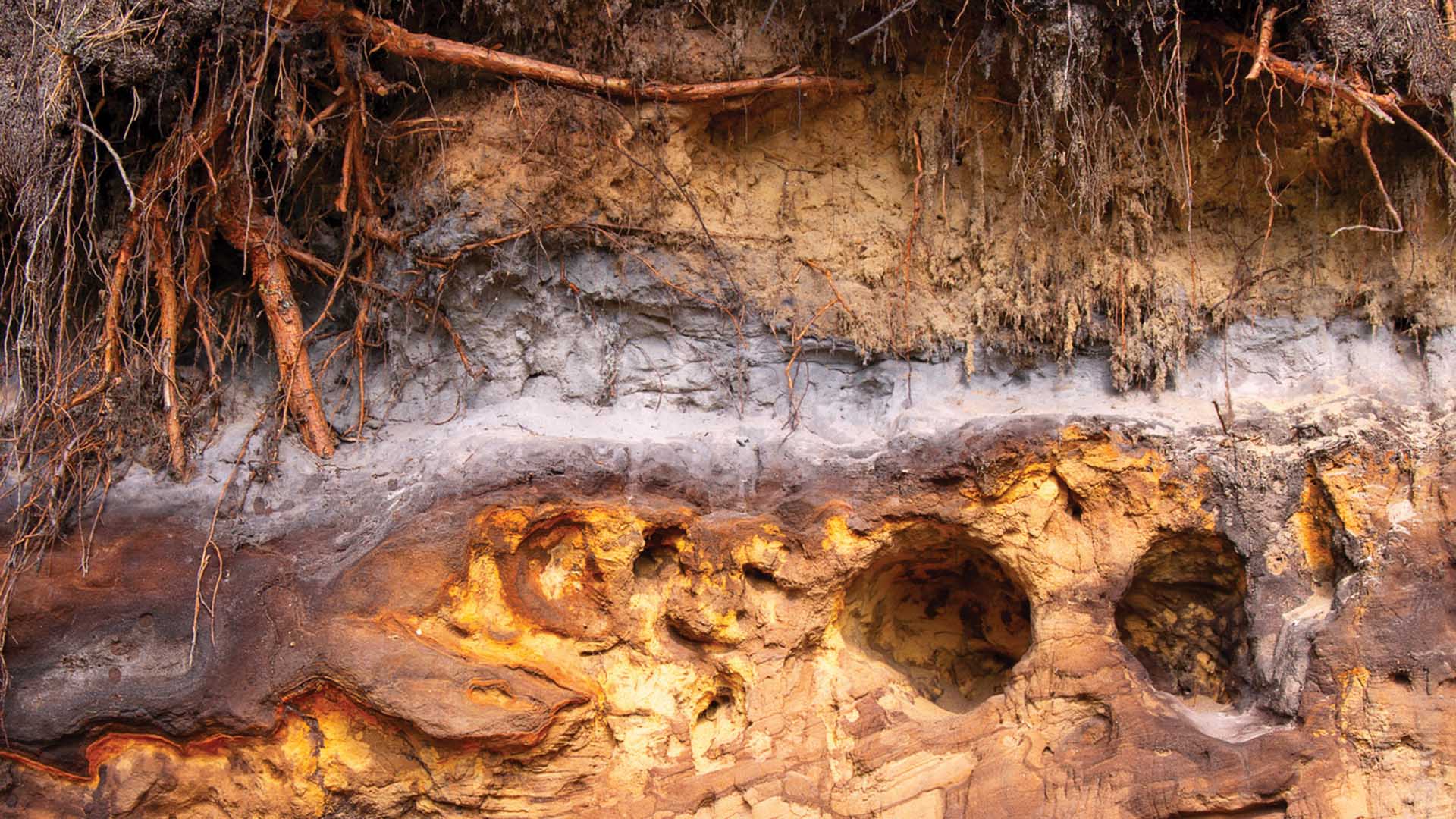
Life on Earth is facilitated and sustained by its physical foundations © iStock
Abiotic nature should therefore be regarded as crucial to developing environmental management and nature conservation strategies and contributing to societal success and wellbeing. Without this, our land management and conservation policies and practices are deficient.
Given that we undervalue the physical foundations of nature, it is perhaps unsurprising that geology—the discipline devoted to studying our physical foundations—sometimes struggles to command attention. As we enter a geopolitical age involving the grab for Earth’s (and even lunar and planetary) resources, the geosystem services approach is surely one that could and should establish geoscience as a fundamental subject that is crucial to our future on this planet and beyond.
Authors
Prof Murray Gray, Queen Mary University of London, UK
Dr Nathan Fox, Michigan Institute for Data and AI in Society, USA
Further Reading
- Tansley, A. (1935) The use and abuse of vegetational concepts and terms. Ecology 16, 284-307; org/10.2307/1930070
- Gray, M. & Fox, N. (2026) Historical perspective and proposal for a comprehensive framework for valuing all environmental services including ecosystem and geosystem services, Ecosystem Services 79, 101835; org/10.1016/j.ecoser.2026.101835
- Gray, M. (2018) The confused position of the geosciences within the “natural capital” and “ecosystem services” approaches. Ecosystem Services 34 A, 106-112; org/10.1016/j.ecoser.2018.10.010
Citation: Gray, M. & Fox, N. Everything comes from Earth. Geoscientist, 36 (3), 18-20, 2026. DOI: 10.1144/geosci2026-025