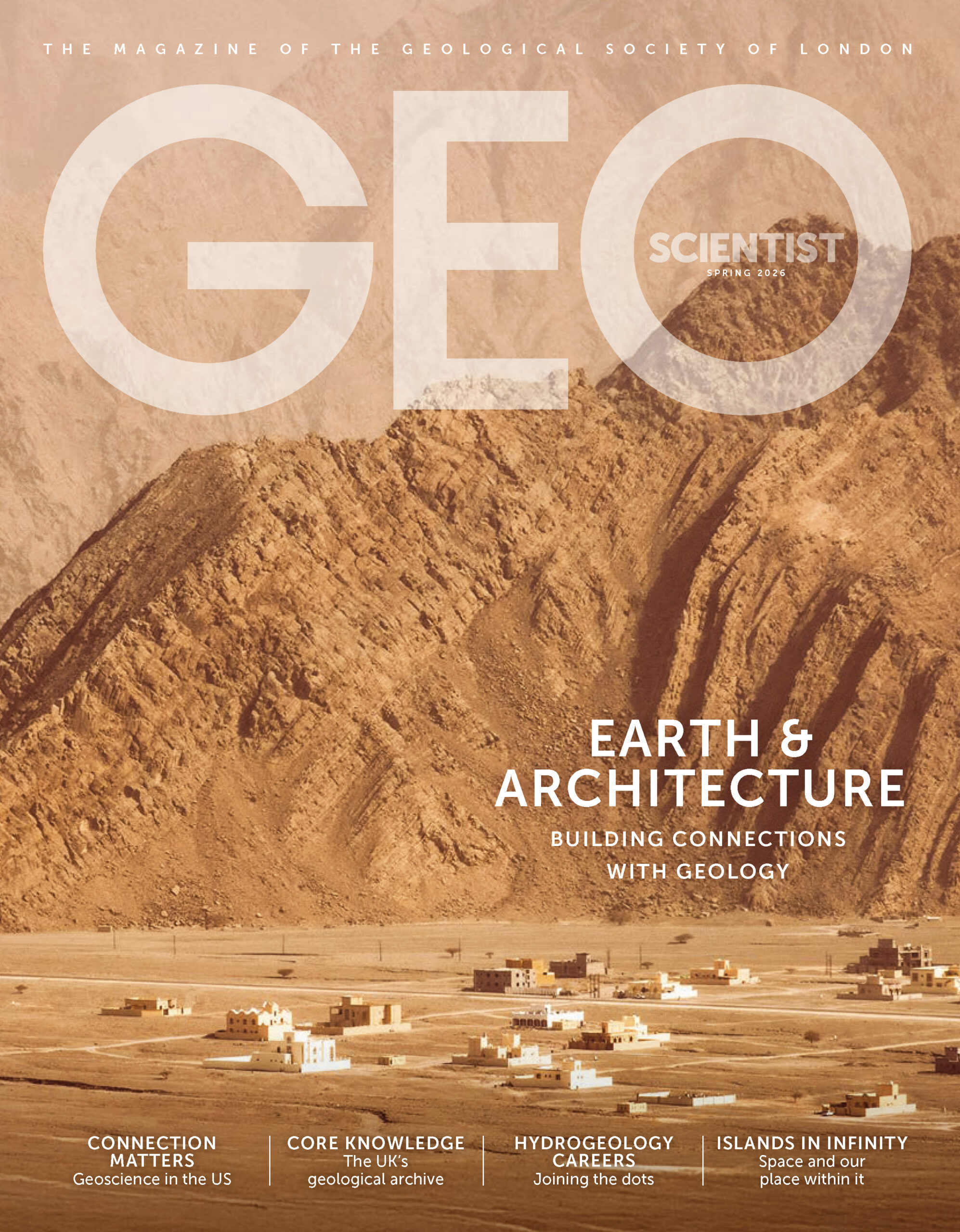
Village against a rocky landscape in Northern Oman (Wadi Khab, Oman, seen from Jebel Harim, 2018 © Manuel Alvarez Diestro)
Popularised following the Wall Street crash of 1929, the comment “When America sneezes, the world catches a cold” is becoming increasingly appropriate.
The ripple effect of the dramatic US policy shifts, staff and funding cuts imposed over the past 16 months or so (p. 12), which have been devastating for many of our US colleagues, is slowing scientific progress, and increasing uncertainty globally. At a time when geoscience in the West already faces significant hurdles, with ongoing closures or restructures of university geoscience departments (p. 14), it is critically important to not only support existing colleagues, but also to shore up the future of our science by sharing the wonder and importance of our subject with new audiences.
For geoscience does not live only in field notebooks, samples or technical reports; it is in almost every element of our lives, though we may not always see it. Architecture, for example, is literally grounded in geology. Where buildings are designed to work with the landscape, rather than flatten or conceal it, architecture can connect human and deep timescales and encourage people to engage with Earth processes (p. 20 & 28).
Geoscience is in almost every element of our lives
Geoscience seeps, often unexpectedly, into the wider culture around us: onto cinema screens and televisions, into museum galleries and podcasts, graphic novels and video games. Sometimes it is centre stage, other times it is background texture, but always encouraging us to ask questions about our planet.
Audio and visual storytelling offer particularly powerful entry points. A podcast or album can help us to explore complex concepts in unique ways compared to textbooks; a fictional volcano or earthquake movie can prompt real conversations about risk, resilience and responsibility; an exhibition can reframe deep time in ways that linger long after we leave the gallery. These encounters often shape how people first engage with geoscience — and how they continue to think about it.
That is why we want to hear from you. Many of you already encounter geoscience beyond the professional sphere, so if you have watched, listened to, visited or read something that made you think differently about Earth, we invite you to share it with us via geoscientist@geolsoc.org.uk in the form of a review for our Books and Arts section. By exploring these perspectives on geoscience encounters, we can broaden the conversation about where geoscience is found, who it speaks to, and how it resonates beyond our own community.
Dr Amy Whitchurch, Executive Editor
Dr Hannah Bird, Associate Editor