Whom do I ask?
Responsible geological sampling requires careful planning. Rachel Wignall discusses permissions, site protection, and best practice for effective research and sample collecting in Scotland

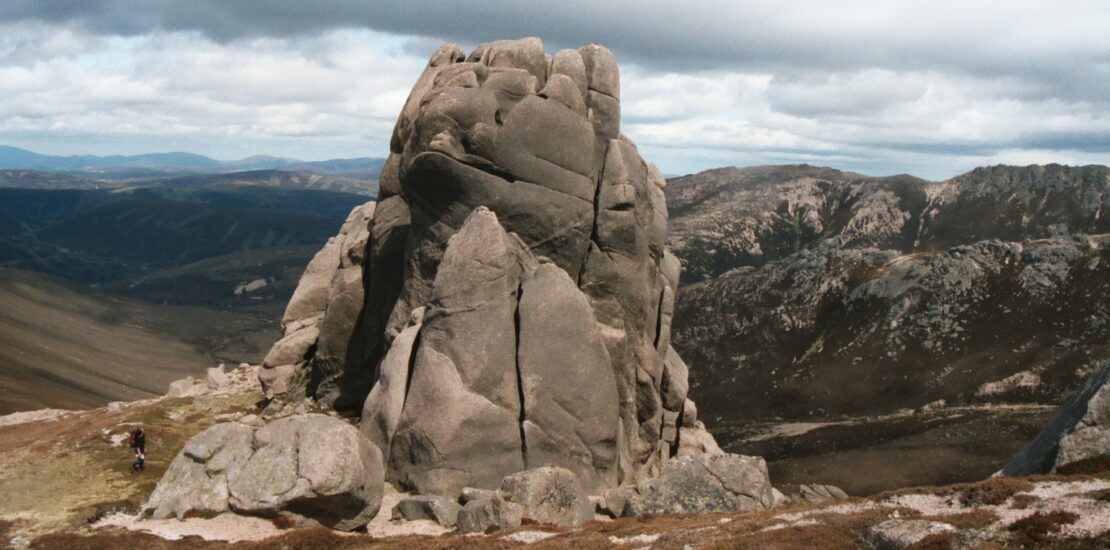
Clach Bun Rudhtair tor, Ben Avon, Eastern Cairngorms SSSI, Cairngorms National Park. Sampling for cosmogenic dating on glacially exposed surfaces, such as these, requires SSSI consent and permission from the mineral rights owner and landowner. Applications that follow NatureScot’s good practice guidance on Sampling for Cosmogenic dating will be most likely to fulfil the requirement to minimise site damage and maximise scientific output, and therefore gain SSSI consent. (© Rachel Wignall/NatureScot.)
Scotland’s rich geodiversity has been studied for over 200 years, yielding significant advances in understanding of our science. Fortunately, many geoscience researchers are still enthusiastic to study Scotland’s geodiversity, carrying out field studies and fieldwork in Scotland. If you are one of these researchers, contributing to our knowledge of Scotland’s geodiversity, your research may require you to collect geological samples for lab analysis. Before you do so, it is important to consider whether your proposed sampling is legal, what permissions you will need and whom you should ask.
These questions should be on the mind of every geologist undertaking fieldwork and collecting samples – whether in Scotland or elsewhere. However, the answers are often not easy to find. Legislation differs between countries, even between the nations of the UK, and may change over time, as may the process of applying for consent. Legislation exists relating to ownership, access rights, areas protected for nature conservation, and historic monuments, so it can be difficult to know where to start.
The process of applying for nature conservation protected areas consents in Scotland changed in 2025, so now is a good time to report on what you’ll need to know if you are planning to collect geological samples in Scotland for research work.
Ownership and consent
Geological sample collecting includes all methods used to collect rock, mineral, fossil, sediment and soil samples, including peat. Good practice guidelines (see box ‘Resources’) should be followed for all sample collecting, but it is also important to be aware of the laws that apply to your activities.
Scotland has arguably some of the best outdoor access legislation in the world
Scotland has arguably some of the best outdoor access legislation in the world, which is set out within the Land Reform (Scotland) Act 2003 and the Scottish Outdoor Access Code. However, fieldwork that includes sample collecting is not covered by access rights under this legislation. You must therefore obtain landowner/occupier permission before you access any site to remove samples, regardless of whether it is in a protected area.
Traditionally small geological specimens are collected without permission and hindrance. However, lawfully the right thing to do is to obtain permission to extract, collect and retain geological specimens and samples. Under Scots law, geological samples are ‘minerals’. You must therefore identify and gain consent from the mineral rights owner (usually, though not always, the landowner) before collecting samples from any site whether it is a protected area or not. Collecting without permission may be regarded as theft. A phone call to the mineral rights owner or a knock on their door before you access the site, may be sufficient to avoid an irate owner. However, if you come to accession your samples (the process of formally recording and taking an item into a collection) to an accredited museum collection, within your own research institute or elsewhere, you may need to show proof of ownership. Written permission from the mineral rights owner – to both collect and take ownership of geological samples – may be required.
Nature conservation
Nationally and internationally important sites for geoscience research in Britain are identified in the Geological Conservation Review (GCR) and many are protected under the Nature Conservation (Scotland) Act 2004 as Sites of Special Scientific Interest (SSSIs).
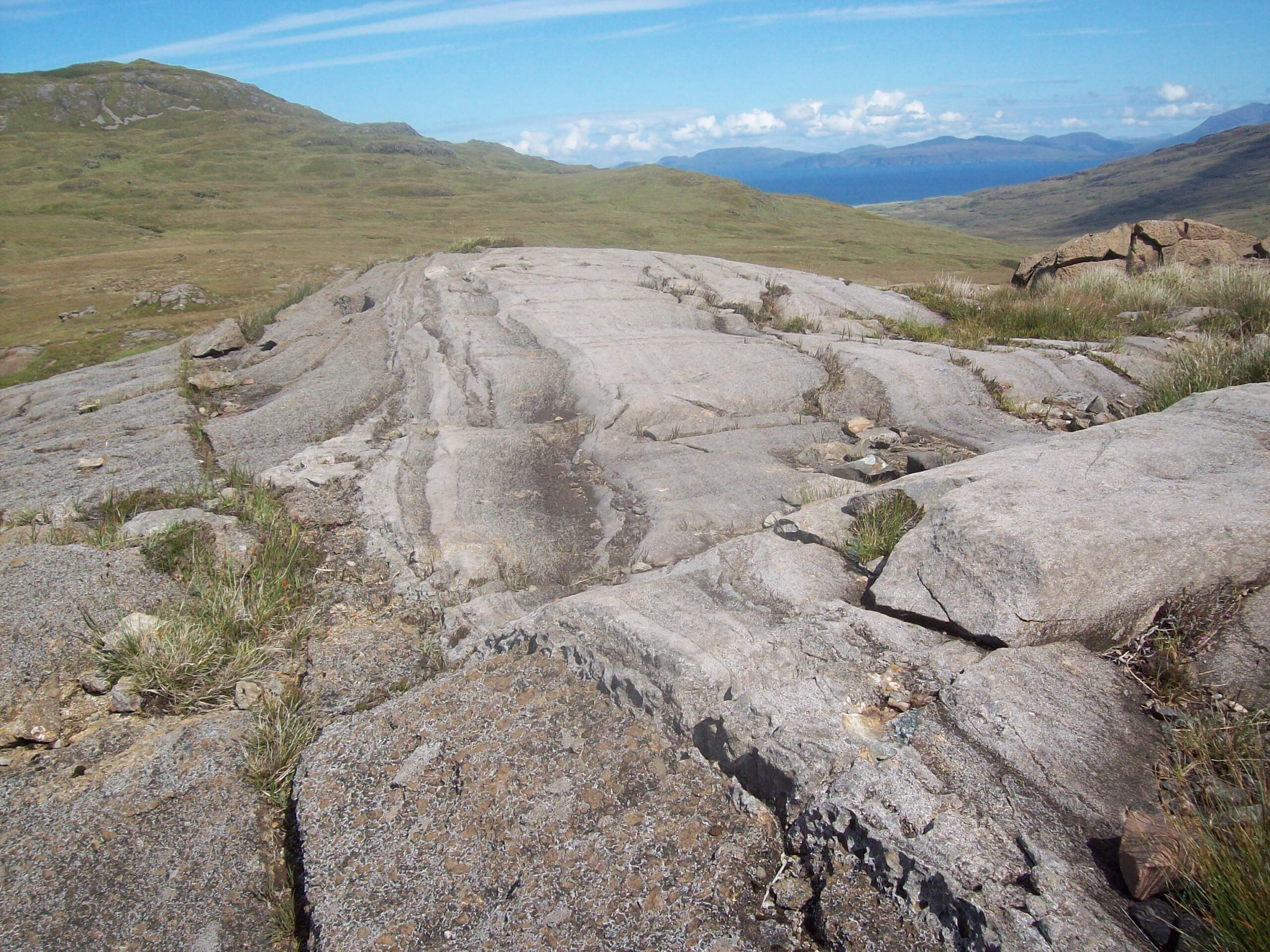
Layered Troctolite in the Central Intrusion of Rum SSSI and NNR, owned by NatureScot. Geological sample collecting on the Isle of Rum requires SSSI consent, as well as consent from the NNR manager as the landowner’s representative. Both can be obtained by submitting an SSSI consent application through NatureScot’s InformedDECISION™ platform. This troctolite outcrop features in a geological field guide to Rum and is a popular teaching locality. Outcrops such as this, which have a high visual value, should be avoided when selecting locations for geological sample collecting. (© Rachel Wignall/NatureScot.)
Geoconservation in Scotland aims to ensure that future generations can enjoy and learn from our remarkable geodiversity while safeguarding key sites for geoscience research and public enjoyment. Geosites are designated primarily for their scientific value. That is, geoconservation focuses on conserving the scientific resource and is therefore pre-disposed to support scientific research. However, sample collecting in a protected geosite presents a potential conflict between conserving material in situ and removing it for scientific study.
In Scotland, it is an offence for any person to intentionally or recklessly damage the protected natural features of an SSSI, and this includes unauthorised sample collecting. If you collect samples from an SSSI without the appropriate consent, you may be considered to be intentionally or recklessly damaging the protected natural features of the SSSI and thus committing an offence. Police Scotland are responsible for prosecuting cases of damage to SSSIs, and categorises this damage, including damage to geological SSSI features, as wildlife crime.
You can check whether your proposed field site is in an SSSI using NatureScot’s web-based service SiteLink (which provides a map view), and you can download SSSI boundary maps for Scotland via NatureScot’s Open Data Hub website (under ‘Protected Areas’). GCR site boundaries and information are available through the Scottish Geology Trust’s excellent Geosites project (https://geosites.scottishgeologytrust.org/).
Additional consents
Additional consent may be required to collect samples from one of Scotland’s National Nature Reserves (NNR). If the reserve is owned by NatureScot, an application for SSSI consent should trigger an application for appropriate NNR consent.
You are also responsible for checking whether the site has any other protected status that requires additional consents (such as scheduled monuments – those monuments with national or international importance relating to human settlement), and to obtain these consents from the statutory body responsible for regulating controlled activities on such sites. Local Authorities may also have lists of protected local sites, such as Local Biodiversity Sites and Local Geodiversity Sites, which you should consider.
You are acting within the law if you obtain permission to collect samples. But permission from one body or person does not imply permission from anyone else. For example, consent from NatureScot does not imply permission from the mineral rights owner or any other body.
SSSI consent from NatureScot
Where geological sample collecting is required for a civil engineering, geoenvironmental or similar project regulated by the planning system, the system requires the planning authority to consult NatureScot for consent where appropriate. However, for activities such as geological sample collecting for scientific research, which are not regulated by the planning system, there are two pathways by which NatureScot may grant SSSI consent:
- Directly to a Public Body (including government-funded bodies and educational institutes) or its representative.
- To the landowner or occupier to permit the activity to be carried out.
If you represent an organisation that may be considered a public body, such as a government-funded body or an educational institution, you can apply directly to NatureScot for permission to collect samples from an SSSI. If you do not represent an organisation that may be considered a public body, you need to ask the landowner, occupier or manager of the SSSI to apply to NatureScot for permission for you to collect samples. The landowner, occupier or manager will need information about your proposed activities so that they can apply to NatureScot.
In 2025, NatureScot launched a new online service called InformedDECISION™ to enable the submission of applications, including applications to collect geological samples from Sites of Special Scientific Interest. Guidance on applying for consent to collect geological samples in Scotland is available through the NatureScot website. The form ‘Public body and SSSI owner geological sample collecting application’ should be completed and uploaded with your InformedDECISIONTM application. Note that this form is only for use by public bodies and the owners, occupiers and managers of the site(s) from which samples are to be taken.
we must balance safeguarding a protected area’s geodiversity for future generations with fostering thriving research and geoscience education
At NatureScot, we must balance safeguarding a protected area’s geodiversity for future generations with fostering thriving research and geoscience education. Requesting permission and outlining your planned research helps us understand how and when geosites are being used for their primary role as scientific resources. It also provides the information we need to assess your proposal and to document authorised research for future site-condition monitoring. If you come across research samples which were inadvertently collected without SSSI consent, you can also apply for retrospective consent, which follows the same assessment process.
The scientific value of a geological SSSI is the sum of the existing scientific data from the site, and the potential scientific information remaining within the site. Removing geological samples decreases the store of remaining information and is usually considered irreversible damage to the SSSI feature. However, in some circumstances, the loss of resource may be off-set, or balanced, by the scientific information gained from the samples taken, allowing an overall assessment of no loss of scientific value for the SSSI.
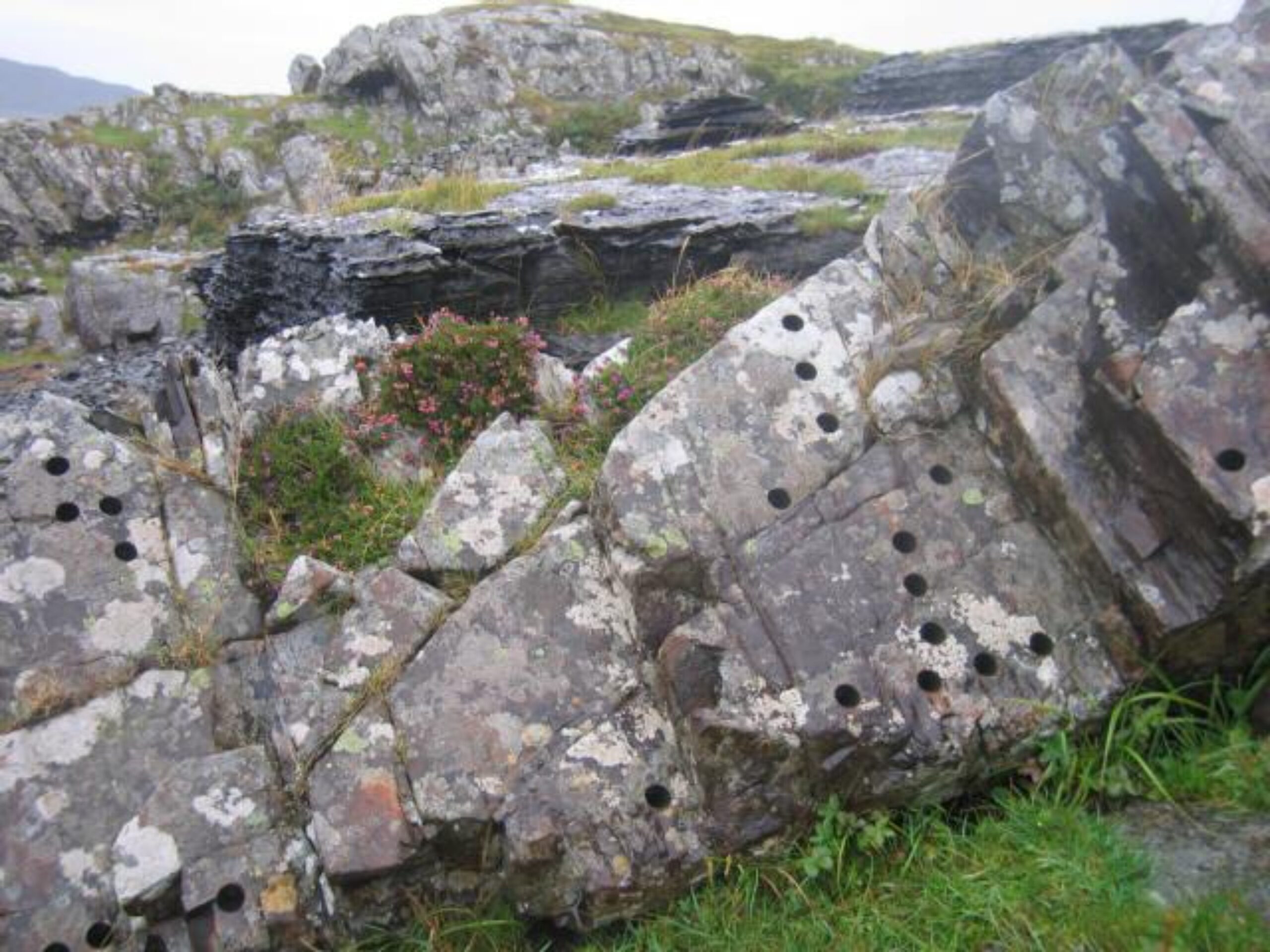
Rock core sampling that does not follow best practice guidelines in the Scottish Core Code, such as this rash of holes at Glas Eilean to Mingary Pier GCR site, Ardnamurchan SSSI (which pre-date effecting SSSI legislation), impact the visual value of the geosite. Such examples of bad practice will effectively last forever and can reduce the amenity value of the site by compromising the perceived naturalness and wildness of our outdoor spaces. (© Jenny Rees/NatureScot.)
Research projects are most likely to generate scientific benefits that offset any loss of in situ geosite material when they:
- minimise the loss of in situ scientific study potential, including minimising damage to the visual value of the site,
- maximise the scientific knowledge gained from collected samples, including through in situ examination before removal, and
- avoid long-term impacts on natural processes at active process geosites.
NatureScot may refuse consent for a variety of reasons, such as a resource being extremely limited, or a site being particularly vulnerable to damage and loss. We may ask for further details about your proposal if we have concerns about damage to the site. It is also important that we understand how any remaining samples will be stored and curated after the research is completed, to ensure that maximum scientific and educational benefit is gained from samples, and that the minimum number of samples are taken over time.
Further guidance on best practice for minimising loss of in situ scientific study potential and maximising knowledge derived from geological samples is provided in our online guidance notes. If you have any questions, please do ask, as we are keen to engage with researchers who are studying Scotland’s amazing geosites.
Resources
- Historic Environment Scotland: Scheduled Monuments
- NatureScot
- NatureScot: Geological Sample Collecting SSSI Permission Application Form
- Nature Scot: Guidance on collecting geological samples from Sites of Special Scientific Interest in Scotland
- Nature Scot: InformedDECISION™
- NatureScot: Open Data
- NatureScot: Sampling for cosmogenic dating
- NatureScot: Scottish Core Code
- NatureScot: Scottish Fossil Code
- NatureScot: Site Link Map Search
- Police Scotland: Wildlife Crime
- Scotland’s National Nature Reserves
- Scottish Geology Trust: Ethical Rock Collection
- Scottish Geology Trust: Scotland’s Geosites
- Scottish Outdoor Access Code
Author
Dr Rachel Wignall
Geology Adviser, NatureScot, Scotland, UK
Rachel.Wignall@nature.scot
Further reading
- Ellis, N.V. et al. (1996) An Introduction to the Geological Conservation Review. Geological Conservation Review Series No. 1. Joint Nature Conservation Committee, Peterborough
- MacFadyen, C.C.J. (2024) Conserving and promoting Scotland’s Geoheritage. In: Smith, M. & Strachan, R.A. (eds) The Geology of Scotland. 5th edn. Geological Society of London, 654 pp.
- Nature Conservation (Scotland) Act (2004); https://www.legislation.gov.uk/asp/2004/6/contents [Accessed November 2025]
- NatureScot (2023) Scottish Fossil Code and Guidance; https://www.nature.scot/doc/scottish-fossil-code-and-guidance [Accessed November 2025]
- NatureScot (2023) Guidance on Establishing and Managing Local Nature Conservation Site Systems in Scotland – 2023 update; https://www.nature.scot/doc/local-nature-conservation-sites-lncs-guidance [Accessed November 2025]
- NatureScot (2025) Guidance on collecting geological samples from Sites of Special Scientific Interest in Scotland; https://www.nature.scot/doc/guidance-collecting-geological-samples-sites-special-scientific-interest-scotland [Accessed November 2025]