Landscapes of identity
Jakob Walløe Hansen explains how Denmark’s Geopark Odsherred connects people and place by fostering pride and engagement with the surrounding landscape.

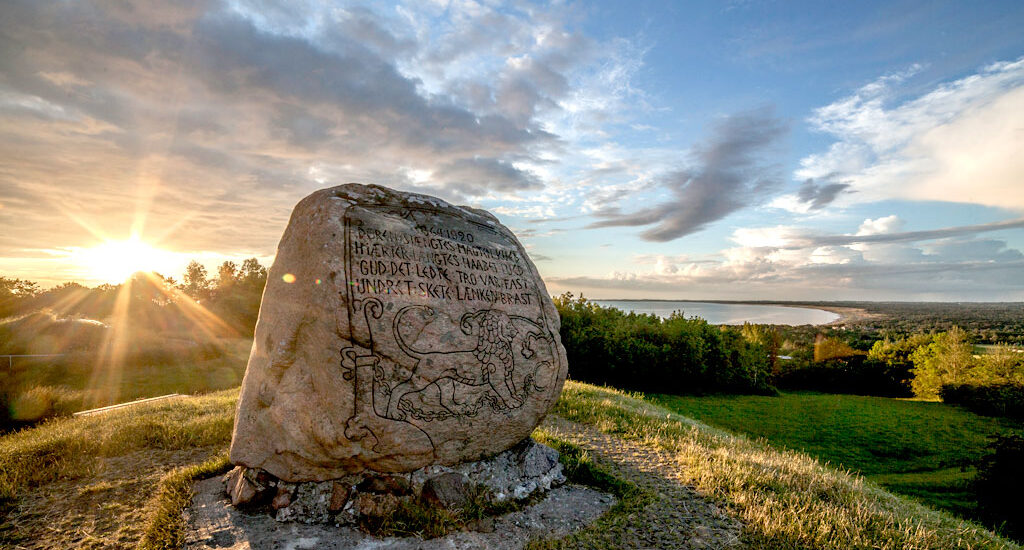
The Esterhøj Stone, one of Denmark’s numerous glacial erratics. This was placed in situ in 1920 to celebrate the reunification of northernmost Schleswig with Denmark following World War I. In folklore, the boulder is said to have been thrown there by a troll. (© Claus Starup)
In Denmark, many people have a strong cultural attachment to their landscape. Outdoor activities such as cycling, hiking and swimming are often deeply embedded in daily life. The immense value placed on open space is reflected in the tradition held by many Danes of having two homes: a primary residence near work and a “sommerhus”, often near the coast, lakes or forests, that offers a retreat into nature.
So, when in 2015 the peaceful and scenic Odsherred peninsula was established as Denmark’s first UNESCO Global Geopark, the sentiment from some locals was one of “profound animosity”, recalls Jakob Walløe Hansen, Head of Outreach and Education at Geopark Odsherred. Many worried that the UNESCO status might impose tighter land-use restrictions, divert funding away from schools, healthcare and infrastructure, and generate increased tourism, leading to overcrowding and damage to the landscape. However, sustained engagement has shifted perspectives, with residents recognising the geopark’s cultural and environmental value and embracing the idea that their identity is bound to the landscape.
Connecting communities
For Jakob, working in Geopark Odsherred is the continuation of a childhood passion for palaeontology and public outreach that led him from his studies at the Natural History Museum of Denmark to his first – and still current – role. Over the years, Jakob has witnessed a transformation in local attitudes towards the geopark. Scepticism shifted to broad support with the realisation of the tangible benefits – for tourists and locals alike – associated with UNESCO Global Geopark status, thanks in large part to significant community involvement.
“We believe the geopark is about its citizens, not me and my colleagues, so we try to involve them in as many activities as possible,” Jakob explains. “At festivals, locals disseminate information about the geopark through their own interpretations of art, literature and food. We have retired farmers who talk about agricultural traditions in the context of the landscape and an agreement with the council allows us to do outreach projects with local school groups. We are also collecting views from the local community on what information they would like to see in a new museum that will be opening in a few years. In this way, we are encouraging locals to take ownership of the geopark and feel pride over interacting with the landscape.”
We are encouraging locals to take ownership of the geopark and feel pride over interacting with the landscape
Jakob and his team also embarked upon educating a group of geoguides to enrich visitor experiences. “The geoguides received expert training over six weekends, consisting of five courses and an assignment that covered the key themes of the geopark: geology, landscape, arts, cultural history and local produce. Whilst we formally trained our geoguides almost a decade ago, some of them still work in the park part-time and have developed strong fields of expertise to teach and guide visitors. People come away from their talks realising that we are very much dependent on what we normally take for granted: the ground beneath our feet.”
Today, Odsherred’s outreach initiatives include almost one hundred information boards dotting the landscape, providing basic geological details for passing visitors, as well as dedicated teaching stations focused on the sea and agriculture that help school groups explore the connections between people and place. Activities such as soil core sampling and discussions of geoscience in local building materials bring science into everyday life too.
Nurturing partnerships
Currently, more than 200 UNESCO Global Geoparks are designated across 50 countries (each retains its status for four years before undergoing revalidation to ensure standards are being met). Collaboration with other international geoparks provides valuable opportunities to share knowledge and experience to further the goal of honouring the past but also looking to the future.
“We have a formal partnership with the Harz – Braunschweiger Land – Ostfalen Geopark in Germany, and I am currently working with geoparks in Norway (Magma), Slovenia (Idrija), Austria (Styrian Eisenwurzen) and Iceland (Reykjanes). Having had the privilege of visiting multiple geoparks now, there is a great deal of inspiration to be found in what to do and, perhaps most importantly, what not to do. The friends you make via the geopark network can give you so many valuable insights that might otherwise take a whole career to accumulate yourself.”
Jakob emphasises the importance of having a clear idea of what you want to gain before embarking on a partnership, to ensure the venture is fruitful for all parties. One such collaborative project involved working with three other geoparks to create a geology teaching kit that includes tools and activity packs, so educators and school groups have all the necessary equipment to explore the geopark and surrounding landscapes properly.
In another example, Jakob notes how effectively cartoon characters (used in signage and pamphlets, for example) work to engage visitors and school groups in Japanese and Korean geoparks. He hopes to implement similar visual media in future educational materials in Denmark.
Jakob is also working with colleagues from Nordic countries to develop a programme that aims to empower educators through the creation of “cross-sectoral hubs for lifelong learning”. These collaborative digital and physical platforms will bring together people working across education, business, government, culture, non-governmental organisations and community groups to provide learning opportunities for people of all ages. Jakob hopes such hubs will eventually gain UNESCO endorsement.
“I would like to see UNESCO produce a universal education programme for every geopark to use to create a common language and standards. Additionally, I hope that the hard work many people do every day in geoparks around the world will eventually get the same amount of appreciation and recognition that our colleagues in the World Heritage designations experience.”
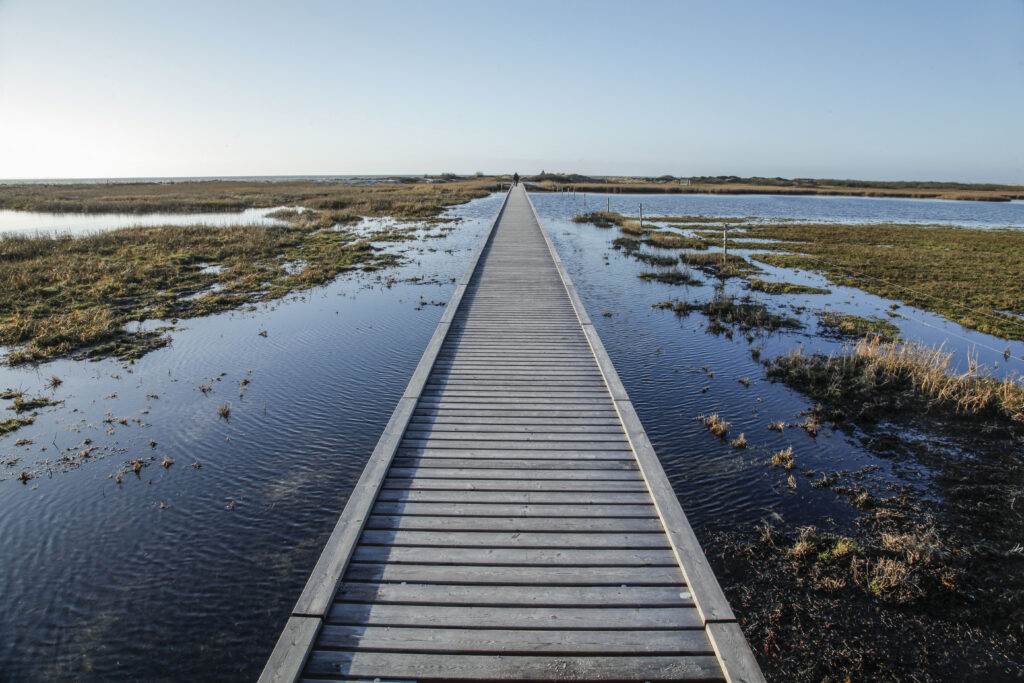
Initially inundated during the Christmas hurricane of 1902, now a tranquil walkway guides visitors towards the sea at Korevle, Sejerø Bay, one of the most classical barrier island coastlines in Denmark. (© Claus Starup)
Future horizons
Beyond education and outreach initiatives, Jakob and the geopark team are called upon as experts on the local area to help inform climate resilience strategies, particularly in relation to conserving nature and rewilding the area. As such, Geopark Odsherred has a role to play in Denmark’s ongoing development of the Green Tripartite Agreement. This landmark deal between the government, agriculture and environmental groups aims to align climate, nature and land-use goals by transforming 15 per cent of the country’s agricultural land into wild natural landscape, thereby supporting biodiversity and coastal ecosystems in particular.
Questions remain about how to compensate those whose livelihoods are affected. However, Jakob is optimistic that the Green Tripartite Agreement may be mutually beneficial, with Geopark Odsherred showing what can be achieved when the landscape and local community are considered hand-in-hand, as well as the potential for funding to support the geopark’s future goals. Already, a multi-million-pound outreach project is underway to inform locals on the need for and best ways to harmoniously achieve this Agreement, so the integration of local voices into national strategy looks set to keep Denmark’s glacial landscapes at the heart of its future.
An emerging landscape
UNESCO Global Geoparks encompass geological landscapes and cultural heritage sites that provide enjoyment, education and a framework for conservation and sustainable development. UNESCO provides financial support for some of these protected areas, which are vital not only for preserving environmental and social history but also for raising awareness of pressing issues such as climate change, natural hazards and the sustainable use of resources. The geoparks instil pride and a sense of place in local communities, while also attracting international visitors and contributing to global geotourism.
While not characterised by dramatic mountains, volcanoes or tectonic activity, Denmark’s more ‘subtle’ geology is important for understanding Earth’s history. Shaped by repeated Ice Age glaciations, the moraines, outwash plains and fertile soils tell a story of glacial landscapes, coastal evolution, and human-nature interactions that are reflected in the country’s three UNESCO-designated geoparks: Odsherred, Vestjylland, and the South Fyn Archipelago.
Odsherred was designated a UNESCO Global Geopark in 2015 – the first in Denmark to achieve this status. Comprising hills, lowlands and beaches, Odsherred exhibits a wealth of textbook glacial landforms, including numerous terminal moraines and a large glacial erratic affectionally known as The Pocket Stone. The strong ties between the natural world and cultural history are evidenced by a folklore story that says a troll threw this stone in a bout of frustration.
Vestjylland was officially recognised as a UNESCO Global Geopark in 2018. Dominated by the Main Stationary Line, this boundary between a hilly glacial landscape to the north and flat outwash plains to the south formed during the last Ice Age between 115,000 and 11,700 years ago.
The South Fyn Archipelago, formally designated a UNESCO Global Geopark in 2024, is an inundated glacial landscape. Comprising 55 islands that developed approximately 8,000 years ago when rising sea levels flooded the region at the end of the last Ice Age, this geopark also represents Holocene coastal development, believed to have formed within the span of a single human generation.
Author
Jakob Walløe Hansen is Head of Outreach and Education at UNESCO Global Geopark Odsherred and Chair of the Geological Society of Denmark.
Interview by Hannah Bird, Associate Editor, Geoscientist magazine
Citation: Walløe Hansen, J. Landscapes of identity. Geoscientist, 36 (1), 44-46, 2026. DOI: 10.1144/geosci2026-008.