Forged by fire
Catherine Hickson reflects on a career shaped by fire, curiosity and the courage to reinvent


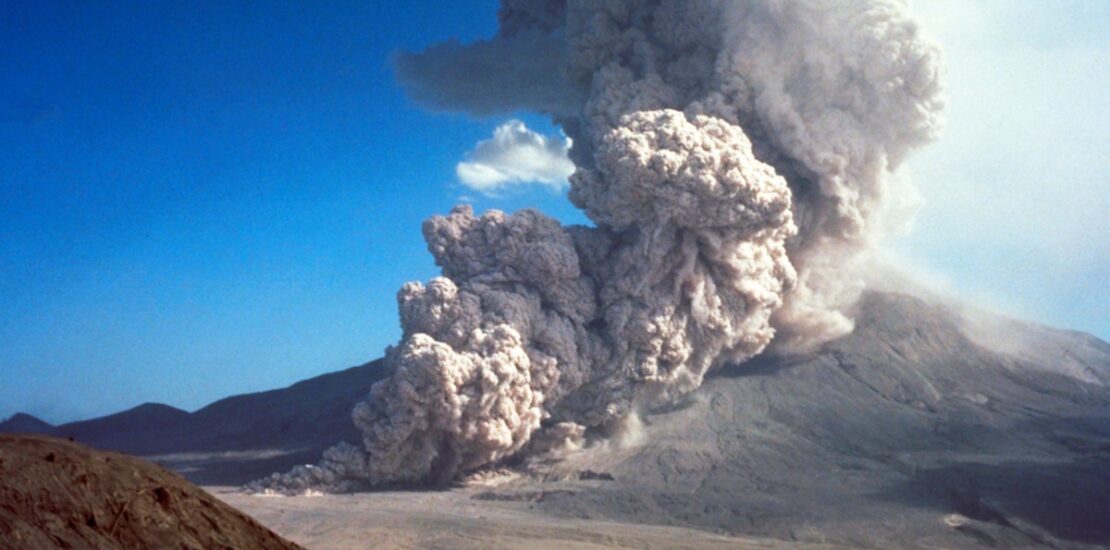
Viewed from Johnston Ridge, a pyroclastic flow surges down Mount St Helens during the 1980 eruption. (© Peter Lipman / United States Geological Survey)
Few geoscientists can say their career trajectory was altered in real time by a volcanic eruption, but volcanologist and geothermal geoscientist Catherine Hickson certainly can. She is also a rare example of a scientist who has moved fluidly between research, science management, diplomacy and industry leadership while remaining deeply committed to public education and community engagement.
From curiosity to calling
Catherine’s lifelong commitment to the natural world began with summers spent at a cabin on Lac La Biche in northern Alberta, Canada.
“I was fascinated by the ‘white sand’ on the beach there,” she recalls. “After a storm, the mixture of quartz, feldspar, garnet and magnetite were sorted by the waves into a rainbow of colours that intrigued me.”
Catherine didn’t yet have the language to describe gravitational sorting or sedimentary processes, but geological questions were already forming. Visits to national parks, like Banff and Jasper in Canada and Yellowstone and the Grand Canyon in the US, further made geology tangible.
Those early experiences planted a seed, but Catherine did not initially imagine herself as a volcanologist. When she began studying geology at the University of British Columbia, Catherine assumed she would become a sedimentologist and work in Alberta’s Western Canada Sedimentary Basin. Then, in May 1980, Mount St. Helens erupted.
When theory met fire
“Mount St. Helens was definitely a life-changing event,” Catherine says.
At the time, she was finishing courses in both volcanology and sedimentology. The eruption and the catastrophic lateral blast that followed collided directly with debates she was encountering in the classroom about how pyroclastic flows behaved.
“As I watched the explosively ejected mass cascade down the sides of the mountain, there was no doubt in my mind that this was turbulent flow. Much of the prior work of pyroclastic flows had been conducted by igneous petrologists but my sedimentology background gave me a different lens.”
That insight became the foundation of her undergraduate thesis. With support from the United States Geological Survey, Catherine was able to conduct fieldwork on Mount St. Helens itself, collecting samples from the blast deposit. Her work helped characterise it as a pyroclastic surge laid down under turbulent, high-energy conditions.
That interdisciplinary approach of igneous and sedimentological training would become a defining hallmark of Catherine’s career. Over time, it enabled her to integrate volcanology with hazard assessment, land-use planning and energy development.

Catherine explores the “volcanic paradise” of Cappadocia, Turkey. (© Leah Finlayson)
In service of society
This background led naturally into doctoral research, where Catherine focused on the Wells Gray–Clearwater Volcanic Field in British Columbia, supported by the Geological Survey of Canada’s (GSC) geothermal research programme. Volcanism in the region is as young as 5,000 years old, raising the possibility of associated geothermal resources. This became a focal line of research, given her supervisor Dr Jack Souther was one of Canada’s geothermal pioneers.
“I had the opportunity to do temperature logging, be present during drilling, and even see a well power a small portable steam turbine while at Mount Meager,” she says. “That had me hooked on geothermal.”
Catherine then joined the GSC as a research scientist and spent the next quarter-century there, working on volcanic mapping, hazard assessment and regional geology. She ultimately achieved Research Scientist Level 05, the highest attainable rank within the Canadian public service research stream and one reached by only a small number of scientists nationwide.
Key milestones include working with the Province of British Columbia on Thunderbird III, a large-scale civil protection exercise built around a hypothetical eruption of Mount Baker in Washington State, testing cross-border emergency response and public safety coordination. Furthermore, between 1990 and 2008, she chaired Canada’s Interagency Volcano Response Committee, coordinating volcanic emergency preparedness across multiple government departments and working closely with US counterparts – critical because the greatest threat from volcanism comes from across the Alaska and Washington State borders. Her efforts contributed to changes in international aviation safety regulations through the International Civil Aviation Organization, a legacy that continues to shape how aircraft operate during volcanic crises worldwide.
Her work also expanded beyond national borders through the Multinational Andean Project (MAP), a long-running multi-million-dollar collaboration between South America’s Andean nations and Canada. MAP began by honing technical and research skills so the geological surveys of the participating nations (Argentina, Boliva, Chile, Colombia, Ecuador, Peru and Venezuela) could provide the best possible geological information to their citizens and companies, before evolving to focus on hazard and risk analysis for volcanoes, earthquakes and landslides. MAP created a network of professionals within South America who met twice a year and undertook field trips so that everyone could experience another country’s geology and associated hazards.
“What I learned is that if you don’t work early and often with local communities, nothing will happen. You can’t reduce risk without the support of the people who live with it every day. We saw lots of reports by other aid programmes gathering dust because they were not well aligned with what the country’s geoscience priorities were and didn’t focus on capacity building for staff. We were able to make some critical changes in a few communities, which made them safer and hopefully, in the long run, will save lives.”
We made critical changes in communities, which made them safer and will hopefully save lives
Resilience and reinvention
In 2008, Catherine made her first major career pivot. After more than two decades in the public sector, she was recruited into the private geothermal industry during a period of intense global optimism for renewable energy.
“It was extremely exciting,” she says. “Our company bought operating assets in Iceland and the US, before acquiring projects in Italy, Chile, Peru and other countries. I was involved in all aspects of the identification and utilisation of the resource, from greenfield and brownfield exploration to resource management.”
But geothermal, like many resource sectors, is volatile. When oil prices collapsed in the mid-2010s, investment appetite shifted. Catherine found herself overseeing the divestment of geothermal assets and contemplating her next move.
With Alterra Power Corp.’s decision to no longer support geothermal exploration and projects, Catherine decided to found her own company, Tuya Terra Geo Corp (TTGeo). Through TTGeo, she has supported geothermal development, lithium exploration and public engagement initiatives, bridging scientific insight with decades of experience navigating government, industry and community relationships across North America, South America and Europe.
“Consulting is cyclic,” she cautions. “Sometimes there’s more work than you can handle, other times are lean. You need economic security to weather that. My best advice for start-up companies is to use contractors rather than build up an employee base early on as it is more flexible and far less risky.”
Beyond her own company, Catherine was lead amongst the researchers who resurrected Geothermal Canada in 2018, which morphed from the Canadian Geothermal Association established in 1974. A name change and reinvigoration of the organisation led to re-establishing a national voice for geothermal research and development after some years of dormancy. Officially registered as the Pan-Canadian Society for Geothermal Research, Innovation & Collaboration, the organisation reflects renewed interest in geothermal’s role in Canada’s energy transition. Calgary, Alberta, will be hosting the World Geothermal Congress 2026 in June of this year, an important milestone for Canada on the geothermal development pathway.
Today, Catherine serves as CEO of the Alberta No. 1 Geothermal Energy Project, the province’s first conventional geothermal heat and power facility. Here, she is involved in an innovative project showing the value of hot oil-field brines for energy production, as well as potentially linking geothermal energy with carbon sequestration. While funding challenges have paused progress on the latter, Catherine remains hopeful that “it’s time will come”.
New players bring novel ideas and technology — that’s where progress comes from
The next horizon
Despite decades in the field, Catherine remains energised by what lies ahead. In volcanology, she sees advances in eruption forecasting, vital for risk mitigation, particularly in densely populated regions. In geothermal energy, she is excited by the emergence of advanced and engineered geothermal systems, supported by new public investment worldwide.
“These new players bring novel ideas and technology,” she says. “That’s where progress comes from.”
For Catherine, progress is not only technological, but human. It comes from continued personal evolution, following curiosity and opportunity rather than a fixed path. Catherine believes visibility and connection are the two key drivers allowing people to make career pivots at any point.
“Being seen matters,” she says. “Go to meetings. Present your work. Talk to colleagues. Volunteer for mentorship. Stay connected to students as they keep you relevant and close to research.”
That belief in connection extends beyond professional networks to the public sphere. She has long been a passionate science communicator, writing and co-authoring several books for the public, including Surviving the Stone Wind, a first-person account of the Mount St. Helens eruption. Thousands of schoolchildren have heard her speak through decades of outreach, field trips and public lectures.
As a founding member of the Scientists and Innovators in Schools program – which for 36 years connected working scientists with classrooms across British Columbia – Catherine helped build what became the longest-running volunteer outreach initiative at Science World (scienceworld.ca), shaping how thousands of students encountered science as something lived rather than abstract.
She continues to advise geothermal developers, collaborate on research proposals, mentor early-career scientists, and contribute to national conversations about energy transition and geological risk. If Catherine’s own career offers a lesson, it is that reinvention is not a detour from a scientific profession, but one of its most powerful tools.
Author
Dr Catherine Hickson is currently CEO of Alberta No. 1 as well as President of her own company, Tuya Terra Geo Corp. In addition, she is currently Past President of Geothermal Canada and helped found a new industry group, the Canadian Geothermal Industry Alliance, of which she is a Director. She holds professional geoscience accreditation in several of Canada’s Provinces and Territories.
Interview by Hannah Bird, Associate Editor, Geoscientist magazine
Further reading
Hickson, C.J. (2005) Surviving the stone wind: A personal account of the May 18 1980 Eruption of Mt. St. Helens. Tricouni Press, Vancouver, British Columbia. 96 pp.