Quest for life
Could life thrive in Europa’s subsurface ocean? Erin Leonard shares how the Europa Clipper mission is bringing us closer to the answer


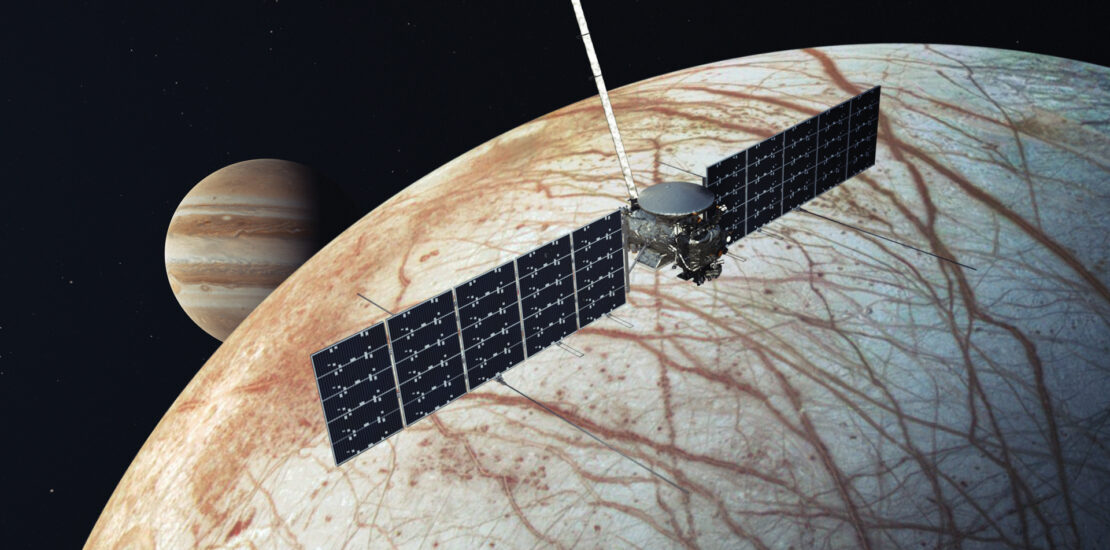
Artist’s concept of the Clipper spacecraft silhouetted against Jupiter as it passes over Europa (courtesy NASA/ JPL-Caltech).
“I have been interested in space for as long as I can remember,” Erin Leonard reflects. But like many scientists, her path into planetary science was not straightforward. It wasn’t until the end of her undergraduate degree studying Astrophysics and Planetary Science that she realised she could turn her fascination into a career.
A summer research internship at NASA’s Jet Propulsion Laboratory (JPL) in California, where she investigated the properties of lunar regolith, proved to be the turning point. “After that summer, I knew I wanted to do something in planetary science because I fell in love with developing and testing hypotheses around the mysteries in our Solar System.”
One image in particular changed everything: the first time she saw the surface of Europa, the smallest of Jupiter’s major moons. “The incredibly complex surface hooked me and beckoned to me like a puzzle that needed to be solved.”
Today, Erin is a research scientist at JPL focusing on the structural geology of icy surfaces in the outer Solar System, particularly the moons of Jupiter, Saturn and Uranus. She led a project with the United States Geological Survey to create a global geologic map of Europa in 2024, providing valuable insights to help refine hypotheses about Europa’s habitability and guide the observational priorities of satellite missions. As such, she used the moon’s landscape as a window into its hidden interior.
Europa’s complex surface beckoned to me like a puzzle that needed to be solved
Bridging science and engineering
On NASA’s flagship Europa Clipper mission, which launched in October 2024 and is due to arrive at Jupiter’s system in 2030, Erin holds a pivotal dual role: Project Staff Scientist and Strategic Science Planning Lead. That means balancing science priorities with engineering constraints.
“I work for the Project Science group, which essentially serves as the bridge between the science and engineering parts of the team,” she explains. “As Strategic Science Planning Lead, I work with the instrument science teams to communicate our collective priorities to the engineering team, who then design the tools and spacecraft needed to achieve those goals and work reliably for decades in the harsh conditions of space. Without close coordination between scientists and engineers, a mission risks being scientifically ineffective or technically unfeasible. Together, science and engineering turn ambitious ideas into successful and cost-effective exploration.”
This coordination ensures that Europa Clipper doesn’t just return intriguing images but systematically addresses the mission’s overarching goal: to determine whether Europa could be habitable.
Exploring Europa
Europa differs from Earth’s rocky moon by having a water-ice shell and a liquid ocean beneath its crust that holds more water than all of Earth’s oceans combined. Its geologically young surface is characterised by chaotic terrains – linear cracks, ridges and ‘rafted’ ice blocks – that suggest interaction between ice and liquid water. Current scientific understanding suggests Europa’s subsurface ocean is similar to Earth’s, and because we think life here originated at seafloor vents, it is therefore possible that life has developed in Europa’s oceans, if the right conditions exist. Some of the critical questions being asked during the mission are: How deep is the ocean? What is its salinity? Does it contain the chemical ingredients necessary for life? And how does ocean material interact with the surface?
To address these questions and more, Europa Clipper will orbit Jupiter in a long elliptical trajectory and perform multiple flybys of Europa, rather than orbiting or landing on the moon (due to the extremely high levels of damaging radiation caused largely by Europa’s orbit within Jupiter’s powerful magnetosphere). “Flybys allow the satellite to collect detailed data during close passes while spending most of its time outside the intense radiation environment,” Erin explains. A future lander remains a tantalising possibility, especially once Clipper provides reconnaissance of potential safe and scientifically valuable landing sites.
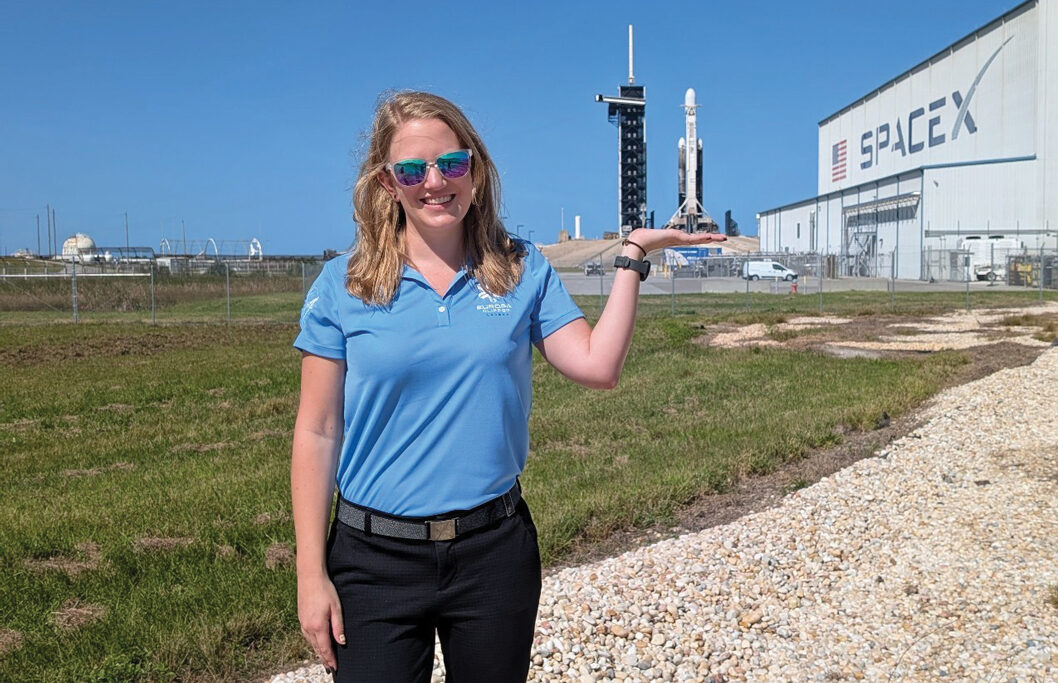
Erin visited the Europa Clipper spacecraft the day before its launch atop SpaceX’s Falcon Heavy rocket from NASA’s Kennedy Space Center, Florida (© Erin Leonard).
In the meantime, Clipper will collect a breadth of data to aid understanding of Europa’s geology, composition, interior and potential current activity (such as tectonics, cryovolcanism and thermal anomalies). For example, high-resolution images (down to approximately 0.5 metres per pixel) and stereo-topography aim to capture detailed views of Europa’s surface features, such as the unique double ridges that are thought to form when pockets of liquid water freeze and expand beneath the surface, the broken chaos terrain consisting of jumbled, drifting ice blocks, and the transient plumes hypothesised to be geysers originating from the icy crust or subsurface ocean.
Thermal imaging aims to detect heat variations across the moon’s surface, helping to identify warmer regions that could indicate recent or ongoing geological activity, or interactions with the subsurface ocean. Ice-penetrating radar will attempt to constrain the thickness of the icy shell and identify pockets of water, while magnetic data will be used to constrain the depth, thickness and salinity of the subsurface ocean.
Near-infrared spectral data will provide insights into the chemical composition of Europa’s surface by identifying salts, organics and other materials that may have originated from the ocean below. Ultra-violet spectrography will target Europa’s exosphere, providing insight into the composition of the moon’s thin atmosphere and identify potential water vapour plumes that may erupt from the subsurface ocean below. Likewise, dust and gas mass spectrometers will be used to identify the composition of ejecta, such as salts and organic molecules in expelled ice grains and atmospheric gases, thereby revealing the chemistry of the subsurface ocean and its potential for habitability.
Together, science and engineering turn ambitious ideas into successful and cost-effective exploration
“This thorough investigation of Europa is one of the things that makes Clipper so interesting and exciting,” Erin enthuses. “We are going to learn so much about every aspect of Europa, leading to an especially powerful and impactful scientific dataset that we will learn from for generations to come.
“When we ‘Dare Mighty Things’ (JPL’s motto) and push the boundaries of exploration, there will always be challenges. It is a testament to the creativity, intelligence and strong communication of the engineering and science teams that Europa Clipper was able to overcome any challenges and launch on time. Post-launch, the spacecraft has been performing well so far. I think the biggest challenge (and greatest gift) that we will face when it arrives at Europa is having so much amazing data, which will take decades to fully analyse!”
Ocean worlds
The Europa Clipper mission follows in the footsteps of Galileo, which orbited Jupiter from 1995 to 2003, and Juno, currently studying Jupiter’s interior and atmosphere. But Clipper is different: it is the first mission dedicated solely to Europa.
Erin highlights its complementarity with the European Space Agency’s JUICE mission, launched in 2023. While JUICE will primarily focus on Jupiter’s largest moon, Ganymede, both spacecraft carry similar instruments and will operate in the Jupiter system simultaneously. “That provides key opportunities for both science teams to cross-calibrate the instruments so that we can all understand the science data better and increase the scientific return of both missions.”
Ultimately, the Europa Clipper mission is more than a quest to study a single moon. It is a cornerstone in NASA’s broader exploration of ‘ocean worlds’, such as Saturn’s moons Enceladus and Titan, where hidden seas may also harbour conditions for life.
“The mission prepares the way for future landers or life-detection missions, while advancing the technologies needed to explore harsh, distant environments in the Solar System,” Erin states.
For now, Europa remains a puzzle waiting to be solved. Thanks to Europa Clipper – and the scientists and engineers behind it – the coming decades promise to reveal whether this icy moon could be another cradle for life.
Dr Erin Leonard
Planetary Geologist at NASA’s Jet Propulsion Laboratory, California, USA
Interview by Hannah Bird, Associate Editor of Geoscientist.
Further reading
- Europa Clipper Mission Overview; science.nasa.gov
- Leonard, E.J., Patthoff, D.A. & Senske, D.A. (2024) Global geologic map of Europa. USGS Scientific Investigations Map 3513 (prepared in cooperation with NASA); doi.org/10.3133/sim3513
Citation: Leonard, E. Quest for life. Geoscientist 35 (4), 38-40, 2025. DOI: 10.1144/geosci2025-035