Celebrating Hutton
Robert Gatliff, Angus Miller and Stephanie Flude report on efforts to make Siccar Point – the birthplace of the concept of ‘deep time’ – a destination for a wider audience

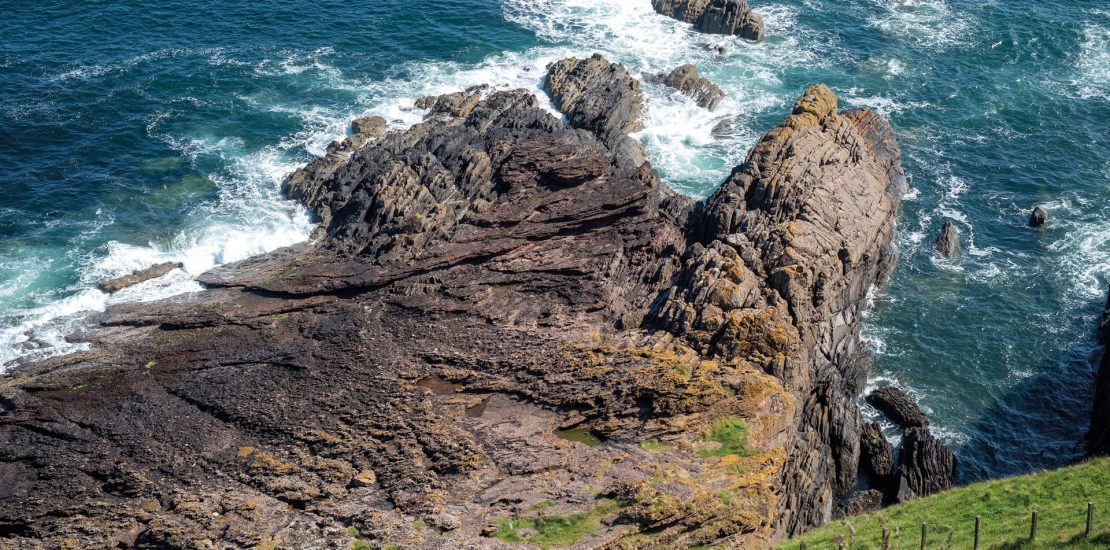
Siccar Point on the east coast of Scotland is considered by many to be the most important historical geological site in the world, but access to the site is difficult. (© Alamy)
Most geologists recognise James Hutton as one of the founders of modern geology, but his contributions to science and agriculture are not so well known by the wider public. 2026 marks the 300th anniversary of Hutton’s birth, and we are taking the opportunity to celebrate his work and highlight his achievements to as many people as possible.
Pioneer of ‘deep time’
Hutton [1726 – 1797] was a star of the Scottish Enlightenment period and a world-class polymath, with a doctorate in medicine; a farmer who introduced tremendous agricultural improvements at a time when food was scarce in Scotland; the first to make regular measurements of temperature variations with altitude; a successful businessman with a factory in Edinburgh making sal-ammoniac (used in dyes) from soot (very common in “Auld Reekie”); and the writer of the two volumes of his book Theory of the Earth. He was also an engineering geologist who worked on the route of the Edinburgh-Glasgow canal.
Hutton’s greatest geological achievement was his work in the Scottish Borders where he sought proof for his theory of Earth – the idea that our planet’s surface is continually recycled and regenerated by natural processes, such as erosion and sedimentation, that operate over immense periods of time.
He mapped out the tightly folded Lower Paleozoic rocks and the much less-deformed Old Red Sandstone. In 1788, he was able to find and demonstrate the evidence to support the concept of ‘deep time’ by predicting an unconformity between the two different successions: a brilliant, and maybe the first, use of the scientific method we use to this day.
Hutton found the unconformity at Siccar Point, where the dramatic junction between tilted layers of greywacke and the overlying, nearly horizontal layers of sandstone represent a 65-million-year gap in time. At a time when most people followed a biblical chronology for Earth, placing the planet at ~6,000 years old, Hutton had evidence that our planet had existed for aeons.
Siccar Point is considered by many to be the most important historical geological site in the world. Indeed, it is the first site in the UNESCO-supported book of the 100 IUGS Geological Heritage Sites (IUGS, 2022).
An account by the scientist and mathematician John Playfair [1748 – 1819] during his first visit to Siccar Point with Hutton in 1788 is a masterpiece in science writing: “the mind seemed to grow giddy by looking so far into the abyss of time”.
Indeed, it is a truly inspirational place. But it is not easy to get to. The route is not clear, bulls often occupy the neighbouring fields, and access is via a steep, grassy slope that can be too slippery to attempt in rain. For non-geologists, the international importance of the site and the sense of ‘deep time’ are not well conveyed.
It is essential not only to improve access to this globally significant landmark, but also to enhance the information provided and make it more engaging for the public. But how can we achieve this without damaging the site physically or spiritually?
It’s essential to improve access to this globally significant landmark and make it more engaging to the public
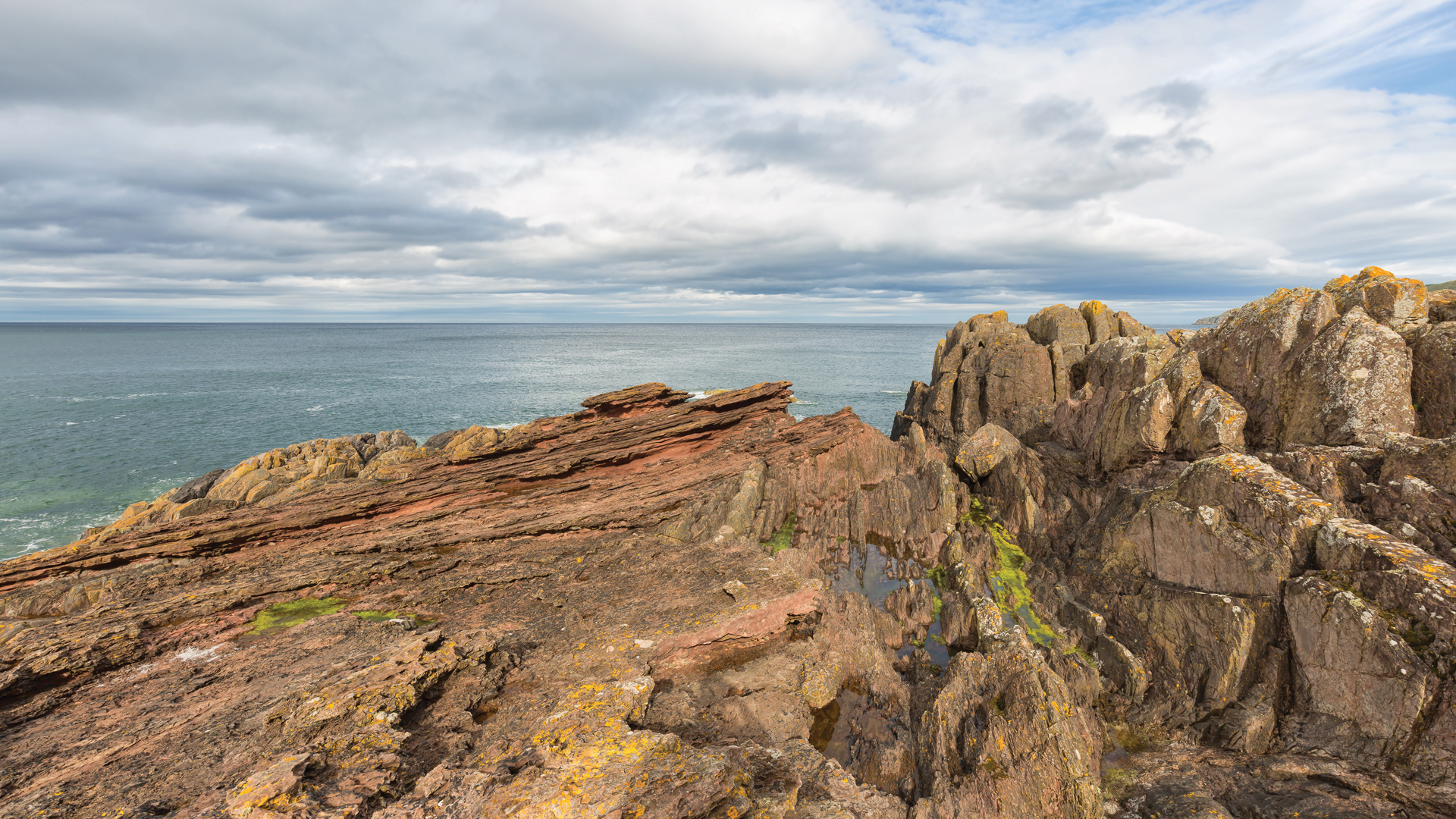
Hutton’s Unconformity at Siccar Point. Nearly vertical sedimentary rocks of Silurian age – greywacke sandstones and mudstones – are covered unconformably by a younger sequence of red sandstone and breccia. The time gap separating the rocks represents ~65 million years of Earth’s history. (© Shutterstock)
The concept
The local community (Cockburnspath), the local council (Scottish Borders), NatureScot, and the landowners and tenant farmers all broadly support improving access to Siccar Point. Edinburgh Geological Society therefore funded CMC Associates to develop and cost a plan to improve the route and lookout (Phase 1), to create a Deep Time Trail and Viewpoint.
The key elements of the proposal include:
- An improved walking route from the village of Cockburnspath with gathering points along the way (at Cove, Pease Bay, and the car park near Siccar Point). Making a clear path, removing barbed wire and enhancing the appearance of parking facilities.
- Branding the route as a ‘Deep Time Trail’ with improved information points en route, making the trail more attractive to local people, geo-pilgrims, day-trippers and long-distance walkers.
- Integrating different themes into the information, including details on James Hutton, the theory of ‘deep time’, the proof at Siccar Point and the impact of Hutton’s discoveries on culture, industrial development and the future.
- Above Siccar Point, the seminal spot where ‘deep time’ was essentially discovered, a new ‘Deep Time Viewpoint’ provides an appropriate focus and dedicated space for information, art and geopoetry that aims to challenge and inspire. The viewpoint will help explain and convey a new, creative exploration of geology, landscape, perceptions of time and space, and the human experience.
- Hutton’s transformative view of time will be explored, encouraging visitors to consider humankind’s place and legacy for the future.
- Links (such as QR codes) to inspiring digital audio-visual content and further resources.
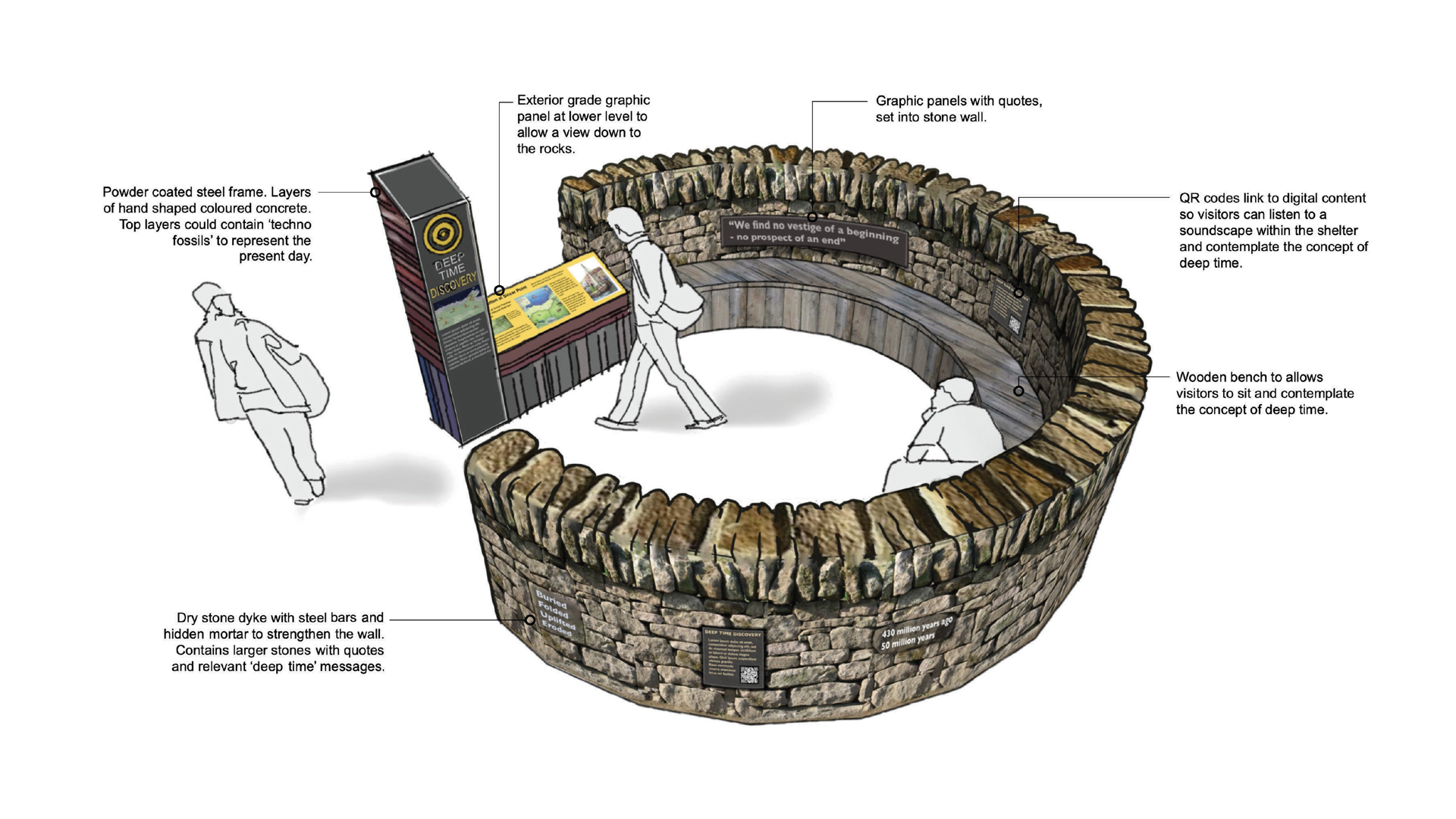
Artist’s impression of how the walk and viewpoint will look
Fundraising
Initial estimates for the development and installation of the Deep Time Trail and Viewpoint (Phase 1) are around £220,000. Edinburgh Geological Society has also asked geotechnical experts and landscape architects to look at possible designs for improved access via steps or a ramp to the foreshore (Phase 2). Additional funding will be required to undertake site investigation, and to then develop a preferred design for and installation of a way down the grass slope to the rocks at Siccar Point, which we can present as a formal plan to authorities.
The Scottish Geology Trust is leading the fundraising efforts. A crowdfunder will be held this autumn (15 September – 27 October). The initial target is to raise the funding for the Deep Time Trail and Viewpoint, but we hope to achieve a contribution towards development of the route down the slope to the foreshore.
We will also apply for funding from other sources.
We plan to reward significant donations to the crowdfunder. We are delighted that we have copies of John Clerk of Eldin’s ‘Lost Drawings’ from Hutton’s Theory of the Earth, donated by the family of John Clerk, as well as other unique gifts including a ‘Hutton Hat’ – hand-knitted showing Hutton’s three most significant outcrops (Glen Tilt, Siccar Point and Salisbury Crags).
More Information
To find out more about the crowdfunder and how to donate, visit: scottishgeologytrust.org/crowdfunder
For more information on the plans for Siccar Point and other tercentenary activities, visit: james-hutton.org
Celebrations for 2026
To celebrate James Hutton’s life and work, there are plans to publish his unfinished treatise on agriculture for the first time. A Geological Society Special Publication is in preparation; there will be a Scottish Geology Trust Hutton-themed festival; and no doubt other field trips, exhibitions and meetings will run throughout next year.
Authors
Robert Gatliff, Edinburgh Geological Society, UK
Angus Miller, Edinburgh Geological Society, UK
Stephanie Flude, Scottish Geology Trust, UK
Further reading
- IUGS (2022) The first 100 IUGS Geological Sites. ISBN: 978-1-7923-9975-6
- McKirdy, A. (2022) James Hutton, The Founder of Modern Geology. National Museums Scotland.
- Perman, R. (2022) James Hutton, The Genius of Time. Berlinn Ltd., Edinburgh.
- Schuchmann, J.B. (2023) James Hutton’s stay in Leiden. Leidse Geologische Vereniging, Leiden.
Citation: Gatliff, R., Miller, A. & Flude, S. Celebrating Hutton. Geoscientist 35 (3), 36-38, 2025. DOI: 10.1144/geosci2025-024.