


Richard Lisle (1948 – 2024)
Structural geologist, respected teacher, and long-standing member of the Tectonic Studies Group community
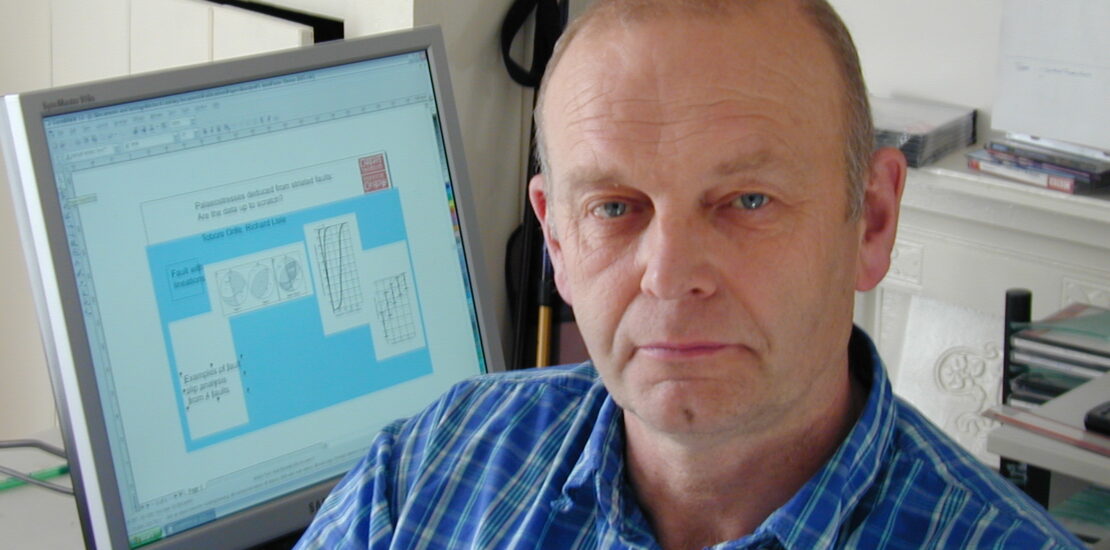
© Ann Lisle
Professor Richard Lisle was born in Broadway, Worcestershire, on 3 June 1948 and died on 28 October 2024 after a long illness. He studied geology as an undergraduate at the University of Birmingham, then moved to Imperial College London to complete the new MSc Structural Geology and Rock Mechanics course, graduating with distinction. He stayed on as a PhD student under Professor Janet Watson, working on the structural analysis of the Lewisian basement rocks of northwest Lewis, Scotland. After a short stint as a lecturer at the City of London Polytechnic, he moved to Leiden University, Holland, in 1974, which later merged with and relocated to Utrecht, until he moved to Swansea University in 1983. With the merger of the Swansea and Cardiff departments in 1989, he moved to Cardiff University for the rest of his career and was promoted to a personal chair in 2002.
Research and scholarship
Over 30 years, Richard was a prolific researcher, producing 94 papers and authoring or co-authoring 5 textbooks that have proved influential with students. Strongly influenced by John Ramsay, Richard had a long-standing interest in the geometry of deformed rocks, from the development and refinement of methods for strain analysis, through the quantification of the description of geological structures, and the analysis of paleostresses using the geometry of striations on fault planes. All these research directions were pursued most thoroughly and with great ingenuity and originality. Richard was a long-standing member of the Tectonic Studies Group (TSG) of the Geological Society of London. It was a pleasure to listen to his original analyses of problems in structural geometry at the annual TSG meeting.
The impact of his work was profound and will stand the test of time
Service to the community
Throughout his life Richard formed collaborations and made academic visits to other geologists worldwide. He became highly respected as a teacher, and since his death, many ex-students and collaborators have consistently complimented Richard’s kindness, approachability, willingness to listen to the points of view of others, and to help develop ideas where appropriate.
TSG was a large focus for Richard’s service to the community, serving as Secretary between 1983 and 1985. He served as editor of the Journal of Structural Geology, had editorial and reviewing responsibilities for several other leading journals, and delivered invited lectures in many countries worldwide, a mark of wide international recognition.
Later years
A self-confessed Hispanophile, Richard and family bought an old stone house in the wilds of Asturias, northern Spain. He intended to spend a lot of time there to pursue his interests in Cantabrian geology and collaborating with colleagues at the University of Oviedo, sadly this was recently cut short by his illness. His loss will be keenly felt by the structural geology community, not only in the UK but in many other parts of the world. The impact of his work was profound and will stand the test of time. Richard is survived by his wife Ann, two sons, and five grandchildren.
By Ernest Rutter and Susan Treagus


