Geoscience skills at the heart of net zero
The Society has launched a new webinar series, exploring how geoscientists can contribute to and benefit from the global energy transition
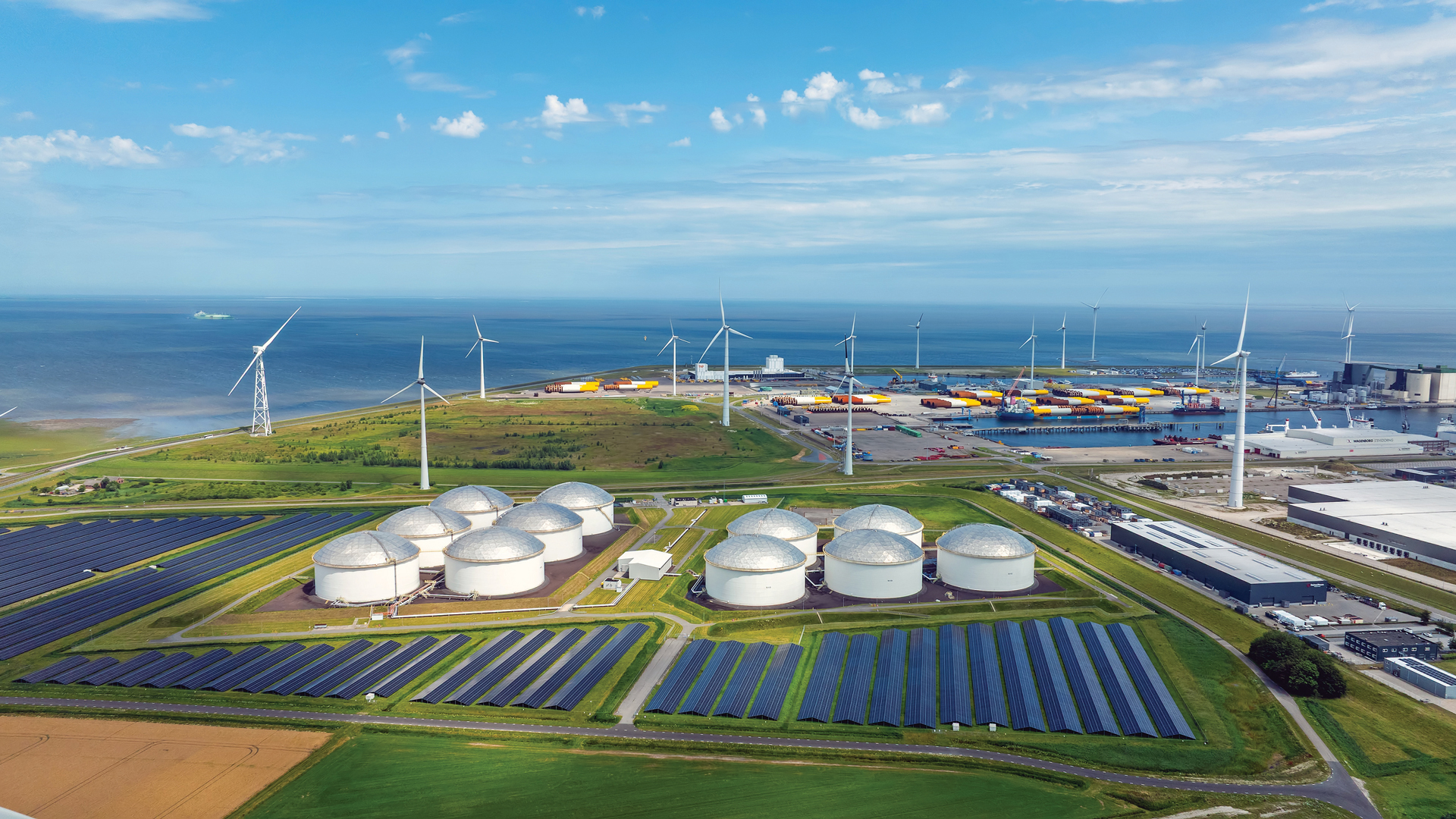
Aerial view of green hydrogen production associated with wind turbines and solar panels near Delftzijl in the Netherlands. (©iStock)
Led by the Society’s Strategic Science Theme Lead for Energy Transition, Bas Spaargaren, ‘Opportunities for Geoscientists in the Energy Transition’ brings together perspectives from industry, academia and emerging energy sectors to examine where geoscience expertise remains critical, and how established skills are being applied in new contexts.
From principle to practice
The series builds on earlier Society initiatives, including a 2021 webinar programme and the 2022 Energy & Material Transition Discussion Meeting, which helped frame the scale and complexity of the transition challenge. The current programme shifts the emphasis from principle to practice, focusing on delivery: how geoscience underpins investable projects, supports risk reduction, and enables decision-making across a rapidly evolving energy landscape. Each session combines short expert presentations with moderated discussion, encouraging reflection on skills development, education and evolving career pathways.
The launch webinar in December 2025 introduced the scope of the series and the breadth of opportunity for geoscientists. Chaired by Bas, the session featured speakers from across the energy system, including Professor John Underhill (University of Aberdeen), Syrie Crouch (Energex CCS), Owain Jackson (H₂Au) and Karize Oudit (CNOOC International). Contributions highlighted how core geoscience capabilities, including subsurface characterisation, uncertainty management, data integration and systems thinking remain central as energy systems diversify and decarbonise.
A recurring theme was continuity rather than replacement. Skills developed in oil and gas, mining, engineering geology and environmental geoscience are increasingly being redeployed in carbon capture and storage (CCS), geothermal energy, hydrogen and helium, offshore wind
infrastructure and critical mineral supply chains. Discussion also emphasised the growing importance of geoscientists who can operate across technical, commercial, financial and regulatory boundaries, particularly as projects move from concept selection through to permitting, final investment decision and deployment.
The second webinar, on 15 January 2026, focused on geothermal energy and its expanding role in the UK and Ireland, as well as internationally. Speakers included Rory Dunphy (Build Geothermal), Ellie MacInnes (WSP UK) and David Walls (TownRock Energy). The session examined deep and shallow geothermal systems, project delivery challenges and the role of public engagement in heat and power developments.
A strategic enabler
Across the full programme, ten more thematic webinars are planned, to also cover wind energy and subsea cables; hydrogen and helium; CCS; subsurface energy storage; nuclear siting and waste management; critical minerals; integrated energy; and the application of artificial intelligence and machine learning in subsurface analysis – areas where geological insight is central to managing risk, ensuring environmental integrity and delivering projects at scale. Taken together, the series positions geoscience not as a supporting discipline, but as a strategic enabler of the energy transition, reinforcing the profession’s relevance in a net-zero future.
Catch up on past webinars and register for upcoming sessions free of charge via: geolsoc.org.uk/science-and-policy/science-themes/energy-transition.