“Be curious, enthusiastic and get involved”
Dr Emma Watts is a postdoctoral researcher in tephrochronology at Swansea University, Wales
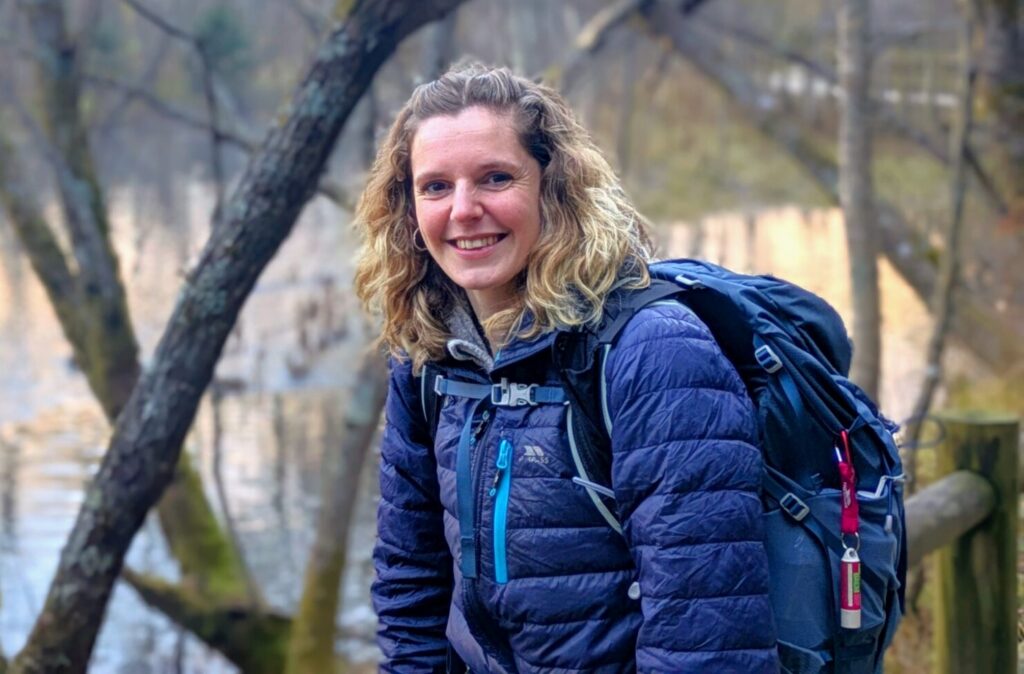
© Twm Jonathan
What are you currently working on?
As part of Dr Paul Albert’s UKRI Future Leaders Fellowship, I am using sedimentary records (marine, lacustrine and ice cores) to investigate the frequency and magnitude of large explosive eruptions across Japan, with the aim of facilitating long-term ash fall hazard assessments. We search for cryptotephras (tephra layers not visible to the naked eye) within the cores and geochemically fingerprint the volcanic glass to a volcano and, if possible, a specific eruptive event. Also, I have been on fieldwork with a team of great scientists to build a database of volcanic glass chemical compositions from known Japanese eruptions to help in the identification process. Alongside this, I am continuing to work on characterising volcanism and magma generation across the Main Ethiopian Rift and Afar region (East Africa), specifically trying to understand how the frequency and style of volcanism changes over a volcano’s lifetime.
What’s a typical day for you?
Some days I am in the lab processing sedimentary samples, looking for tephra layers or counting tephra shards under the microscope. On others, I delve into geochemical datasets, read the latest publications, or write my own.
What’s your favourite thing about your work?
Volcanoes are incredibly fascinating and each one is somewhat unique. I love the puzzle that they present, with each bit of new information or method unlocking a little more of the picture. I enjoy trying to apply this knowledge to how volcanoes shape the Earth and its processes. Additionally, I have been lucky to collaborate with creative, intelligent and genuinely lovely people across the world, who have made the work ever more enjoyable.
Have you encountered any challenges along the way?
Challenges are a part of science and life, so I feel without them the journey wouldn’t be as interesting. As with many people, COVID presented a significant challenge during my PhD as my research was laboratory-based, so I had to come up with innovative approaches to carry out my research. However, that time led me to some fantastic new collaborations and to learn methods I otherwise might not have known, helping me to develop multidisciplinary skills.
What advice would you give to someone hoping to work in your field?
Be curious, enthusiastic and get involved where possible. Learn a range of techniques, including coding and geographic information systems (GIS), and if you don’t understand something, ask. If you’re at university, attend seminars on a range of geology and geography topics, as that broader knowledge can really help. I also recommend joining the UK’s Volcanic and Magmatic Studies Group and attending their annual meeting. I went as a third-year undergraduate and it was the best decision as I learned so much about volcanology and met new people who I still keep in touch with now. The community is very friendly, you just have to be brave enough to take the plunge!