


Volcanoes: 10 Things You Should Know
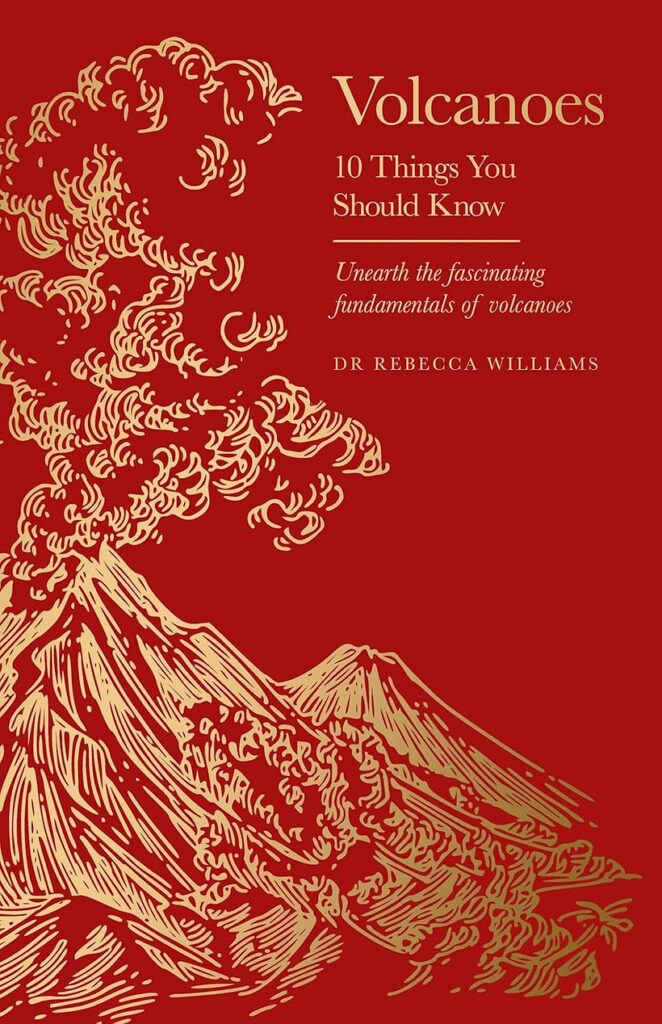
Volcanoes: 10 Things You Should Know does exactly what its title promises by offering a concise, engaging introduction to volcanology, aimed less at comprehensive coverage but instead orientating the reader within the subject and sparking curiosity to explore further.
Dr Rebecca Williams’ book is structured around short, vivid case studies that broaden into wider volcanological themes, a framing that works extremely well by presenting volcanoes as dynamic geological systems embedded within ecological, climatic and human contexts. A volcano forming in someone’s back garden leads naturally into discussions of monitoring networks and hazard mitigation; a seemingly inhospitable hot spring becomes a gateway to extremophile ecosystems and flamingos happily drinking near-boiling freshwater. These anecdotes are not decorative flourishes but the engine of the narrative, grounding big ideas in memorable ‘geological trivia’.
Throughout, volcanoes are presented not simply as destructive agents but as fundamental shapers of Earth systems and human history. The narrative moves confidently from agricultural fertility and geothermal energy to diamonds, precious metals and tourism, reminding the reader why people continue to live in (and often revere) volcanic landscapes. The cultural importance of volcanoes to Indigenous communities is handled with care, reinforcing that these landscapes are not just physical features but places of meaning and identity.
Volcanism’s influence is also shown to extend well beyond the eruption column, with climate perturbations, social unrest and ecological cascades treated with welcome nuance. The discussion of Tambora’s 1815 eruption and the subsequent “year without a summer” is particularly effective, tracing unexpected links between crop failure, cultural creativity (such as Mary Shelley’s production of Frankenstein) and technological innovation, including Baron Karl von Drais’s invention of a proto-bicycle following the loss of horses to famine. Longer-term consequences are highlighted too, with large igneous province volcanism introduced as a driver of profound global change, including the end-Permian mass extinction.
The tone is consistently accessible, almost conversational, as if a geology-savvy friend is excitedly sharing something they have just learned. Technical terms are carefully embedded and explained, making the book approachable for non-specialists while remaining satisfying for readers with formal Earth science training. A short list of suggested further reading would have nicely extended the book’s role as a springboard into deeper engagement.
The book is an enjoyable, quick read that refreshes familiar concepts and reframes them in a broader societal and planetary context. Its closing excursion into volcanism beyond Earth, encompassing our Moon and other planetary bodies, provides a neat reminder that volcanic processes are not uniquely terrestrial. Ultimately, this reminds us why volcanoes remain one of the most compelling intersections of geology, biology and human culture.
Reviewed by Hannah Bird
DETAILS
BY: Rebecca Williams (2025) Seven Dials, 128 pp.
ISBN: 9781399632577
PRICE: £12.99, available from Geoscientist’s bookshop


