


Space: Could Life Exist Beyond Earth?
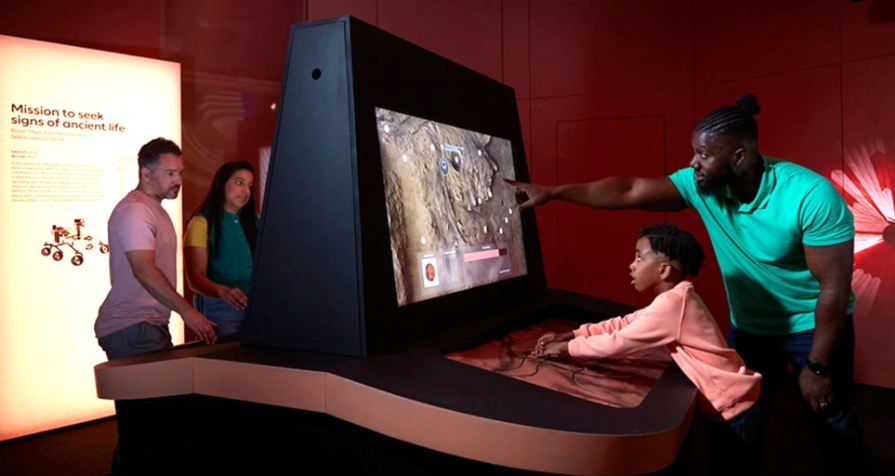
Interactive Mars rover stations help you explore the planet’s surface and virtually collect samples for a mission (© Natural History Museum).
The Natural History Museum’s new exhibition opens with a big question, one that has held the attention of scientists and the public alike for generations: could there be life beyond our planet? Space: Could Life Exist Beyond Earth? certainly makes you believe so! This exhibition highlights life’s origins from celestial chemical ingredients and the modern-day scientists following evidence of potential lifeforms on other planets, both in our Solar System and beyond.
The information is masterfully layered and designed to engage multiple senses. Rather appropriately for an exhibit about space, the rooms are darkly lit with spotlights on the various cabinets, projections and curiosities on display. This includes a collection of meteorites, each being an example of the various metals and minerals essential for building life, almost like a cosmic shopping list. Throughout the exhibition journey, visitors are gifted the opportunity of touching samples of space rock (some older than Earth itself!) giving a tangible thrill with the connection between life and minerals.
Intriguing “smell pods” are dotted around the rooms, built to give a sample of what scientists think extraterrestrial atmospheres could smell like, such as Mars and the moons of Jupiter. I will warn you now that if/when humanity colonises Mars, we are going to need permanent nose pegs against the iron-rich pong! Even the partitions between areas are decorated with twinkling, star-like LEDs and thick, bouncy carpet as if moonwalking between exhibit sections.
There are plenty of interactive points designed with children in mind, the most popular of which is a Mars rover simulator in which museumgoers are tasked with driving around the surface and searching for scientific finds. However, curious adults are not forgotten amongst the more eye-catching entertainment opportunities – each display is packed with information cards to carefully explain (even to a novice like me) how rocks can tell stories of potential past bacterial life and evidence water.
For any visitors who somehow reach the end of the exhibition still sceptical of the possibility of life beyond our planet, the curators have cleverly placed a fascinating display of animals on Earth who live at the extreme edge of conditions, evidencing how even the seemingly bleakest of environments may still harbour life. Is it then much of a stretch to imagine alien forms adapting to other planets?
You probably won’t exit this exhibition believing in little green men, but the possibilities it leaves you with for a plethora of other life forms are far more tangible and exciting.
Review by Claire Campey
DETAILS
LOCATION: Waterhouse Gallery, Natural History Museum, London
AVAILABILITY: Open until 22 February 2026
PRICE: £4-£16.50 nhm.ac.uk


