


The International Atlas of Mars Exploration: Curiosity, InSight and Perseverance
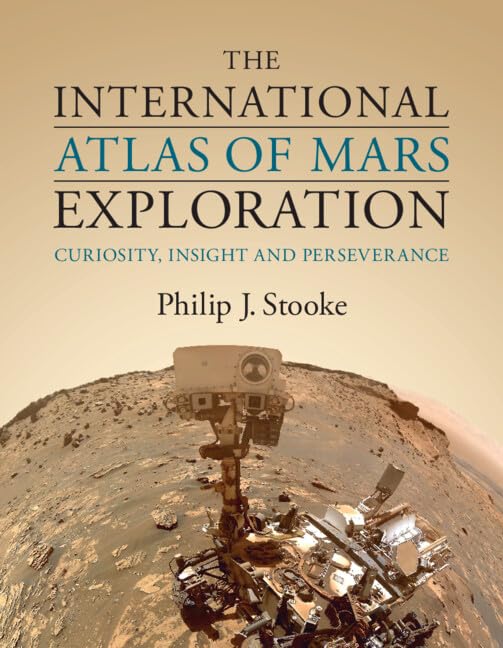
Mars exploration has reached a stage where its recent history is scattered across image archives, conference proceedings and thousands of mission updates. The third volume of The International Atlas of Mars Exploration series brings this material together in a meticulously organised visual record, tracing exploration from 2015 to 2021 through maps, diagrams, images, tables and sol-by-sol accounts.
Although described as an atlas, the book maps time as well as space. It charts the rover missions of Opportunity, Curiosity, ExoMars and InSight, followed by the new wave of missions launched in 2020, including Hope, Tianwen-1 and Perseverance. Landing-site selection, rover traverses, sampling sites and engineering events are all placed within their operational context, showing not only where a mission travelled, but how exploration unfolded.
One of the book’s main strengths is the detailed mapping. Rover routes are related to landforms, observation points, sampling sites and surface features, with Mars emerging as a landscape that can be read much like a terrestrial field area. The images and diagrams are both interesting and useful rather than merely decorative, clarifying mission sequences, geological settings and complex operational histories, whilst the maps reveal how mission priorities changed.
The level of detail is considerable, and the daily operational record can become repetitive; however, extensive tables and references make the atlas valuable for anyone needing to locate an event or reconstruct a mission sequence without searching numerous archives. As the author acknowledges, coverage is inevitably uneven because mission data are not equally accessible, with NASA missions documented more fully than those from China, for example. These are understandable consequences of the atlas’ ambition and source material rather than shortcomings of the book.
This volume is not a narrative introduction to Martian geology, nor is it designed to be read consecutively. Instead, it is a substantial reference work to explore visually and revisit whenever a particular site, sol or decision requires context. Stooke’s precision turns a vast, dispersed record into something coherent and accessible. For readers interested in planetary mapping, Martian geology or space exploration more broadly, it is an impressive and highly visual resource likely to be repeatedly returned to.
DETAILS
BY: Philip Stooke (2025), Cambridge University Press, 626 pp.
ISBN: 9781108907460
PRICE: £150, cambridge.org


