


The Wake of HMS Challenger: How A Legendary Victorian Voyage Tells the Story of Our Oceans’ Decline
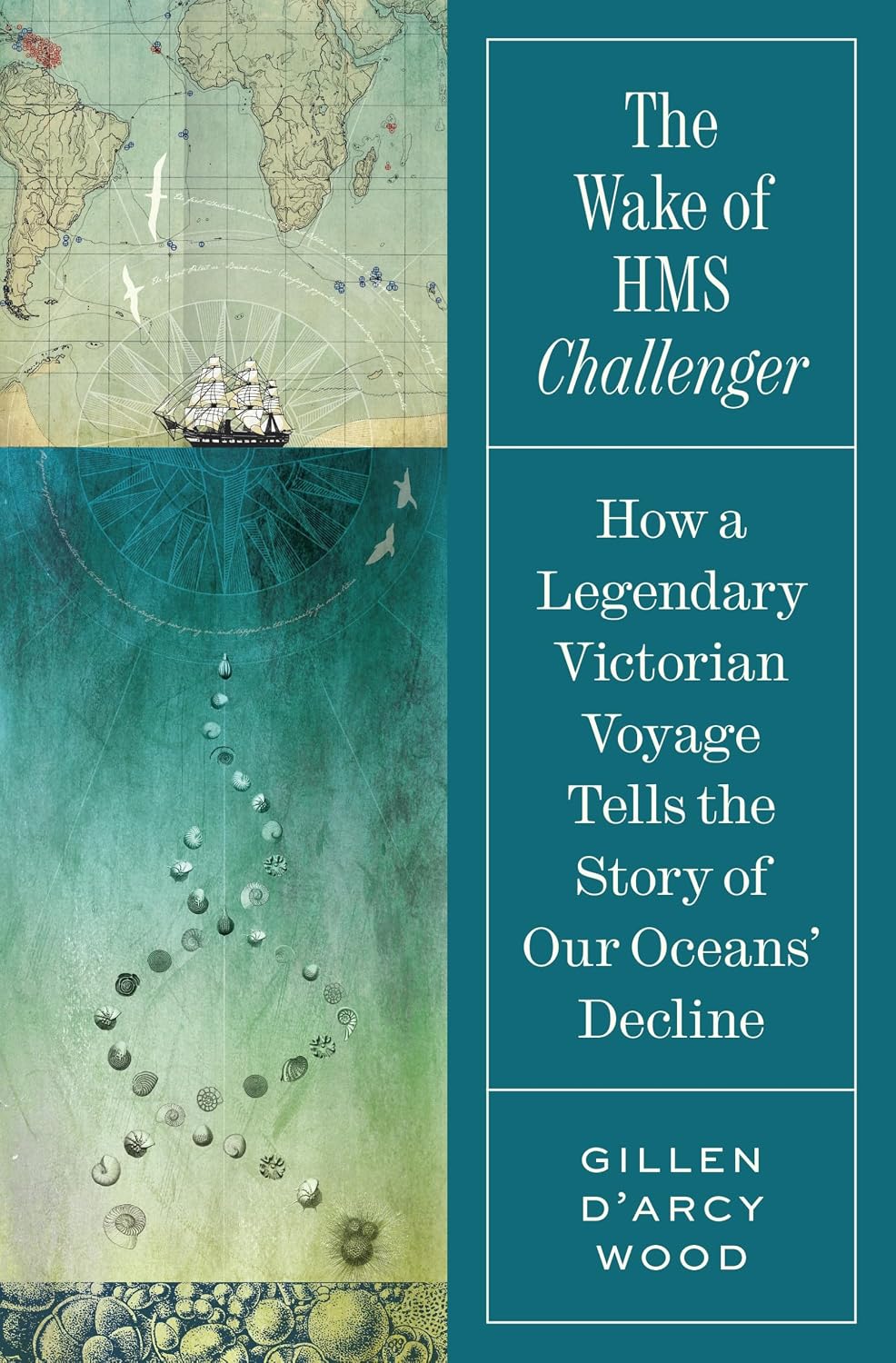
By the 1870’s, much of the world’s coastlines and shallow depths significant to safe navigation of ships had been charted, but almost nothing was known of the deep ocean. That was until the Royal Society hired the warship HMS Challenger from the Royal Navy to undertake research from 1872 to 1876. This first global scientific expedition of the deep ocean, its ecosystems and marine organisms is the subject of The Wake of HMS Challenger.
Science historian Gillen D’Arcy Wood details how HMS Challenger was converted to a floating marine laboratory with chemical apparatus, as well as trawls, dredges and 180 miles of hemp rope for depth soundings. Captain George Nares was commander for navigation and scientific operations, while Charles Wyville Thomson was chief scientist, both overseeing the expedition’s scientific crew comprised of three naturalists, two oceanographers and data collectors, a secretary-artist, a photographer and a dissection room supervisor. However, life below deck for the full 210 crew was awful, surviving on stale bread and salted meat in the cramped fetid darkness.
During the three-and-a-half-year circumnavigation of the globe, HMS Challenger travelled approximately 70,000 nautical miles, collecting sediment samples at over 360 stopovers. Measurements included ocean temperatures, flow rates and water chemistry data, and they dredged up over 4,700 previously unknown deep-sea lifeforms. Specimens were preserved for later analysis in brine or alcohol, or were dried. Other major findings included proving that life could exist below 550 meters, the circulation of globe-girding ocean currents, and discovering the deepest ocean floor point in the Mariana Trench, Challenger Deep.
D’Arcy Wood writes in a rich prose, particularly focused on the newly discovered creatures representing legs of the journey, but also highlighting key episodes of human endeavour and discovery. An up-to-date bibliography acknowledges the volume of journal articles and reports that have been published on the expedition’s findings. There is also a clear frontispiece map to help the reader follow HMS Challenger‘s criss-crossing of the oceans.
Whilst the content is mostly historical, D’Arcy Wood continually emphasises how profoundly our oceans have changed over 150 years, particularly due to overfishing, pollution and microplastics. As such, it provides a thought-provoking read for anyone on the next 150 years of ocean exploration and conservation.
Review by Richard Dawe
DETAILS
BY: Gillen d’Arcy Wood (2026) Princeton University Press, 328 pp.
ISBN: 9780691233246
PRICE: £25, available from Geoscientist’s bookshop


