


Harmonia Macrocosmica: The Finest Atlas of the Heavens
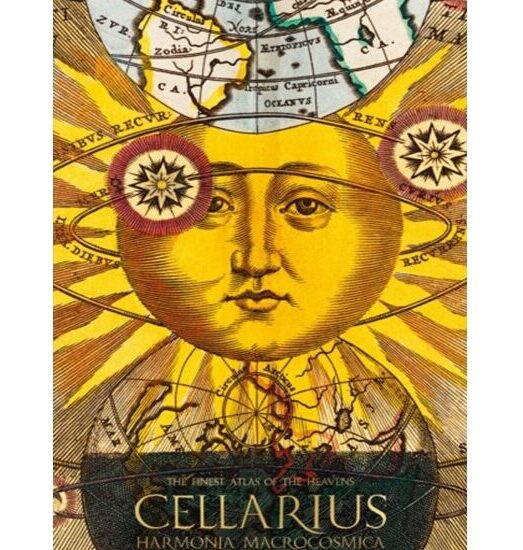
Cellarius Atlas, as it is more succinctly known, makes an immediate statement by its sheer size, as if it is a monument to celestial cartography. Housed in a decorative slipcase that echoes its gold-foiled cover, the book has all the ceremony of a collector’s piece. Upon opening, a curated gallery of 17th-century engravings are reproduced with a level of clarity and scale that allows every flourish of linework to shine.
The opening chapter’s text by astronomy historian Robert van Gent can be dense at times, packing a substantial amount of historical and scientific context into a small space. The narrative traces the long arc of humanity’s attempts to understand the heavens: from ancient cultural reverence for constellations, through early scientific attempts at stellar cataloguing, to the development of celestial mechanics to calculate the positions of cosmic objects and the transformational impact of telescopes and, later, astrophotography. It also sets the stage for Andreas Cellarius’ Harmonia Macrocosmica of 1660, the work faithfully reproduced and expanded upon here.
The 29 illustrative plates are the heart of the volume, with most elaborately depicting the Ptolemaic geocentric worldview, placing Earth at the centre of the Universe. There are dedicated plates for Nicolaus Copernicus (whose revolutionary worldview placed the Sun at the centre of the Universe) and Tycho Brahe (combining the two worldviews, where the Sun orbits Earth and the other planets the Sun). Some of the plates also show how knowledge of Earth’s landmasses, oceans and climate zones evolved over time, alongside depictions of the Sun’s daily path, Earth’s changing seasons and the Moon’s phases as they were understood in the 17th century. The final eight plates highlight constellations, beginning with Christianised interpretations before returning to the mythic figures familiar today.
What makes these plates so captivating is the fusion of science with classical artistry. Roman and Greek mythological figures swirl across the skies; astrology, alchemy, theology and astronomy intertwine; and historical instruments for celestial observation, like cross-staffs and dividers, appear as reminders of the labour involved in mapping the night sky.
The volume concludes with a concise glossary of key terms, a useful catalogue of the constellations referenced throughout, and a short biography of Cellarius that situates his work within the wider history of astronomy.
The production itself is exceptional, with thick pages, immaculate imagery and colours so vibrant they seem newly painted. While not a contemporary reference guide to the cosmos, the book offers something arguably more valuable: a vivid reminder that scientific ideas evolve not only through data but through culture, imagination and artistry. Cellarius Atlas invites the reader to reflect on how future generations might one day look back on our own models of the Universe with wonder.
Review by Hannah Bird

Mythical creatures outline constellations in the Southern Hemisphere.
DETAILS
BY: Robert van Gent (2025) Taschen, 248 pp. (hbk)
ISBN: 9783754404935
PRICE: £125 taschen.com


