A home for essential debate
Dear Editors,
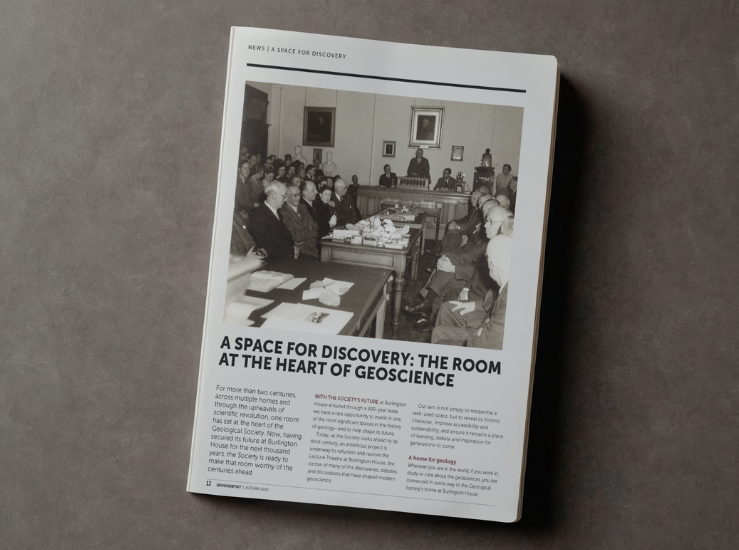
I was fascinated by the article A Space for Discovery (Geoscientist 36 (3), 12-16, 2026) about the refurbishment of the Society’s meeting room. I vividly recall the vote in the early 1970s as to whether we stuck with the parliamentary style chamber or replaced it with a fan-shaped lecture theatre as it is today. I was heavily persuaded by a colleague to retain the parliamentary chamber arrangement. Needless to say, we lost the vote.
Over the years, the Society and its meeting room have often provided a forum for discussion on matters that bridge disciplines—for example, between the civil engineering and engineering geology industries. I recall giving a talk years ago (in the current lecture room) about tunnelling issues. Several reputable contactors had gone bankrupt because the ground conditions were what they call ‘unforeseen’ and not included in the price they had offered based on the original information they were given. That is, the geotechnical investigations did not sufficiently identify the potential geological problems. Whether influenced by my talk or not, the construction industry soon introduced what is now referred to as ‘a Geotechnical Baseline Report’ prepared by an experienced geoscientist that serves as contractually agreed-upon definitions of the subsurface conditions a contractor is expected to encounter during excavation and on which his price is based. While not a scientific guarantee of what lies underground, this set of reference conditions establishes a clear commercial and legal benchmark. The difference between the conditions encountered and the baseline statement are considered when assessing a compensation event.
While I am now largely retired, I still work on projects including radioactive waste disposal. One project I am working on is for the Norwegian government agency on the concept of Deep Borehole Disposal (DBD) of the most dangerous radioactive waste. I consider borehole disposal an ideal solution for small inventories of high-level waste, such as spent nuclear fuel, and a much safer option than a mined repository—and I was recently asked to give a presentation on this subject to the International Atomic Energy Agency in Vienna, Austria attended by representatives from 50 countries.
Worldwide, after all the time since nuclear power became reality, only Finland has achieved consent for a mined facility for disposal of high-level nuclear waste. After more than 50 years of unsuccessful efforts to find a suitable site for a Geological Disposal Facility (GDF) in the UK, despite the country having some of the best-known geology in the world, this remains an important and urgent issue. It offers an opportunity for serious debate about real geology and whether a geological barrier can safely contain waste for up to a million years. I hope that debate will take place in the Society’s newly refurbished lecture theatre. We also need to consider alternatives such as DBD, particularly for spent fuel from past, current and future nuclear power plants.
Author
John Beswick
Formerly Director, Marriott Drilling Group, but now retired, with more than 60 years’ experience in civil engineering, geotechnical investigation, geothermal research and deep drilling for oil, gas geothermal and geoscience in over 50 countries, including over 35 years’ experience researching the concept of deep borehole disposal for various governments and involved in investigations for a GDF in the UK, Switzerland and France.