Clarification required: Response from Dr Wignall
Dear Editors,
I am writing in response to the letter from Stephen Moreton entitled, Clarification required.
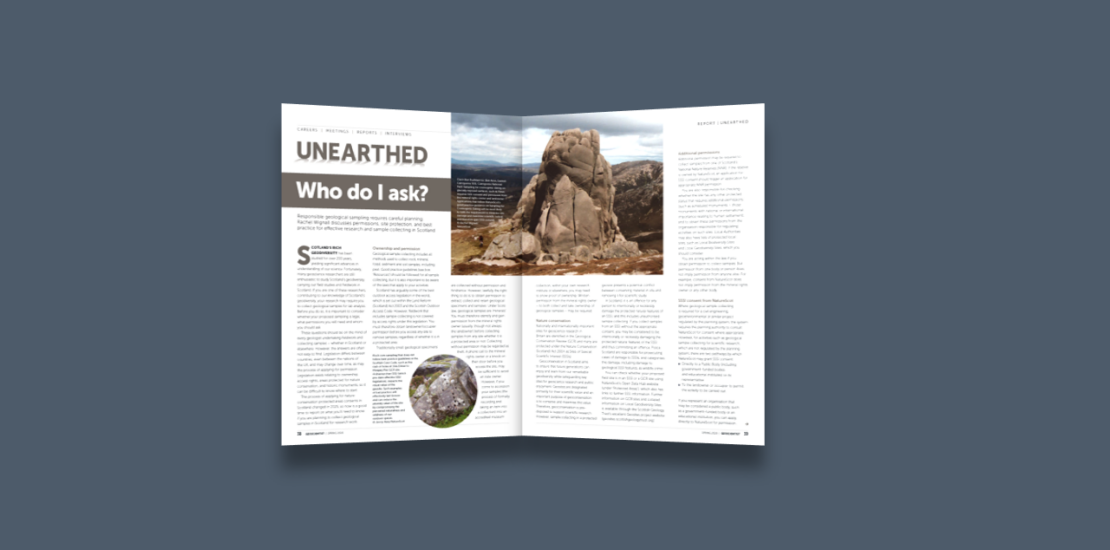
The article (Who do I ask? Geoscientist, 36 (1), 38-40, 2026) did not mention Operations Requiring Consent (ORC) because they are not relevant to the vast majority of applications we receive to collect geological samples from SSSI.
At NatureScot, most of the applications we receive for geological sample collecting are for research and come from representatives of universities or other publicly funded research bodies who we can treat as representatives of ‘public bodies’. NatureScot can give consent to public bodies who are carrying out their normal functions on land that they do not own, and consent is required for any operation likely to damage an SSSI feature. ORC do not apply in this situation, as they are solely part of the legislation relating to activities of non-public-body landowners and occupiers of SSSI
It is important to recognise that NatureScot cannot give consent to members of the public (‘third parties’) to carry out management or other activities on an SSSI on someone else’s land. Landowners and occupiers are responsible for managing their land and for allowing third parties to carry out anything that is not covered by public rights—they must apply to NatureScot for consent to carry out any of the activities listed on a site’s ORC list.
ORC lists are lists of activities that can be regulated by NatureScot, are likely to be carried out by landowners or occupiers in the normal management of their land, and may damage the features of the SSSI. Very few landowners or occupiers of SSSI are likely to require geological sample collection in the normal management of their land, therefore, ORC 25 (removal of geological specimens) appears on very few SSSI ORC lists. ORC 20 (extraction of minerals) and ORC 24 (modification of features) are on more ORC lists, usually being included to cover larger-scale activities (such as extracting rock material to repair tracks). However, these ORC will commonly also cover geological sample collecting because ORC wording does not exclude smaller-scale activities.
Critically, ORC lists are not a comprehensive list of activities that might damage SSSI features. For example, they do not include activities that are regulated by other regulatory bodies such as planning authorities, or ones that the landowner or occupier will not be likely to carry out in the normal management of their land. Under current legislation, landowners and occupiers cannot be given (or refused) consent by NatureScot (and therefore NatureScot consent is not required) for any of the many activities that are not on the ORC list. However, this does not mean that such activities will not be damaging to SSSI features. If you are planning an activity on someone else’s land, therefore, you should not consider ORC lists a guide to what may or may not be damaging to SSSI features.
What everyone must consider is that under the Nature Conservation (Scotland) Act 2004, it is an offence for anyone, including SSSI landowners and occupiers, to recklessly or intentionally damage an SSSI feature in Scotland, with Police Scotland and the Courts (not NatureScot) having enforcement powers. To avoid an offence of reckless or intentional damage, third parties proposing an activity on an SSSI that involves removing anything, disturbing anything or falls outside access rights under the Scottish Outdoor Access Code, and SSSI landowners or occupiers proposing to carry out (or permit to be carried out) an activity on an SSSI that is outside the normal management of their land, should always consider whether the activity might damage an SSSI feature, and seek advice if unsure.
To clarify, geological sample collecting is likely to be considered damaging to SSSI features if:
- the material you are removing forms part of a notified Earth science feature;
- the material you are removing forms part of the habitat for a notified species feature or is part of a notified habitat feature;
- your sample collecting activity disturbs a notified species (e.g. nesting birds) or damages a notified habitat or Earth science feature (e.g. by trampling).
If you are proposing to collect geological samples, you may be reasonably expected to know whether your samples are likely to be part of a notified Earth science feature, though you may be less knowledgeable about habitats and species. Therefore, if in doubt (for example, you are unsure whether loose rock material forms part of the geological feature, or if your activities will disturb or damage notified habitat and species features), you should always seek advice and, if appropriate, permission. In the interim, take a precautionary approach (for example, assume that all rock material whether loose or in situ is part of the feature).
If at any time you are unclear on how to proceed to ensure that you are not damaging an SSSI feature in Scotland through geological sample collecting, please do contact us at NatureScot (geodiversity@nature.scot).
Author
Dr Rachel Wignall
Geology Adviser, NatureScot, Scotland, UK
NatureScot’s existing guidance on ORC is directed at landowners and occupiers. Further information for third parties is due to be added to the guidance on geological sample collecting webpage when it is next reviewed (before the end of 2026).