Clarification required
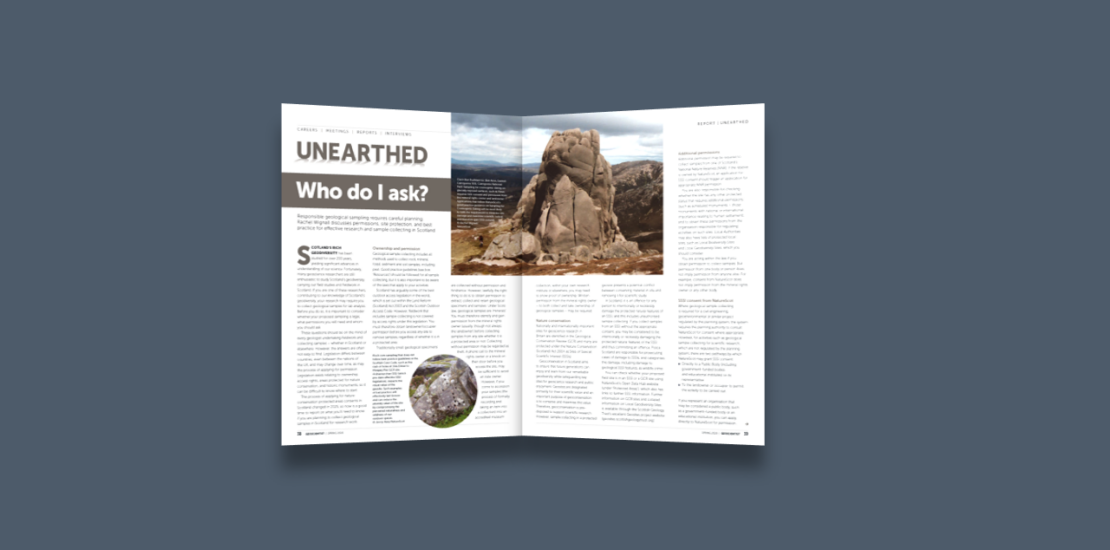
I read with interest Rachel Wignall’s article in the spring edition of Geoscientist (Who do I ask? Geoscientist, 36 (1), 38-40, 2026) and agree that legislation is required to protect our Sites of Special Scientific Interest (SSSI) and prevent acts of geo-vandalism. However, current legislation is confusing, leaving geoscientists and members of the public who wish to collect samples open to potential prosecution, even when they think they’ve followed all the rules. A simpler, clearer approach is needed.
In particular, the article did not mention Operations Requiring Consent (ORC). When a site is declared an SSSI, a list of ORC is included in the citation. NatureScot state on their website, “There are a number of situations in which a private owner or occupier does not require consent” to carry out activities in an SSSI. But what about members of the public?
The list of situations for which consent is not required includes “The activity is not on the site’s ORC list”. Only ORC 25 concerns the collection of geological specimens. Thus, it follows that geological sampling at SSSI that lack ORC 25 (which is most of them) may be permissible without NatureScot’s consent and that, in such cases, only permission from the landowner or occupier is required.
Many SSSI have ORC 20 (Extraction of minerals) and ORC 24 (Modification of features). The exact wording for ORC varies from one SSSI to another, but these refer to bulk extraction (sand, gravel, peat etc.) or large-scale operations (buttressing, clearing scree, infilling quarries), respectively, rather than specimen collection specifically.
There seems no simple way of knowing whether an innocuous activity will be considered “damage” or how the ORC apply (if at all). Collectors of geological materials are unsure where they stand.
Author
Dr Stephen Moreton
Research & development chemist and mineral collector with interests in mineralogy and Earth science
Read the response from Dr Wignall here