


Space Journal: The Art and Science of Cosmic Exploration
As a child, I was fascinated by space. As an adult, I still am. Reading about the Apollo programme and the astronauts who landed on the Moon was my gateway into geology. Harrison “Jack” Schmitt, the last person to walk on the Moon and, so far, the only geologist to do so, particularly captured my imagination. It was learning about Schmitt and the geologists who trained Apollo astronauts to become skilled field observers that crystallised my own interest in geology, especially planetary geology. I even dreamed of becoming the first geologist on Mars.
It is through the lives of influential individuals that Dallas Campbell explores humanity’s relationship with space in Space Journal. Some names are instantly recognisable: Isaac Newton, Arthur C. Clarke, Carl Sagan, Wernher von Braun and Elon Musk among them, but the lesser-known figures are often the most fascinating.
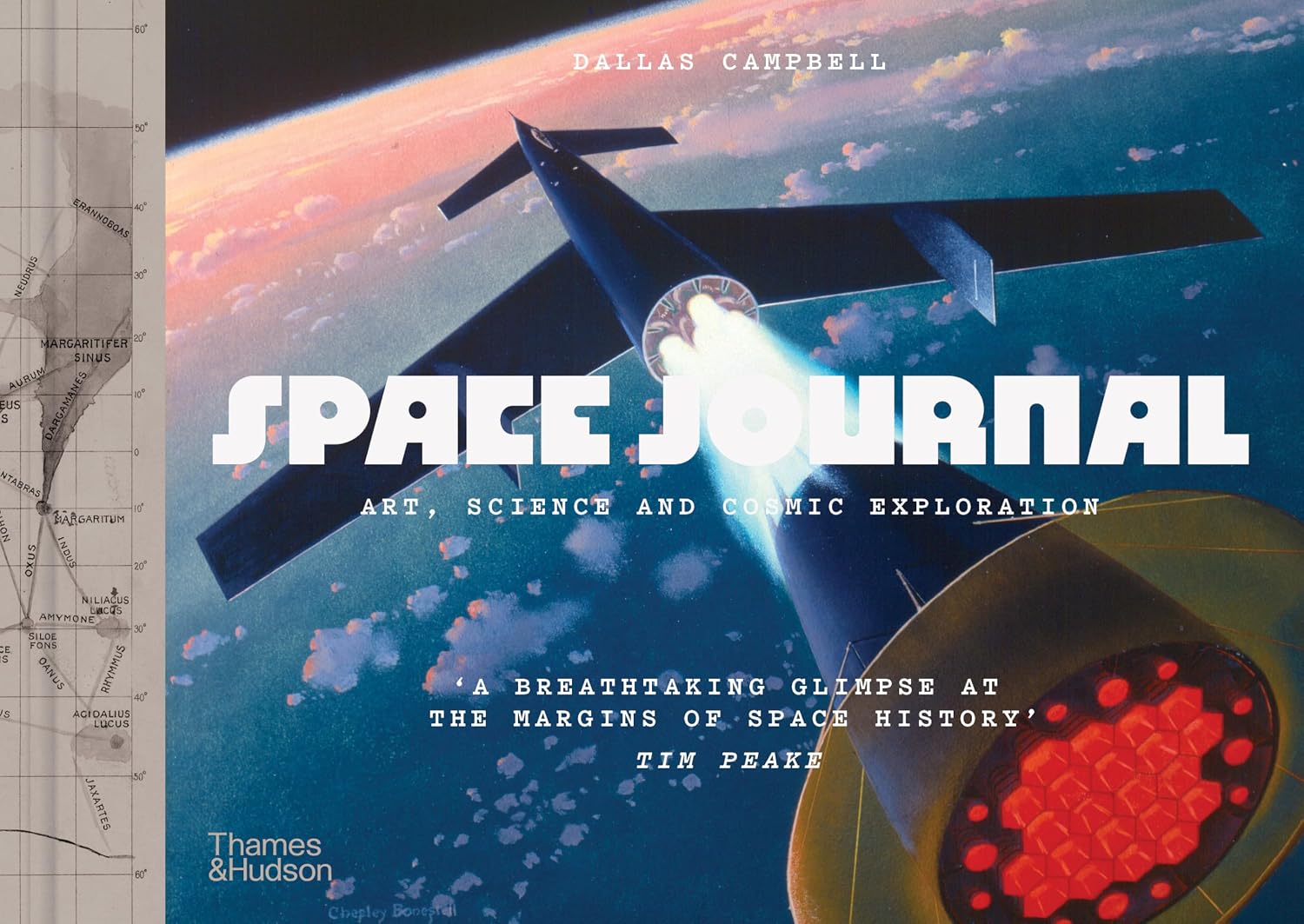
One particularly memorable example is Chesley Bonestell, the Hollywood set artist whose paintings of planetary landscapes in the Romantic style helped inspire public imagination for space during the 1950s. His dramatic depictions of spacecraft orbiting Earth, reproduced in glossy magazines of the era, helped visualise the future of spaceflight for a post-war generation. One such image fittingly appears on the book’s cover.
The sections covering the early pioneers of rocketry are equally compelling, tracing how rocket engineering developed simultaneously in different countries. Perhaps the most curious character is the German engineer Gerhard Zucker, who attempted to develop rockets for delivering mail between remote Scottish islands in the 1930s. Sadly, he failed.
I particularly enjoyed the discussion of NASA’s visual identity, from the development of its famous logo to the typography now synonymous with American spaceflight and popular culture more widely. There are some nice images of the fonts and iconography of America’s space agency through the years.
The chapters on the American astronauts and Soviet cosmonauts of the 1960s are among the book’s most affecting. Especially poignant is the extract from Yuri Gagarin’s farewell letter to his family, prepared in the event of his death during humanity’s first crewed spaceflight. Also reading how Neil Armstrong struggled with the fame that came with being the first man on the Moon reminds the reader of the sacrifices made by early astronauts. Equally significant, though less widely recognised by most people, was Theodore C. Sorensen, whose words for President John F. Kennedy helped ignite the space race with the ambition of “landing a man on the Moon before this decade is out”.
Regrettably, there is little mention of the geologists who have played such an important role in shaping our understanding of the Solar System, from revealing evidence of water on Mars to unpicking the mysteries of the icy moons and even the methane sand dunes of Pluto. Geologists have helped transform our understanding of planetary processes beyond Earth and their absence feels like a missed opportunity.
That said, this is an informative, entertaining and visually impressive book. The imagery is thoughtfully selected and well-integrated with the text, making for a highly enjoyable read. Space Journal would sit comfortably on the coffee table of any geoscientist with an interest in space exploration.
Review by Richard Hosker
DETAILS
BY: Dallas Campbell (2026) Thames & Hudson, 288 pp.
ISBN: 9780500028186
PRICE: £35, available from Geoscientist’s bookshop


