


Positive Tipping Points: How to Fix the Climate Crisis
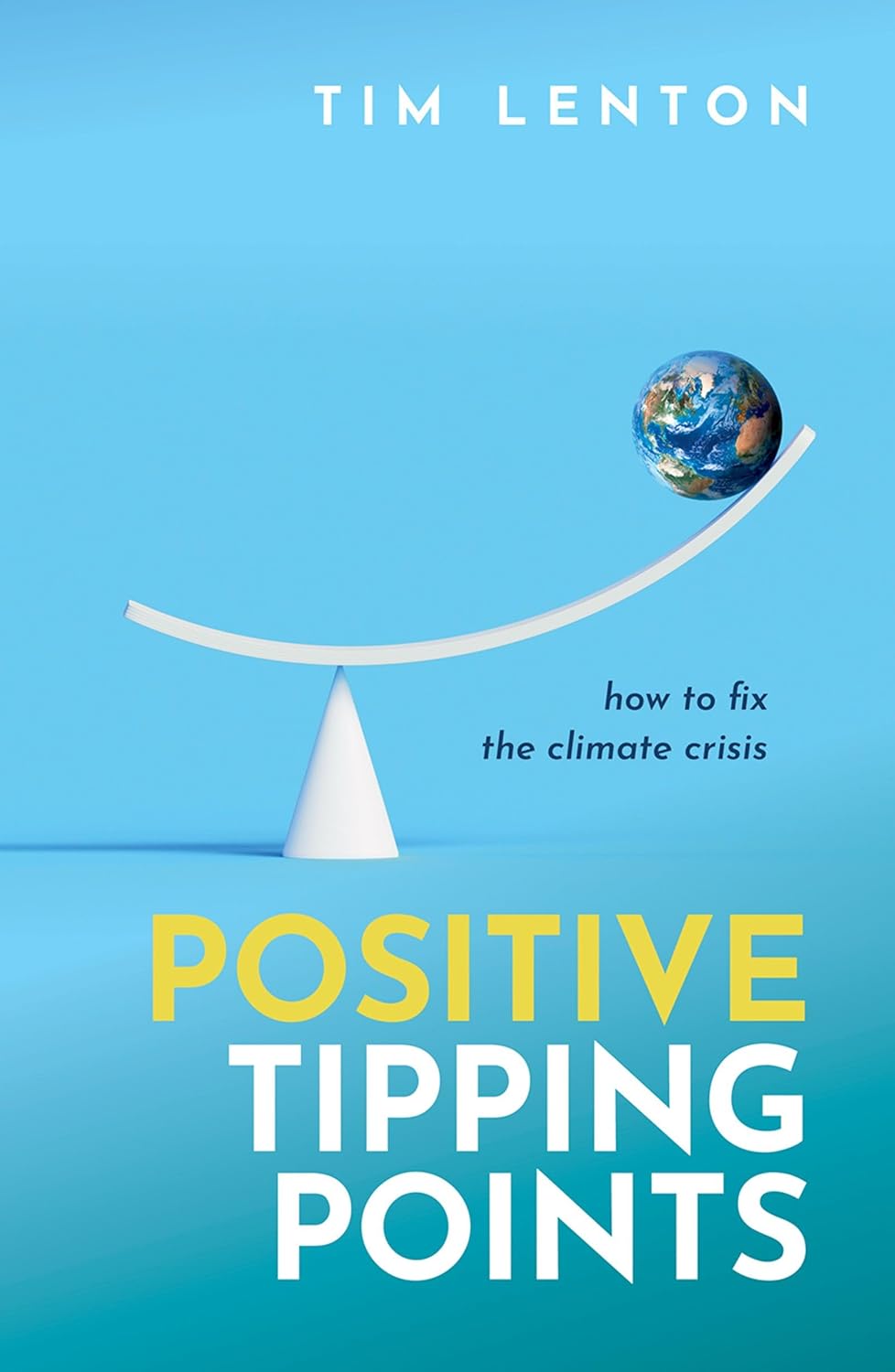
This is an impressive, important and clearly written book, and likely to become a key text for human life in the Anthropocene. It is one of Tim Lenton’s most important works and one of the few on global warming to be positive about humanity’s chances of controlling carbon emissions and, therefore, averting catastrophic climate change.
It is a skilfully constructed narrative, written for a wide audience, with vivid examples drawn from the various worlds where tipping points occur: not just in climate, but also in areas like trade (the effects of the 2021 accidental blocking of the Suez Canal) and finance (the effects of the 2008 banking crash). The science of tipping points is made accessible, as is their reality in past climate, such as Ice Age cycles. It also introduces us to the dangerous tipping points that loom before us, as made clear in the recent scientifically published work of Lenton and his colleagues, from Amazon forest dieback to runaway ice loss and sea level rise.
Bearing in mind the potential submergence of coastal cities by sea level rise over the thousand year time frame caused by the impending loss of the Greenland Ice Sheet, Lenton differs from most mainstream economists who ‘discount’ the value of things and people living in the future by ignoring damages happening quite far ahead. Some of those same economists argue that the effects of global warming will be trivial, because they concern themselves only with financial impacts, valuing damages to the rich more than those to the poor. But the damage from global warming will increase the further we go into the future.
He reminds us for instance of the potential perils of Arctic permafrost collapse, with its ensuing emission of methane, and of Arctic forest expansion, which encourage fire risk by covering tundra in dark trees that warm the climate. Already, some places like Australia and Pakistan are seeing the kinds of extreme heat than endanger human life. Stopping our metaphorical ship to prevent further damage means stopping the engines providing the driver of warming: carbon dioxide. We cannot, unlike the Titanic, wait until the iceberg is right ahead.
This recognition sets the context for the positive tipping points of the book’s title: an exploration of how socioeconomic tipping points can introduce positive change more quickly than we usually imagine. Lenton draws on the co-called ‘S’-Curve to explain how positive tipping points work. Things begin small with a few innovators; they grow a bit faster with ‘early adopters’; once the benefits become obvious, an ‘early majority’ join in, stimulating yet faster rise; this is followed by a more sceptical late majority once the new ideas become the norm; and it ends with the few laggards bound by tradition. Today we see a remarkably steep, if geographically uneven, rise in the use of renewable energy and electric vehicles already in full swing, plus new technologies aiming to go mainstream, such as green ammonia and hydrogen, and green methanol as ship fuel. More local initiatives are described too, like the successful spread of tree-planting programmes in Tanzania and Tamil Nadu in India, as well as attempts to cut down on humanity’s seemingly insatiable appetite for meat, which demands more and more deforestation to supply pastureland.
Lenton introduces us to positive tipping points that can profoundly reduce global harm and injustice from global warming, while recognising that formidable forces are ranged against this goal. Among our successes we can number the numerous Clean Air Acts that have drastically reduced air pollution in cities, along with the Montreal Protocol that stopped the emission of the chemicals that were destroying the ozone hole. What we need are small wins to provide the stimulus for others to join in and act together to gain momentum. As these actions progress, fossil fuels will eventually be stranded in the ground.
En route to a fossil fuel-free future, Lenton argues that we must take steps to restore nature by stopping the forms of economic growth that damage it. We shall have to fight against the mainstream calculations favouring continued economic growth, instead choosing those that regenerate the nature that provides all of us with essential services (clean air and water, for example). Calculations favouring growth inform advice to governments about what to spend their money on. Tipping this norm would make a profound difference, moving us away from an emphasis on maximising short profit at the expense of health, education, welfare and infrastructure. As Lenton says, ‘our current model of economic growth is pathologically flawed’ and underpins environmental damage. We must remember, as James Lovelock explained, that we are living in and benefitting from a remarkable living system, and should respect that, not destroy it. We need a new worldview.
This is a book that should be widely read and used in teaching, to help overcome a widespread sense of helplessness at the scale of the problem. There is much work to do and those with vested interests have benefited from business as usual and will continue to do so. But a thoughtful blueprint for action like this one can provide inspiration and energy to help redress the balance.
Reviewed by Colin Summerhayes and Jan Zalasiewicz
DETAILS
BY: Tim Lenton (2025) Oxford University Press, 256 pp. (hbk)
ISBN: 9780198875789
PRICE: £20, available from Geoscientist’s bookshop
This review originally features in the Anthropocene Working Group Newsletter Issue 1/2006 (March).


