Is water lava?
Fabian Wadsworth and Edward Llewellin explore a playful yet serious nomenclature debate about water, sparked by the podcast The Rest Is Science.
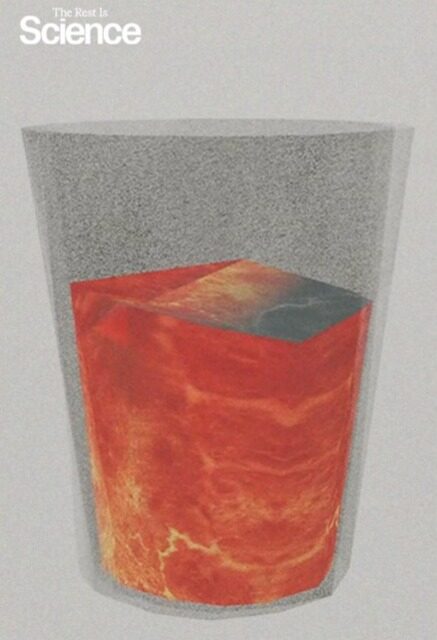
A thirst-quenching ‘glass of lava’ illustrates the debate around water’s nomenclature. (@ Goalhanger Podcasts Ltd)
The Mineral Cup was launched by Eddie Dempsey in 2017 and is now an annual competition where people vote for the best of two minerals. Controversially, ice won the award in 2019, initiating the debate of whether ice is really a mineral. The answer amongst geoscientists is a begrudging ‘yes’ because ‘mineral’ is simply another name for a naturally occurring inorganic crystalline solid (Clopton, 1994).
A block of ice is made from many crystals of ice. Does that therefore mean that ice is a monomineralic rock? If so, does that then imply water is molten rock? And if we go that far, is it fair to refer to water as lava? That’s the line of mind-bending reasoning that YouTuber and co- host of The Rest Is Science podcast Michael Stevens has taken. The logic seems hard to fault, but it is also clear that this is stretching the definition of lava.
To be or not to be lava
Let’s first consider ice volcanoes – or cryovolcanism more generally – on Solar-System bodies such as Enceladus and Europa (Spencer et al., 2009; Sparks et al., 2017), where great geyser-type features erupt water and ice in ways not seen here on Earth. In that context, water is unequivocally a form of lava.
For anyone who finds this hard to accept, it can be tempting to adjust the definitions of mineral, rock, or lava to somehow exclude ice and water from those categories. Since ice did win the Mineral Cup 2019, it seems hard to argue that it is not a mineral; instead, one might suggest that ice is not a rock, as rock should be formed or involved in geological processes. Yet this doesn’t really solve the issue as ice is a key player in our geological world – anyone who has learned about glacial U-shaped valleys knows the geological power of ice (Bennett and Glasser, 2011).
Similarly, we might be tempted to say that lava (and its subterranean counterpart magma) should not just be molten rock, but molten rock that is forged in the Earth’s mantle or by melting and assimilation in the crust. However, water is a key part of these processes and, in fact, without water a lot of partial melting of mantle or crustal rocks simply wouldn’t occur (Ohtani, 2020; Grotzinger and Jordan, 2020). From that earliest formation of magma, water is a constituent of all molten rock on Earth – all lavas contain a fraction of water dissolved in the magmatic liquid and it is incorporated in some magmatic minerals. Therefore, water is erupted from volcanoes, just as lava frequently is.
Then if we think of gaseous water, large explosive eruptions are, volumetrically, dominantly water at Earth’s surface. From that point of view, volcanoes can reasonably be thought of as places on Earth where gaseous water erupts, and lava, pyroclasts, and other gases are just along for the ride.
From lava to life
Michael’s argument appears to hold water lava. But that doesn’t mean that all water is lava. In Earth’s 4.5-billion-year history, almost everything on our planet (including the constituents of humans) has erupted from volcanoes at some point. That doesn’t mean we call everything lava. Over time, solidified lava becomes other things, such as sediments or soils, nutrients, and solutes in oceans. The sediment may be lava-like in its chemistry, but it is no longer definable as lava. That is, lava loses its identity through the changes that come with time.
If we apply that same logic to Michael’s glass of thirst-quenching water-lava, while it may be lava in the glass, it stops being lava as soon as it becomes part of our metabolism. So, while it might be true that all water has been lava for a period of time, not all water on Earth is lava today. What a wonderful reminder of the driving force for endless mutable change: geological time.
Authors
Fabian Wadsworth Ludwig-Maximilians-Universität München, Germany
Edward Llewellin Durham University, UK
To explore the The Rest Is Science episode further, visit: youtu.be/m7KXCpEpyL8.
Further reading
Clopton, E.L. (1994) Ice as a mineral. Rocks and Minerals, 69 (2), 90–103. DOI: 10.1080/00357529.1994.9926581.
Spencer, J.R. et al. (2009) Enceladus: An Active Cryovolcanic Satellite. In: Dougherty, M.K. et al. (eds) Saturn from Cassini-Huygens. Springer, Dordrecht. pp. 683–724. DOI: 10.1007/978-1-4020-9217-6_21.
Sparks, W. B. et al. (2017) Active Cryovolcanism on Europa? The Astrophysical Journal Letters, 839 (2), L18. DOI 10.3847/2041-8213/aa67f8.
Bennett, M. & Glasser, N. (2011) Glacial Geology: Ice Sheets and Landforms. Wiley-Blackwell, Oxford, 385 pp.
Ohtani, E. (2020) The role of water in Earth’s mantle. National Science Review, 7 (1), 224–232. DOI: 10.1093/nsr/nwz071.
Grotzinger, J.P. & Jordan, T.H. (2020) Understanding Earth (8th edition). W.H. Freeman & Company, New York. 780 pp.