


Meandering Streamflows: Patterns and Processes across Landscapes and Scales
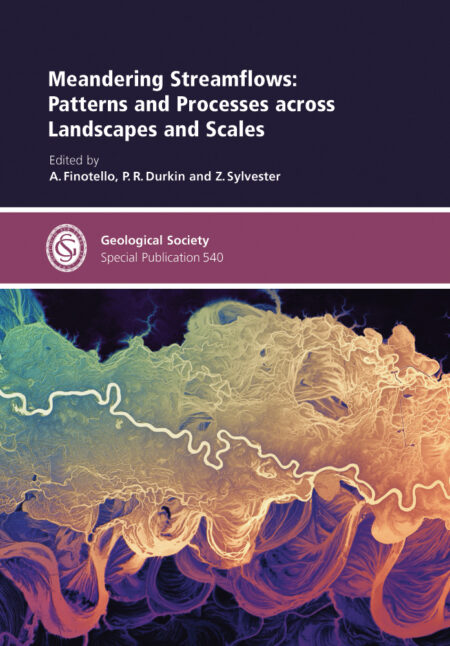
The sweeping forms of meanders are not only beautiful but capture both the movement of flowing water and the slower, deeper story of how landscapes evolve through time. Meandering Streamflows offers a broad and detailed look at why streams bend, how they change, and what those changes mean across different environments.
The editors have brought together a fascinating set of studies that trace meandering processes from early environments to the present day, including non-fluvial examples from submarine channels. The opening chapters take a philosophical approach, setting the scene by asking what meandering really means and how processes such as sediment transport and bank stability shape the forms we see. Readers are encouraged to think carefully about definitions and what existing models can and cannot explain.
A central thread running through the volume, as the title suggests, is the importance of scale. Chapters in the first half explore how local flow processes, sediment supply, bank strength and turbulence govern channel migration and floodplain development over time. This is illustrated by work on Holocene river systems along Italy’s Venetian Plain and by experimental studies of bank erosion and flow structure. These modern examples are contrasted with a paper focusing on the Neoproterozoic Diabaig Formation, Scotland, which widens the discussion spatially and temporally, showing how mud-rich closed basins may have supported meandering long before terrestrial vegetation. Together, these highlight shared physical principles across environments and timescales.
Several mid-volume chapters broaden the discussion by linking meandering to wider environmental processes; for example, a detailed study of Ontario’s Vermilion River demonstrates how migrating bends influence the burial and turnover of organic carbon, while other contributions examine how preservation and accretion rates shape the longer-term stratigraphic record. Collectively, they emphasise that meanders do not simply record landscape history but actively regulate it, linking hydrology, sedimentology and biogeochemistry in subtle and dynamic ways.
The final section widens the lens further, demonstrating that meandering is not limited to rivers. Later chapters describe meandering submarine channels in the Gulf of Mexico, autogenic stacking patterns in deep-marine environments, and the influence of monsoonal tides on macrotidal channels in Korea. This wide environmental scope is one of the volume’s strengths, illustrating how comparable feedbacks between flow and sediment operate across marine, fluvial, and tidal systems.
Taken as a whole, the volume provides an overview of current research into meandering and is aimed primarily at specialist readers, while remaining accessible to those seeking a grounding in the field. By bringing together studies that span deep time, modern streams, and marine systems, Meandering Streamflows reinforces the value of thinking about meanders as expressions of shared physical principles.
Review by Kane Coxon
DETAILS
BY: Alvise Finotello et al. (Eds., 2024) Geological Society of London Special Publication 540, 320 pp. (hbk)
ISBN: 9781786205971
PRICE: £90 (£45 for Fellows) geolsoc.org.uk


