From rock to reverence
Anjana Khatwa reveals how her debut book, The Whispers of Rock: Stories from the Earth, reimagines our connection to the land beneath our feet


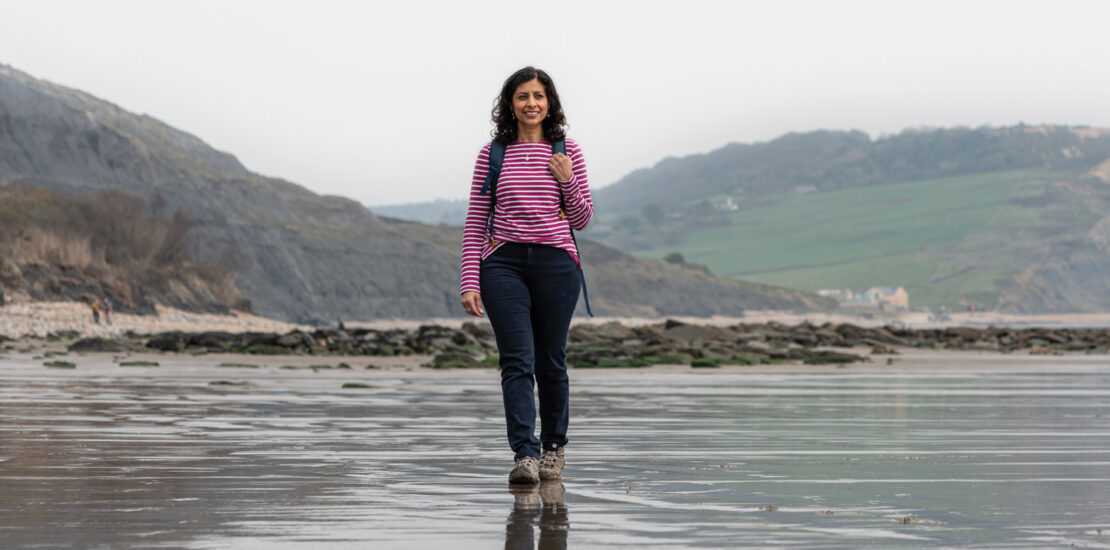
Anjana explores personal connections to the ground beneath her feet as she walks the English coast (© Rob Coombe).
For Anjana Khatwa, the solid presence of rocks hum with life. Whilst scientifically they are inanimate and many people do not feel a natural empathy for them as they might do for a tree or bird, there’s more to rocks than meets the eye.
“My experience working at the forefront of public engagement in the geosciences and conservation has shown me that people feel a significant disconnection between themselves and the geological world. I believe that this distance, in part, is perpetuated by poor communication so that concepts and language are often too complex and abstract to engage with emotionally. I realised that stories have the power to unite human experience with scientific understanding, unlocking the key to connect hearts and minds with this aspect of the natural world.”
And so, enriched by conversations with her mother and a local walking group, Anjana began an unforgettable journey that was as much about her own spiritual reawakening as it was about science. The culmination: her debut book, The Whispers of Rock: Stories from the Earth. It has an unusual alchemy, being part geology textbook and part spiritual reflection by retelling Indigenous stories. Through blending “modern science and ancient lore”, Anjana hopes to create something that will dissolve the perceived distance between people and the rock beneath their feet.
Living geology
From the outset, Anjana knew her audience: people who love nature and science but who have never really understood or taken notice of the rocks around them. To draw them in, she weaves Indigenous narratives, spiritual interpretations, and even first-person voices of the rocks themselves into the structure of each chapter. Anjana believes such a creative approach “adds a flourish of magic” to the reading experience.
She also deliberately centres voices historically excluded from geology. The opening poem, Kinship is the Basic Principle of Philosophy by Professor Jack D. Forbes (of the North American Powhatan, Rappahannock, and Delaware Nations), sets the tone, inviting readers to embrace more diverse global perspectives on the subject matter.
Stories have the power to unite human experience with scientific understanding
Each chapter pairs a rock type with its story of geological formation, cultural significance, and human impacts to highlight the relevance of geology to us all. Some sections explore how storytelling has helped communities living in seismic zones through stories, songs and legends that memorialise experiences and help future descendants cope with disaster, grief and change. Others link geology directly to everyday life, such as how soil mineral content shapes the flavour of coffee or how ground chalk was used to whiten bread.
Anjana’s goal was to make geology tangible, relevant, and emotionally resonant. The Whispers of Rock deftly weaves together our human experience to help the reader feel and contextualise emotions about the geological world.
Storytelling ethics
The scope of The Whispers of Rock is extensive and that range was part of the joy of writing. “There were moments where I read papers that documented major threshold moments in our science that gave me goosebumps,” Anjana says. Some discoveries came through conversations with scientists, whilst the most profound moments came not from rocks themselves, but from the Indigenous people who had lived alongside them for millennia, leading to fieldwork taking on an almost sacred quality.
“Their generosity in sharing stories from their ancestors brought a richness and authenticity to my writing, which infused the scientific narrative with emotion and meaning. With this knowledge in my heart, my field experiences became more profound. Some encounters, such as seeing the sandstones at Petra and the slate spoil tips at Llechi Eryri (Snowdonia), felt like a pilgrimage to witness how humans could wield such creative and destructive power over the natural world. Some of the most vivid and lyrical parts of the book are drawn from these moments where I could feel and sense the animacy of rock around me.”
Writing about Indigenous traditions as a non-Indigenous author brought its own responsibilities, including seeking official guidance and permission to reprint stories. Some of the extracts, such as the creation stories of pounamu jade, or greenstone, from Aotearoa (New Zealand), took over eight months of careful and sensitive consultation with Maori elders to be approved.
“The whole experience has transformed me, not only as a writer and a scientist, but it has also given me a sense of shared humanity with the world we live in.”
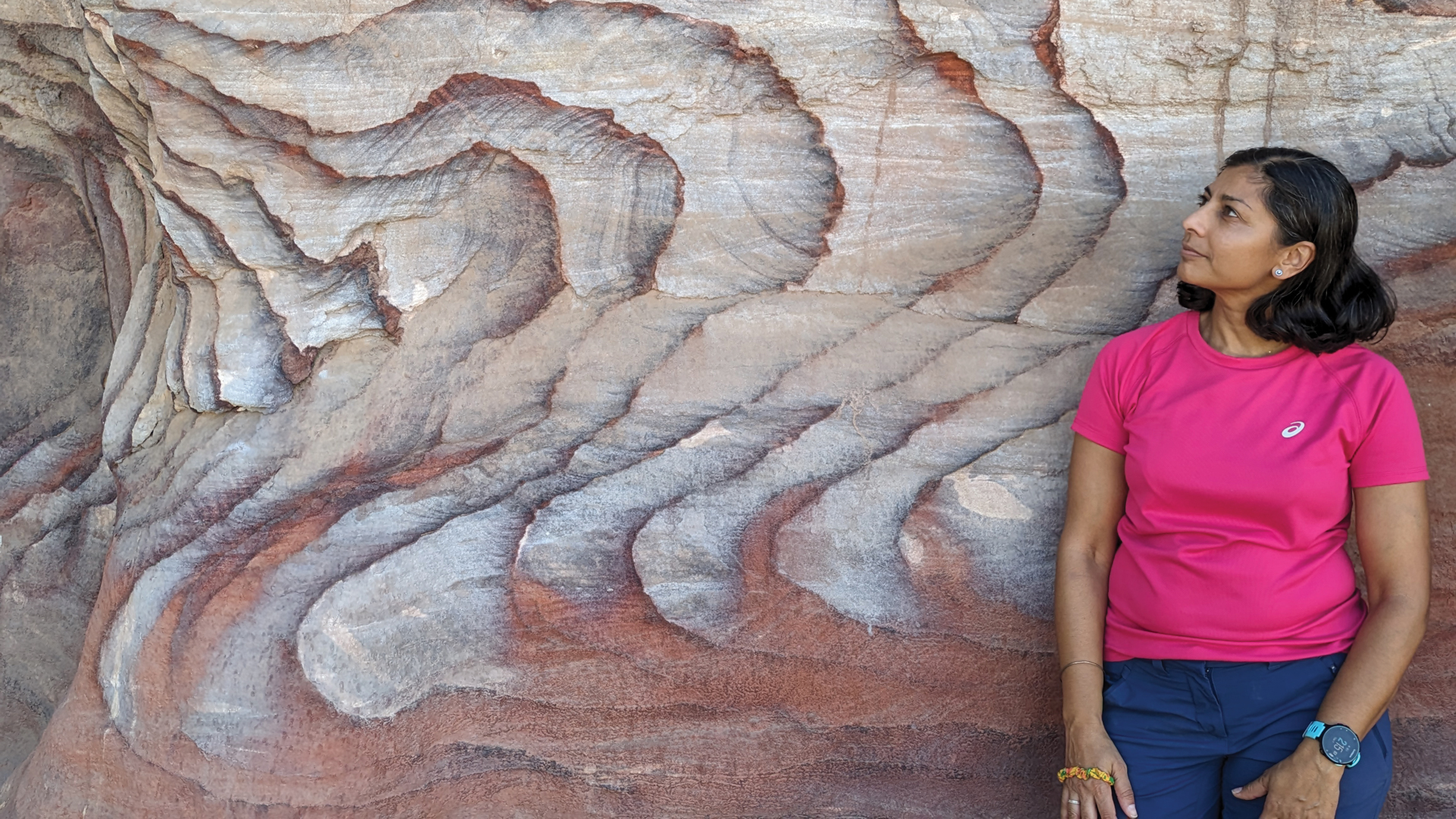
Anjana is mesmerised by the cross-bedded sandstones of the Umm Ishrin Formation in Petra, Jordan (© Anjana Khatwa).
Breaking publishing barriers
Getting such a unique book about geology into the public’s hands was not simple, given perception in the wider media that it would not attract mass interest. Frustrated by this mindset, Anjana submitted a proposal to the 2021 Nan Shepherd Prize for nature writing. Her first concept, The Rock Whisperer, was longlisted and caught the attention of literary agent Richard Pike at C&W Literary Agency.
What followed was a meticulous process: shaping a proposal under Richard’s guidance that could balance scientific integrity with mass appeal. The challenge was to craft a commercially viable book that gently helped the reader engage and connect with these ideas through the human experience. When the proposal was acquired by commissioning editor Holly Harley at Little, Brown (Hachette) in 2022 for a figure rarely offered to debut non-fiction authors – particularly women and people of colour – Anjana was stunned.
Over the next two years, the project consumed her life. Some days, the work was exhilarating; on others, harrowing. “There were times when some of the primary accounts of violence and injustice against Indigenous people I read were so incredibly traumatising I had to step away from the writing process to mentally recover.” The emotional intensity was matched by a disciplined routine, often waking at 4am to expunge the words that were bursting from her mind. After submission in September 2024, the manuscript took a further six months to edit under the scrupulous eye of editor and publisher Sameer Rahim. Anjana marveled at the way Sameer was able to help her shape the writing so that it became more purposeful and strident whilst still retaining a sense of enigmatic wonder.
I read papers that documented major threshold moments in our science that gave me goosebumps
For anyone wishing to follow in her footsteps to write an accessible book about the natural world, Anjana’s guidance is clear and strategic: know why the disconnect exists, then find fresh ways to bridge it. She advises reading thoroughly in the genre, but also knowing about publishing trends, as readers are looking for innovative books that provide different perspectives on the natural world and authors who are grounded in expertise, authenticity and truth.
“Readers want to feel confident and reassured by robust, expert knowledge but at the same time they need to also gain a sense of compassion and connection with you as a storyteller. If you can write a book that guides a reader through the natural world with kindness and empathy, they might open their hearts and minds to you and perhaps you might have a bestseller on your hands!”
Lasting legacy
Ultimately, Anjana’s ambition for The Whispers of Rock is to change how people see the world. “For centuries, people have been drawn to stories that focus on that most fundamental human emotion – love. To build that into a book about geology and nature was controversial and perhaps (at one point I thought) even career-ending. But I am emboldened to think that the book will redefine how people engage with and relate to the rocks around them.”
She hopes the book will be a resource for students, a companion to other works championing the animacy of nature, and a rallying call for empathy and humility towards the non-living elements of our environment. “The book was never about me, I was simply the narrator. It was always about championing the beautiful stories held deep inside the rocks, so that they could be loved and cherished by all.”
And in that sense, The Whispers of Rock is not merely a remarkable geological book, but a love story – one written in stone, carrying voices from the depths of time into the present, asking us to listen.
Dr Anjana Khatwa
Earth scientist, presenter and author, currently working as the Joint Head of Inclusion and Belonging at the National Trust, UK
Interview by Hannah Bird, Associate Editor of Geoscientist.
Read the full book review for The Whispers of Rock here.
Citation: Khatwa, A. From rock to reverence. Geoscientist 35 (4), 42-44, 2025. DOI: 10.1144/geosci2025-036