Bringing the field to the classroom
Interactive Earth science gardens on campus can break down barriers to field learning, says Kate Pedley
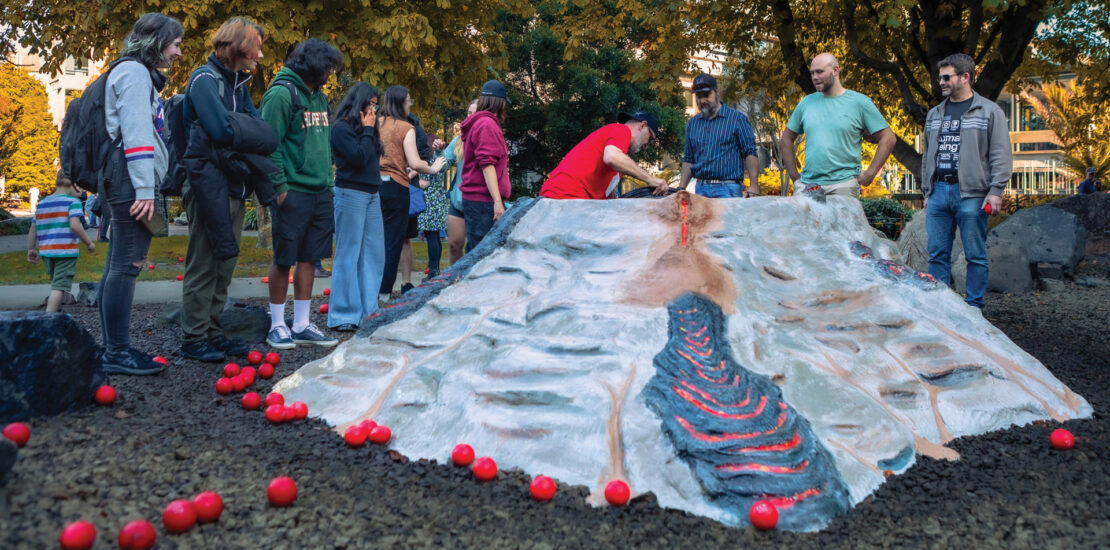
Students can get creative with an interactive volcano to learn about lava flows on the the University of Canterbury campus, New Zealand (© Corey Blackburn).
Spatial skills are a critical competency for success in science, technology, engineering and mathematics, and are a non-negotiable in geoscience (McLaughlin & Bailey, 2023). Field teaching is an integral component of undergraduate geoscience education. Yet, teaching spatial skills and testing 3D visualisation ability through repeated and sustained access to field sites often comes with a variety of financial, environmental and personal challenges (Jolley et al., 2023).
In April 2025, my colleagues and I formally opened an interactive Earth Science Garden at the heart of the University of Canterbury (UC) campus in New Zealand. Our experience demonstrates that ‘rock gardens’ can be much more than eye-catching displays – they can engage a wide range of learners and provide valuable preparation for fieldwork.
Rethinking rock gardens
The design and development of the UC Earth Science Garden began back in 2016 with the near completion of the Rutherford Regional Science and Innovation Centre, following the devastating Christchurch earthquakes sequence in 2011. Originally, a rock display garden was proposed, but I felt that rocks just sitting on the grass might reinforce the stereotype that all geologists do is look at rocks. It certainly wouldn’t connect with or inspire non-geologists, plus it would have limited real opportunities for teaching. Additionally, the new building was earthquake-proofed with steel reinforcement, meaning that the compasses so often used in classrooms to introduce students to basic field skills were no longer able to find north! I sensed an opportunity to rethink the traditional rock garden.
As a structural geologist and field teaching specialist, I feel strongly that innovative pedagogical approaches can make studying geology more future-focused and fun, while equipping students with work-ready skills and the ability to solve interdisciplinary spatial and temporal problems. Weaving together cutting-edge digital technologies and tactile authentic experiences, while removing distance and barriers to learning, can make geology tangible and relevant for students, deepening understanding and igniting curiosity.
I sensed an opportunity to rethink the traditional rock garden
So, I researched interactive Earth science gardens around the world. Such gardens can provide students with the opportunity to physically practice and enhance 3D visualisation to understand geological relationships and basic field techniques. Plus, students can collect a variety of qualitative and quantitative data that can be further analysed by laboratory methods and digital visualisation tools (Dillon et al., 2000; Benison et al., 2005; Waldron et al., 2016; Wong Hearing et al., 2024).
I discovered great inspiration from the Geoscience Garden at the University of Alberta, Canada, and the award-winning Earth Sciences Garden at Monash University, Australia, as well as from the geology academics involved with designing these projects, who were so generous in giving their time and resources to help inspire my concept for the UC campus design.
Relishing the opportunity to design something unique for the UC garden, I decided to create a real-life puzzle map of key landscapes from New Zealand’s South Island for students to solve.
A living laboratory
Today, the UC Earth Science Garden is New Zealand’s first and one of very few map-based teaching rock gardens worldwide (Wong Hearing et al., 2024). Working with quarry owners, Māori advisors, UC staff and contractors, more than 200 rocks representing 15 key South Island lithologies were hand selected, some weighing over six tonnes.
I’ve arranged them as a walk-through miniature of Te Wai Pounamu South Island, particularly focused on the Canterbury and West Coast regions. Greywacke belts flank schist from the Southern Alps and the Alpine Fault trace bisects the garden, offsetting the unique rock dunite (a climate-change fighting rock that absorbs carbon dioxide from the atmosphere and also becomes our most treasured rock pounamu, or greenstone, through metamorphism). Large spherical concretions hold the bones of ancient marine reptiles, and our local Banks Peninsula is represented by an interactive mini volcano. This turns the campus lawn into a permanent living laboratory, starting with the rocks and then layering on native and endemic plant species representative of the regions.
We are also weaving in representations of surface processes and cultural and historical narratives, including engaging art installations (exploring geological time and folds for stereonet analyses with 3D printing) and displays of cores extracted when a ground-source heat pump was installed at the site prior to creating the garden. This pump also provides innovative heating and cooling capacity to the entire science area.
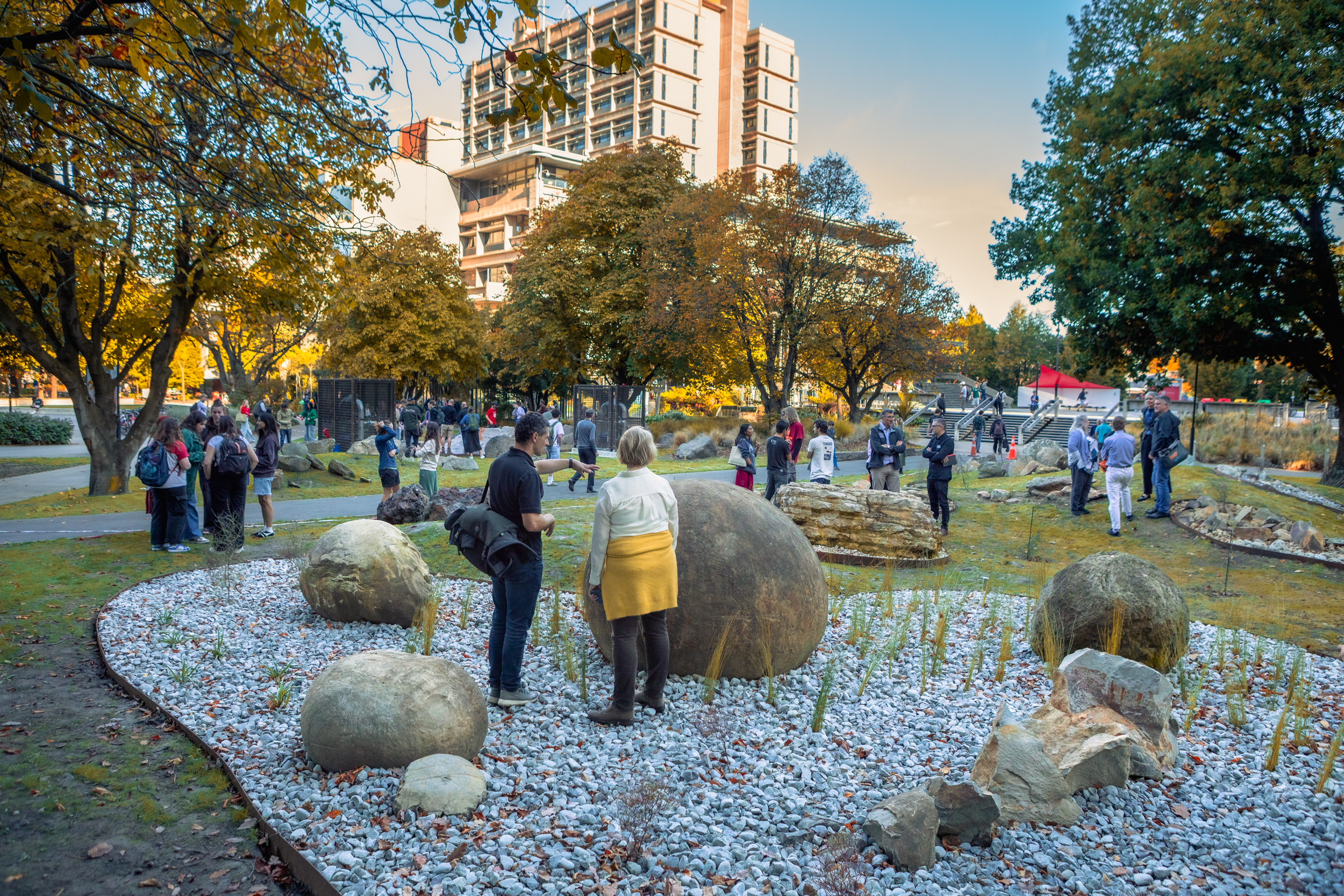
Visitors get a closer look at the microcosm of New Zealand’s geology by walking through boulders of different lithologies laid out as a map of the country (© Corey Blackburn).
Geology for all
Pedagogically, the garden solves three persistent problems: (1) limited field hours in a crowded curriculum; (2) unequal access for students with financial, mobility, or caregiving constraints; and (3) the steep learning curve of translating textbook diagrams into real outcrop geometry. Because the rocks sit minutes from the lecture theatre, I can embed practical, tactile exercises into labs and set self-directed mapping challenges that students tackle between classes.
The garden offers flexible 24/7 access for students juggling other commitments and enables learners with mobility challenges to still get authentic outcrop experiences without the steep hillsides. The increased opportunity to practice field skills also frees up time during off-campus trips for higher-order interpretation and critical thinking. Use of the site is not restricted only to university staff and students; it is already popular with schools and community groups, with numerous educational activities and resources in development, pitched at a wider audience.
I’ve been conducting school outreach programmes and events for many years now, and every time I start with the question: what do geologists do? By far the most common answer is “study rocks”. What’s novel about the UC garden is that it challenges this persistent stereotype, which unfairly simplifies and misses the point of what we study far more holistically – Earth and how it works through deep time. This is arguably a much more exciting concept for attracting and inspiring young minds.
At a time when many geoscience departments face cuts or closure, a rock garden may seem unfeasible for many. However, while it hasn’t been easy, the UC garden proves what it is possible with time and dedication. We received no government, industry or sponsor funding; instead, quarries donated rocks, and I purchased some via a partnership between our School of Earth and Environment and the UC Facilities Management. The UC garden has cost tens of thousands of New Zealand dollars so far, compared to the award-winning one at Monash University costing millions of Australian dollars.
The key factors that made the UC garden viable were: building relationships to pitch the dream, emphasizing interest to non-geologists; approaching quarries early and stockpiling rocks; in-house landscape design, which limits the size of rocks and angles you can install them at, but saves money on architects and engineers; use of existing faculty expertise (such as my art and design background to create our website and on-site signage). An initial, small project can attract investors allowing expansion of the project over time. So, I strongly recommend exploring the possibility of creating such a garden – even on small scale – should funding or opportunity arise. Alternatively, geology departments can take advantage of existing local Earth science gardens as unique teaching resources.
The professional geoscience sector is predicted to face a severe shortage of skilled workers in the near future (Boone et al., 2021; Keane, 2022). We need to actively address the visibility of geology as a rich and rewarding career path, fundamental to many other disciplines, and vital for the sustainability of living with our planet. Interactive Earth science gardens offer one creative approach for connecting with and engaging the next generation of geoscientists.
Dr Kate Pedley
University of Canterbury, New Zealand
Acknowledgements
The UC Earth Science Garden is a collaboration between Te Aronukurangi School of Earth and Environment and UC Facilities Management. We would like to thank and acknowledge our many partners and contributors who have made, and continue to make, this project possible!
Further reading
Benison, K.C. et al. (2005) Artificial outcrops give real experience in interpreting a geologic history: the CMUland group project for historical geology courses. Journal of Geoscience Education, 53, 501–507. DOI: 10.5408/1089-9995-53.5.501.
Boone, S. et al. (2001) Australia’s unfolding geoscience malady. Eos, 102. DOI: org/10.1029/2021EO163702.
Dillon, D.L. et al. (2000) A geologic rock garden as an artificial mapping area for teaching and outreach. Journal of Geoscience Education, 48, 24–29. DOI:10.5408/1089-9995-48.1.24.
Jolley, A. et al. (2018) Are we there yet? Sense of place and the student experience on roadside and situated geology field trips. Geosphere, 14 (2), 651–667. DOI:10.1130/GES01484.1.
Jolley, A. et al. (2023) Supporting a sense of belonging for students with disabilities in the field. Geological Society of America Abstracts with Programs, 55 (6). DOI: 10.1130/abs/2023AM-393798
Keane, C. (2022) Geoscience enrollment and degrees continue to decline through 2021. American Geosciences Institute, Geoscience Currents, DB_2022-010.
McLaughlin, J.A. and Bailey, J.M. (2023) Students need more practice with spatial thinking in geoscience education: a systematic review of the literature. Studies in Science Education, 59:2, 147-204. DOI: 10.1080/03057267.2022.2029305.
Waldron, J.W.F. et al. (2016): Building an outdoor classroom for field geology: the geoscience garden. Journal of Geoscience Education, 64, 215–230. DOI: 10.5408/15-133.1.
Wong Hearing, T.W. et al. (2024) The Rock Garden: a preliminary assessment of how campus-based field skills training impacts student confidence in real-world fieldwork, Geoscience Communication, 7, 17–33. DOI: 10.5194/gc-7-17-2024.
Citation: Pedley, K. Bringing the field to the classroom. Geoscientist 35 (4), 10-12, 2025. DOI: 10.1144/geosci2025-029