Islands in infinity
Through their three-dimensional vision of the cosmos, Brian May, Derek Ward-Thompson and J-P Metsävainio invite us to reimagine both space and our place in it

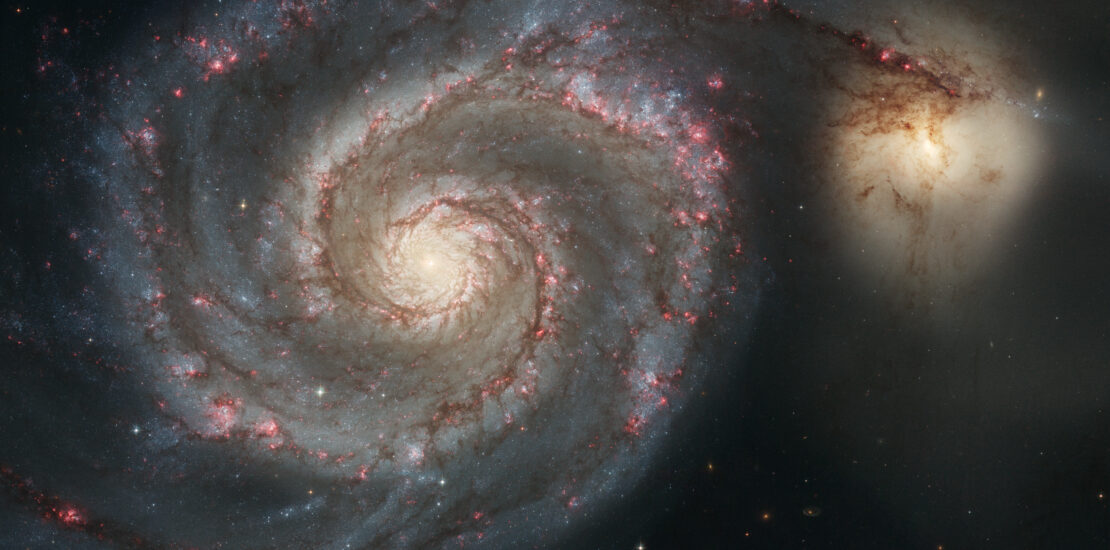
Whirlpool Galaxy M51NGC 5194 interacts with its ‘companion’ dwarf galaxy NGC 5195, located approximately 23 million light years from Earth (courtesy of NASA and the European Space Agency).
Galaxies, nebulae and interstellar dust clouds drift through the Universe in ceaseless motion, as vast architectures of light shaped over cosmic time. When captured through telescopes and cameras, for both science and art, their journey across space becomes still — a single frame in an eternal dance. Yet in capturing a singular moment, something is inevitably lost. This flat two-dimensional echo of billion-year histories can be a disservice to the Universe’s wonders.
And so, with a passion burning as bright as stars themselves, astrophysicists Brian May and Derek Ward-Thompson, alongside astrophotographer J-P Metsävainio, aim to bring a whole new dimension to viewing the night sky. Through their new book, Islands in Infinity: Galaxies 3-D, and a specialised OWL stereoscopic viewer designed by Brian (which transforms pairs of two-dimensional photographs into a three-dimensional effect), everyone can learn to appreciate the realms beyond Earth. By inviting readers to experience astronomical imagery in three dimensions, the trio seek not only to reveal depth and scale, but to restore a sense of wonder often diminished by conventional photography.
Bringing the cosmos closer
The ability to visualise data has long shaped the way science communicates complexity. From geological cross-sections to astronomical composites, the translation of invisible processes into visual form bridges the gap between expertise and imagination. In this sense, Islands in Infinity is not merely a scientific or artistic endeavour but an experiment in accessibility, inviting non-specialist audiences to experience connection with the cosmos in ways that text alone cannot convey.
“From our position, sometimes millions of light years from the object we are studying, we can’t perceive depth information because our eyes are not far enough apart to give us the parallax differences between left and right views that communicate solid shape to us, as they do in the world immediately around us,” Brian explains. “J-P is an astrophotographical genius whose magical transformation of images gives us that vital extra perception, enabling our brains to instantly perceive these awesome objects as they really are in glorious 3-D. The insights that this gives us are inspiring like never before.”
The book’s approach echoes a broader shift in how astronomy engages the public. Projects such as Galaxy Zoo (zooniverse.org) — which invites volunteers to classify galaxies or identify features in telescope data — have shown how visual participation can transform passive audiences into active contributors. What Brian, Derek and J-P achieve through stereoscopy operates on a similar principle by transforming the viewer from observer to participant. Seeing in three dimensions is, in a sense, a kind of citizen science of perception, training the eye to discern the bigger context of the cosmos.
For J-P, this way of viewing the Universe can be transformative. “With the methods I have developed over the years, I am able to turn any astronomical image into a 3-D presentation that is as scientifically accurate as possible. Each image tells a story to the viewer. The final 3-D image is always an informed simulation of reality, based on established scientific facts, logical deduction, and a touch of artistic creativity.” The result translates the intangible into something the human eye can grasp.
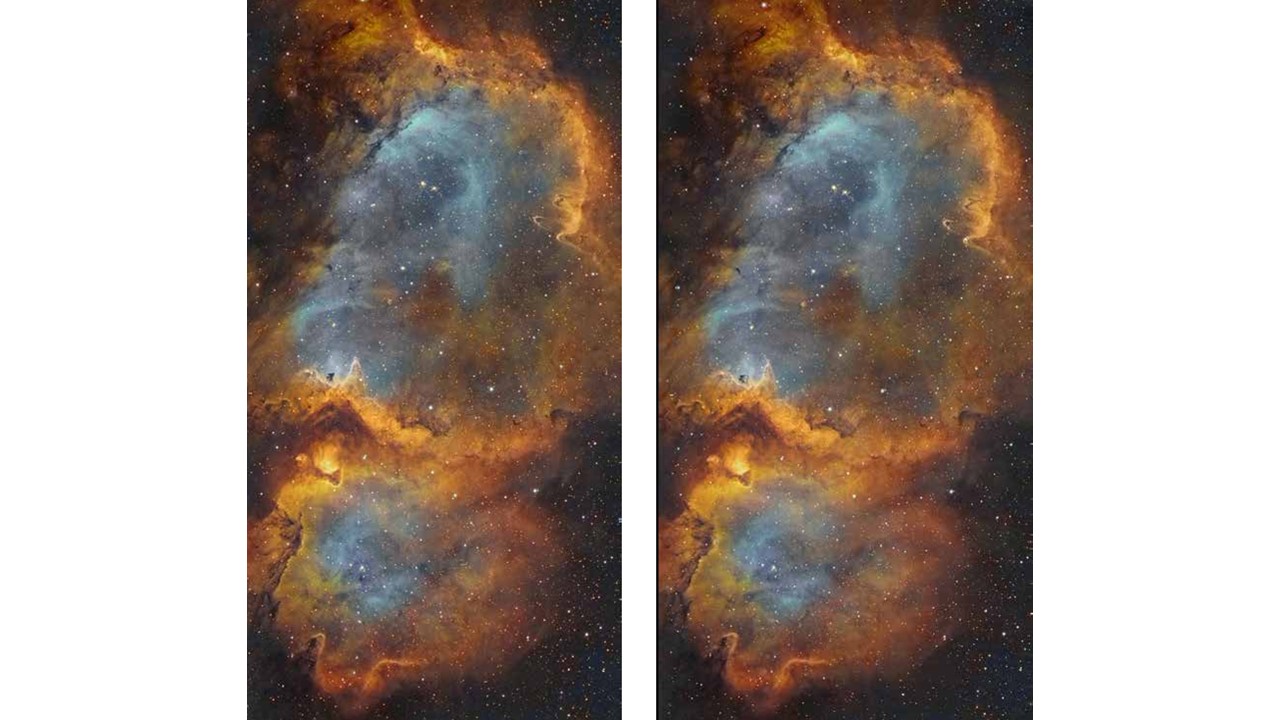
Stereoscopic images of the star-forming region IC1848 in Cassiopeia, approximately 7,500 light years from Earth (courtesy J-P Metsävainio).
Windows to the Universe
Both space and ground-based telescopes are used to capture images of the cosmos. Whilst those in space are becoming ever-more advanced, Derek reiterates that there is still a “vital role” for those telescopes here on Earth because their larger size affords greater resolution and sensitivity. Furthermore, increasing the number of operable telescopes is necessary to meet the needs of researchers globally, who often only have a few minutes to capture images for their individual project.
“Ground-based observatories have had, and will continue to have, great value in science — and, in my case, art as well,” J-P adds. “There is enormous global demand for imaging time, and the world’s large ground- and space-based observatories cannot meet that demand alone.
“Large observatories produce material I could never hope to create, yet I can devote unlimited exposure time to generate images that these technical marvels could never produce. Although I photograph the sky purely from an artistic perspective, my images also meet the standards of scientific imaging and are sometimes used in scientific work as they are never altered beyond standard colour and tonal adjustments. When science and art meet, the result can be greater than either could ever achieve alone.”
When science and art meet, the result can be greater than either could ever achieve alone
However, there is a growing danger to space observations and photography in the form of debris. Current estimates by the European Space Agency suggest there are over 54,000 objects orbiting Earth that are greater than 10 cm in diameter, with the number growing each year. While space telescopes are usually placed in very high orbits to reduce risk of impact, J-P suggests that the rapidly increasing volumes of space debris may place even these telescopes at risk.
The threat is both practical and philosophical: the more our orbit clutters, the more we risk obscuring our own view of the Universe. Preserving that line of sight is as much about safeguarding scientific capability as maintaining humanity’s connection to the wider cosmos. Satellite imaging once designed to survey stars now helps monitor planetary change, from glacial retreat to deforestation. This exchange of methods has not only expanded the frontiers of research but also redefined how scientists tell stories about our place in the Universe. In the age of critical tipping points for Earth, ensuring the longevity of satellites is paramount to conserving our ability to look outward and inward as complementary ways of understanding a shared environment.
Powerful perspectives
Astronomy and geoscience depend on the act of turning raw data into vision. Each discipline seeks to make the unseen visible, revealing patterns and processes that unfold beyond the scale of ordinary experience.
“Both subjects produce beautiful pictures that are easy to relate to and, if anything, it is simpler for geoscience, being ‘closer to home’,” Derek states. “When we compare Earth to other planets, we realise just how special our home is. If we can get that message across to the majority of the population, then people might be even more conscious of its uniqueness and therefore be keener to look after it.”
Brian concurs, believing that finding engaging ways to educate the public about the world is the necessary antidote to actions that harm it. “It is my experience that anyone who has learned to truly appreciate the wonders of the vast Universe around us, and our delicate place within it, is incapable of inhumane behaviour. In the 21st century, some powerful humans are attempting to undermine the work of generations of brilliant scientists. Right now, the world desperately needs education to counterbalance pseudoscience and misinformation.”
From a planetary point of view, education begins with perspective. Astronomers have long invoked the “overview effect”, the profound cognitive shift reported by astronauts who have seen Earth from space and recognise both its unity and vulnerability. Through stereoscopic imagery, Brian, Derek and J-P attempt something similar for the armchair observer: to collapse incomprehensible scale into perceptible form, and in doing so, restore our sense of belonging to a shared cosmos.
If science begins in curiosity, it matures in empathy and the recognition that knowledge carries moral consequence. The act of seeing, whether through a microscope, a field lens or a stereoscope, becomes a form of stewardship. To learn to see is to learn to care.
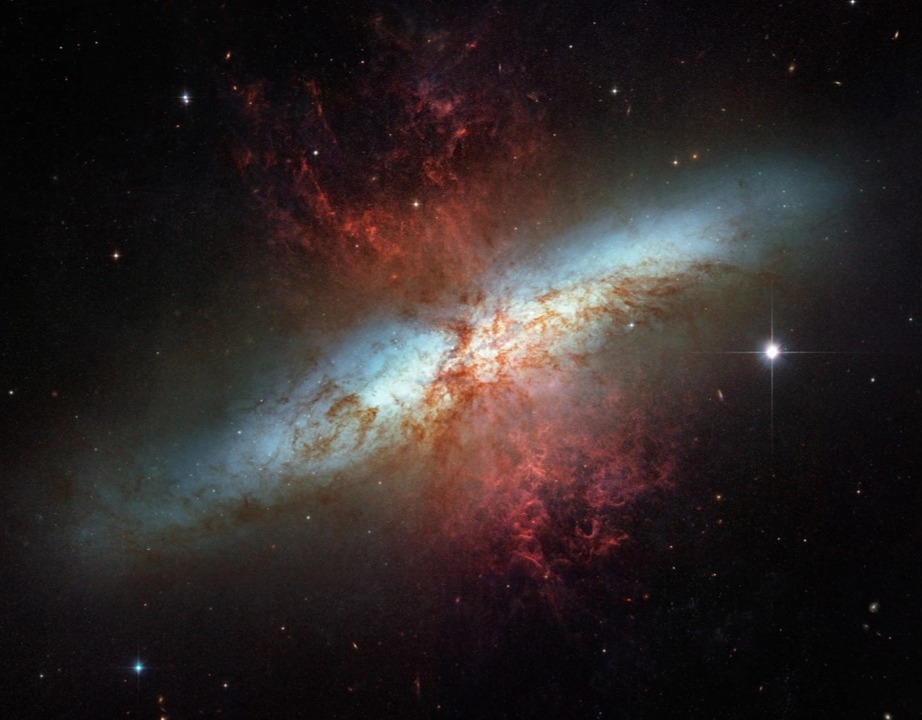
Starburst galaxy Messier 82 is located 12 million light years from Earth in the constellation Ursa Major (courtesy NASA, ESA and the Hubble Heritage Team (STScI/AURA)).
Stellar legacies
One of Islands in Infinity’s most striking threads is its meditation on temporal as well as spatial scale. Just as geoscientists navigate billions of years of Earth’s evolution, astronomers trace the lifecycle of stars across cosmic aeons. J-P’s favourite subjects are supernova remnants — the ashes of stars that once forged the elements of life.
“Without supernovae, the Universe would consist almost entirely of hydrogen and helium,” he says. “We are children of the supernovae. The iron in our haemoglobin, the carbon and oxygen that build us — all were forged in the hearts of ancient stars.
You have been a star and, after billions of years, you will be a star again
“Our own Sun is too small to become a supernova. When it dies, it will shed its outer layers, destroying the planets and scattering our remains into space. After aeons, those remnants will become the building blocks for a new generation of stars. There is a profound symmetry in this process: you have been a star and, after billions of years, you will be a star again.”
That powerful sentiment distils the emotional core of Islands in Infinity: the recognition that the same physical laws shaping galaxies also shape us. The stereoscopic imagery is more than visual spectacle; it is a reminder that we, too, are part of the cosmic architecture.
Authors
Sir Brian May, Director of the London Stereoscopic Company, UK, and musician
Professor Derek Ward-Thompson, Director of the Jeremiah Horrocks Institute at the University of Lancashire, UK
J-P Metsävainio, Visual artist and astrophotographer based in Oulu, Finland
Interview by Hannah Bird, Associate Editor, Geoscientist Magazine. Read the full book review for Islands in Infinity here.
Further reading
- European Space Agency; esa.int
- Galaxy Zoo; zooniverse.org
- Ward-Thompson et al. (2025) Islands in Infinity: Galaxies 3-D. The London Stereoscopic Company, 256 pp.
Citation: May, B., Ward-Thompson, D. and Metsävainio, J-P. Islands in infinity. Geoscientist, 36 (1), 48-51, 2026. DOI: 10.1144/geosci2026-009.